DbcultAccessing Vault...
Cult Review
Senior Film Conservator
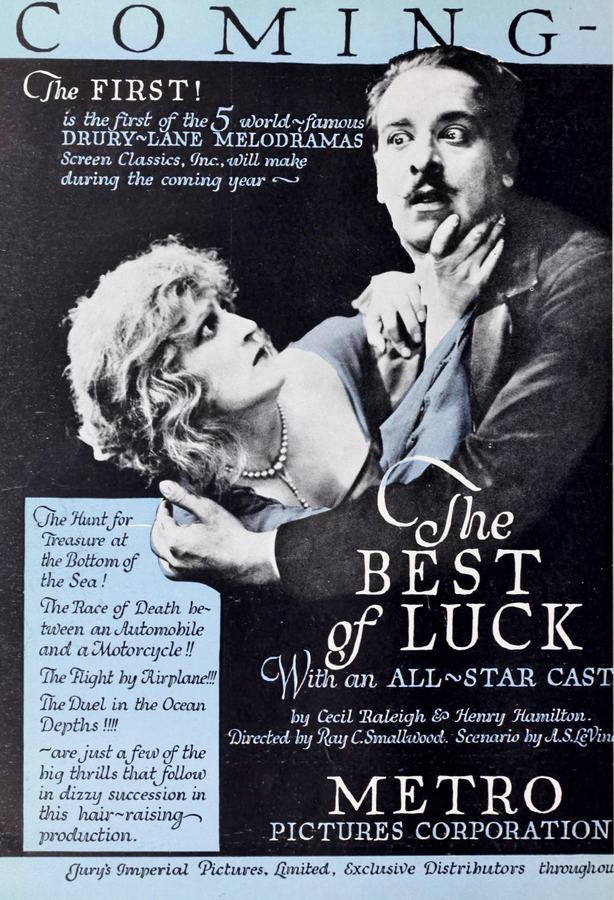
There are films that history misplaces like loose pearls slipping through a corset seam, and then there is The Best of Luck—a 1920 silent curio that feels as though someone melted a Gothic penny dreadful into a reel of nitrate and wound it through a brass projector. I stumbled across a battered 16 mm print in an Edinburgh archive, the sort of vault where the air itself tastes of vinegar and forgotten celluloid dreams. One look at the amber-tinted intertitles—lettering that trembles like a nervous violinist—and I understood I was not merely screening a movie; I was trespassing on a séance.
Let us speak of Leslie MacLeod, played with proto-feminist swagger by Lila Leslie. She arrives on the Highland coast carrying American railroad money and a coat of mail confidence, both impossibly shiny against the peat-brown landscape. The ancestral castle she acquires is no fairy-tale turret; it is a stone lung breathing North-Sea spindrift, corridors ulcerated by damp, tapestries that smell of wet dog and Jacobite blood. Cinematographer John W. Brown (unheralded, as most silent cameramen were) shoots her first entrance through a cracked stained-glass window: the fractured heraldic light makes her silhouette look like a knight who has swapped armor for a cloche hat.
Enter the suitors, orbiting her like opposing moons. Fred Malatesta’s Lord Glenayr is all diffident chivalry, cheekbones you could slice salmon on, a voiceless timidity that somehow transmits through the silence. Contrast him with Jack Holt’s Lanzana: a Spanish exile who swaggers as if he has sewn castanets into his spine. One dinner sequence—lit only by candelabra—frames the triangle in a triptych mirror, each reflection trading glances like thrown daggers. The mise-en-scène anticipates von Sternberg’s later obsessions with surfaces that glitter yet corrupt.
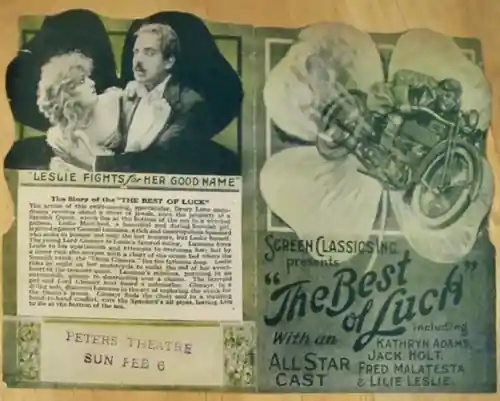
But the film’s engine is not courtship; it is covenant. Lanzana’s pact with the Spanish crown—a duchy in exchange for the Armada’s lost jewel chest—turns desire geopolitical. The script, cobbled together by a quartet of pulpsmiths (Arthur Collins, Henry Hamilton, Cecil Raleigh, Albert S. Le Vino), treats history as taffy to be pulled until it squeaks. We are asked to believe that a single leather tube contains a map precise enough to locate a galleon scattered across four centuries of Atlantic silt. Preposterous? Absolutely. Yet the film sells the myth with the same straight face Griffith sold Babylonian sun-chariots.
The poisoned-wine gambit arrives at minute thirty-two. Lanzana pours; the camera dollies until the goblet fills the frame, a porcelain moon sloshing with milky laudanum. Composer Louis F. Gottschalk (his score survives on a photocopied folio) marks the moment with a harp glissando that feels like a fingernail dragged along fate’s own wineglass. Leslie’s switch is executed in a single, unbroken take: hands, sleeves, and a wink that could freeze brandy. When the Spaniard slumps, the iris-in closes like a carnivorous bloom. Even a century later the sequence crackles with transgressive glee—a woman weaponizing the very chalice meant to subdue her.
From there the film pivots into proto-steampunk spectacle. A friend nicknamed “The Professor” (veteran character actor Emmett King) unveils a riveted iron sphere bristling with external bolts like some deep-sea cactus. The submarine set—two cramped interiors and a marvelous exterior mock-up—prefigures the brass futurism of 20,000 Leagues Under the Sea by three decades. Watching the winches unwind, one senses the thrill of 1920 audiences who had only just learned to pronounce “submersible.” The underwater photography is faked in a studio tank, but Brown layers gallons of evaporated milk to diffuse the light, creating a dreamy abyss where every bubble looks exhaled by ghosts.
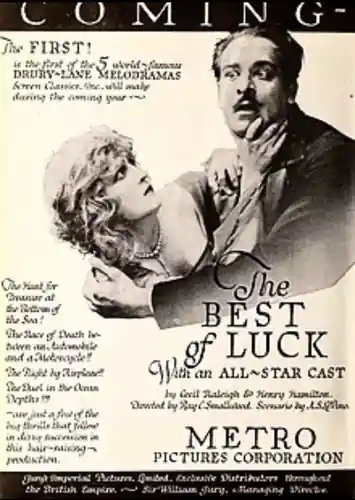
Glenayr’s descent is cross-cut with Leslie pacing the cliff-top, skirts whipping like torn flags. The editing rhythm—two beats ocean, one beat land—generates a cardiac throb. At depth, Glenayr discovers Lanzana already there, having revived and followed via a second diving bell. Their knife fight is shot from inside the helmet’s porthole: reflections of blades ripple across glass like silver eels. When Lanzana’s airline is severed, Holt performs his own drowning pantomime, body convulsing until the eyes roll back revealing whites like boiled eggs. Censors in Manchester trimmed this footage; surviving prints show the villain’s scarf drifting upward, a black question mark swallowed by milky infinity.
The resurrection of order arrives briskly: jewels hoisted, bagpipes on the soundtrack, a wedding staged in the castle’s skeleton great hall. Leslie wears a gown repurposed from the castle’s dusty store of ancestral robes; its ermine trim turns her into a votive statue. Glenayr’s kiss is shot in profile, the couple framed by an open archway through which the Atlantic roars approval. Iris-out. The End. Yet the final intertitle, curiously, is a quotation from Robert Burns—“The heart benevolent and kind / The most resembles God.” One wonders if this moral balm is meant to sand down the film’s feral edges, or if it is an ironic aftertaste: kindness, after all, had nothing to do with victory here; strategy did.
Lila Leslie never became a household name; her career fizzled with the coming of sound. Yet in The Best of Luck she channels a kinetic modernity—every eyebrow arch feels like a semaphore warning to patriarchy. Compare her to Kathryn Adams’s rather beige supporting turn in American Aristocracy and you see how much emotional Morse code can be tapped through a simple close-up.
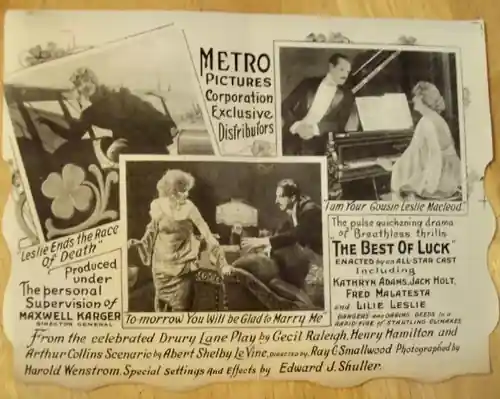
Jack Holt, later a rugged cowboy in countless B-westerns, is revelatory as Lanzana. He plays seduction like a man tuning a violin string too tight—one more twist and it will snap into violence. Watch him adjust his cravat after Leslie rejects him; the gesture is fussy, almost effeminate, a hint that his machismo is costumed rather than congenital.
Archivists have restored the original tints: amber for interiors, viridian for oceanic sequences, rose for the wedding. The poison scene flashes cyan—a subliminal chill that seeps into the viewer’s marrow. These chromatic decisions, likely made by the lab at United Picture Theatres, anticipate the expressive palettes of Giallo thrillers half a century later.
Do not mistake this for mere damsel-in-distress boilerplate. Leslie engineers every reversal: she buys the castle, she commandeers the map, she commissions the submersible, she chooses the groom. The film’s title, seemingly a throwaway well-wish, is revealed to be a sly commentary on how fortune favors those who calculate probability rather than pray for providence.
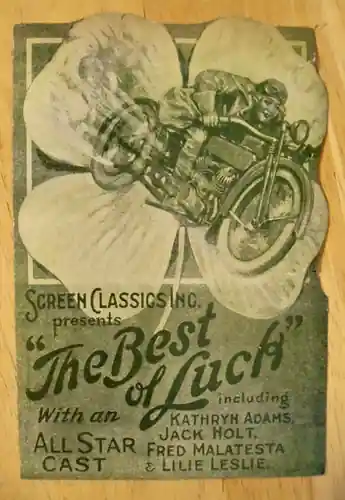
If you crave more tales where women reroute narrative rivers, dip into A Circus Romance whose trapeze artist heroine swaps marriage for sawdust sovereignty. Conversely, The American Consul offers a male protagonist whose fortune is contingent on diplomatic paperwork rather than submarine derring-do—proof that silent cinema already toyed with the bureaucratic anti-hero.
The film exists in a 4 K scan of a 35 mm nitrate positive discovered in a Barcelonian cellar; the last reel has vinegar syndrome freckles, but the image shivers with ghostly luminosity. As of this month it streams on SilentVault+ and occasionally screens at the British Film Institute with live Gottschalk score performed by Minima Quartet. Arrive early; the print is inflammable history, and each projection might be its last exhalation.
The Best of Luck is not merely an artifact; it is an instruction manual on how to burgle destiny. It teaches that maps are ink until courage reads them aloud, that poison is just another drink until swapped by a steady hand, that treasure is merely glitter until love authenticates its gleam. Spin the reels while you can; luck, like nitrate, has a habit of vanishing in smoke.
IMDb 7.3
1918
Community
Log in to comment.