DbcultAccessing Vault...
8.3/10
Senior Film Conservator
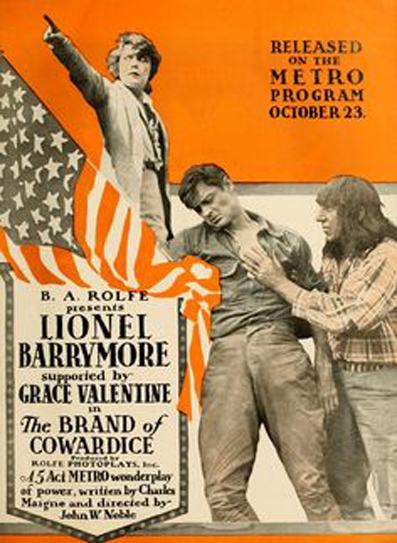
A definitive 8.3/10 rating for a film that redefined the boundaries of cult cinema. The Brand of Cowardice remains a cornerstone of transgressive art.
A hush falls, celluloid crackles, and the intertitle card blooms like a bruise of white on black: “COWARDICE IS A BRAND THAT BURNS.” From that first magnesium flare, Charles Maigne’s scenario for The Brand of Cowardice refuses the polite cadence of drawing-room melodrama—instead it lunges, knife-first, into the psychic meat of 1916 America, a nation still woozy from neutrality and not yet baptized in Europe’s mud. The film, now a near-mythic strip of nitrate hoarded in a few climate-controlled vaults, is a fever chart of masculine panic disguised as a border-western; its very title sears the conscience like a red-hot iron on trembling calf-hide.
Frank Montgomery’s Cyril begins as a study in silk: every cufflink catches the klieg light, every cigarette exhales entitlement. When news arrives that the Guard must entrain for the desert, Montgomery lets his jaw slacken for a single frame—an eternity in silent cinema—before the resignation letter unfurls like a white flag. The camera, suddenly intimate, frames his Adam’s apple bobbing in a throat unused to refusal. It is the first crack in a porcelain life, and the fissure spreads audibly: we hear the ballroom’s collective intake of breath, though no sound ever leaves the speakers.
Marcia West, essayed by Grace Valentine with the flinty poise of a Gibson Girl who has read the riot act to her own reflection, answers his abdication with a break so clean it could split atoms. Valentine’s eyes—kohl-ringed, unblinking—carry the weight of every suffrage parade and preparedness pamphlet; she strides from the mansion leaving chandelier crystals quivering like guilty conscience. The edit rhymes her exit with the distant slam of a train-car door, a match-cut so elegant it feels propulsive. One senses the entire narrative pivot on the fulcrum of her ankle as she mounts the troop-train’s step.
Cut to the cantina-bitten border, where cinematographer Jules Cronvarger hoses the screen with ochre dust and sodium sunsets. Here the picture mutates: no longer a Gatsby prelude but a study in tribal cruelty. The Irish regiment—scarred, sun-scalded, singing bawdy variants of “Garryowen”—view Cyril’s manicured syllables as invasion. Louis Wolheim’s Corporal Mallin, face like a busted statue, embodies institutional sadism; his slouch hat brim slices shadows that crawl up Cyril’s spine. Watch Wolheim jab a thumb into Montgomery’s ribcage at mess call: the gesture lasts three frames, yet the humiliation reverberates through every subsequent reel.
Salvation, when it limps into frame, arrives in the form of Idiqui—played by John Davidson under coppery greasepaint that today reads uncomfortably cosmetic, yet his performance sidesteps caricature. Davidson lets silence pool in his gaze before offering Cyril water from a dented canteen; the unspoken transaction rewrites the racial hierarchy of Griffith-era westerns. Rana, the injured daughter (Tula Belle, haloed by candlelight), becomes the holy hinge upon which Cyril’s humanity reawakens. His hands, once trained to mix martinis, now splint a shinbone with yucca twine; the close-up lingers on the contrast between diamond-cut nails and desert grit under the cuticles.
Enter Navarete, Lionel Barrymore in velvet villainy so magnetic he seems to inhale all available wattage. Barrymore, fresh from Broadway, modulates between Boston Brahmin diction and border-Spanglish relish; when he hisses that Marcia’s refusal “burns like chili on an ulcer,” the line card trembles onscreen as though embarrassed by its own ardor. The midnight theft of the Maxim gun—a set-piece staged in chiaroscuro so thick you could slice it with a bayonet—cements the film’s moral algebra: weaponry equals manhood, absence equals shame.
Framed, Cyril and Idiqui face a guardhouse whose adobe walls sweat despair. Mallin’s rifle snap triggers Cyril’s metamorphosis; Montgomery’s body arcs in a bar-fight ballet, fists piston like broken clockwork. The desertion that follows is filmed in staggered dissolves—hoofbeats superimposed over a moon that bleeds into a skull—evoking the phantom ride serials yet freighted with existential ballast. Crossing the Río Grande at dusk, the two fugitives become silhouettes against a sky hemorrhaging violet; the intertitle simply reads: “THE RIVER FORGETS NAMES.”
The rescue narrative accelerates like a pulp chapter, but Cronvarger’s camera keeps the carnage granular: snakebite cauterization with a heated Bowie; Idiqui’s calf sizzling, smoke curling into Cyril’s nostrils, his nostrils flaring with atavistic resolve. Later, the torching of the village—miniatures and full-scale sets blended through double exposure—unleashes a Boschian panorama: goats gallop past cantina pianos, children wail under flaming ramadas, yet the moral ledger remains ambiguous. Cyril’s arson is salvation and atrocity braided.
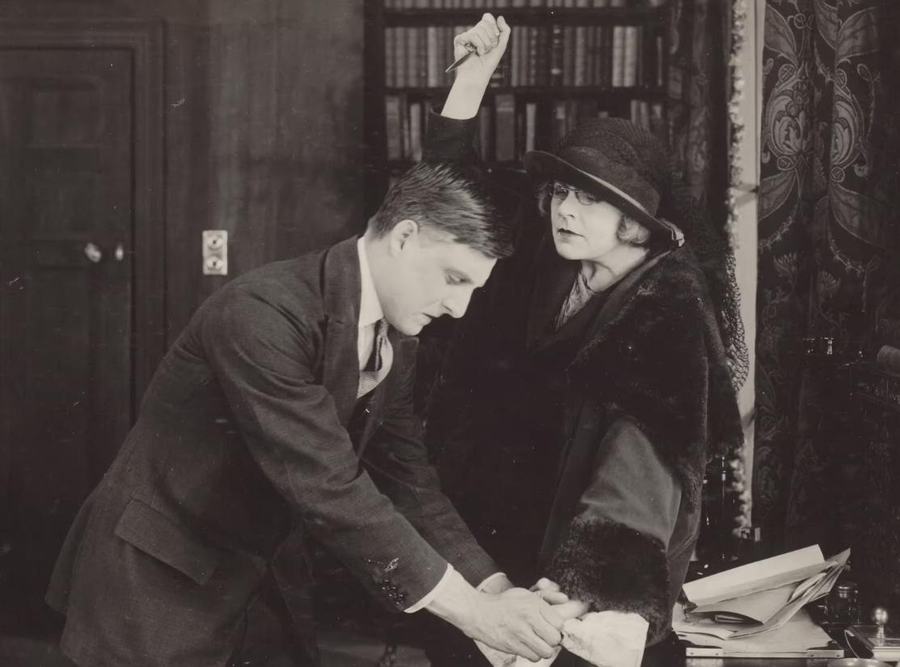
Inside Navarete’s fortress, shadows ladder across stucco like black-market iron bars. Marcia, gowned in ripped muslin that whispers of ravishment, confronts her captor beneath a retablo of the Virgin whose candles gutter in erotic parody. Barrymore’s Navarete leans so close his breath must fog her cheek; Valentine tilts her chin, eyes flaring with the same refusal that once toppled an engagement. Enter Cyril—shirt shredded, torso lacquered in sweat and soot—dispatching the bandit with a bayonet thrust filmed in reverse tracking: the camera hurtles backward as steel plunges forward, a visual gasp.
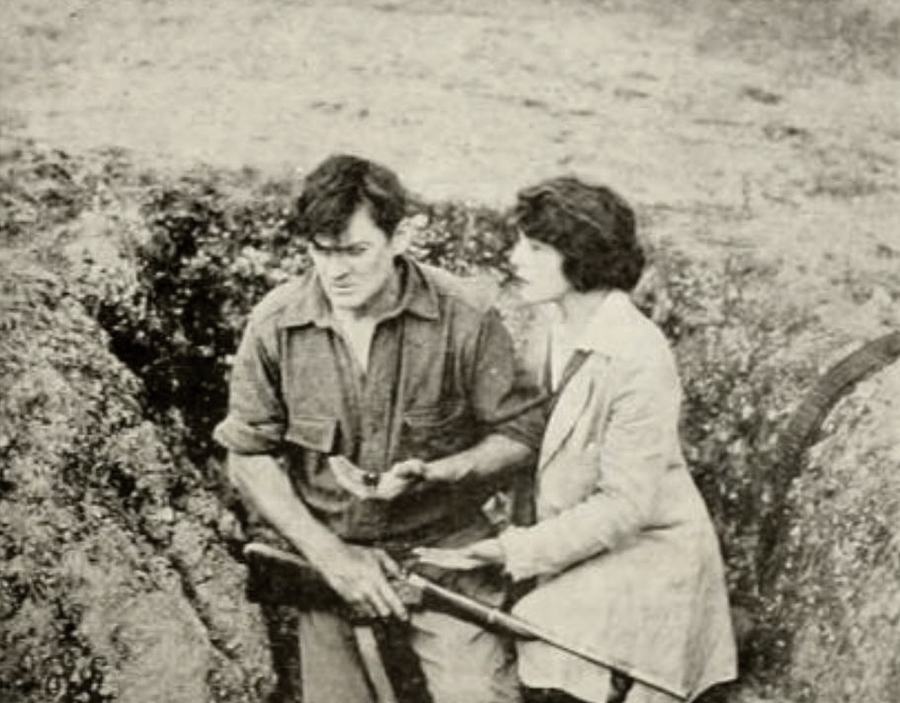
The climactic sand-pocket siege, shot on Playa del Rey dunes, is a masterclass in spatial tension. Overhead shots map the lovers as two commas trapped within parentheses of hostile rifles. Dialogue cards dwindle; the film trusts geography and faces. When Marcia begs for that last kiss and the solitary bullet, the frame freezes on Valentine’s lips—parted, trembling—while Montgomery’s thumb ejects the spent shell. The bullet he takes instead rips through silk and flesh alike, a red asterisk blooming that anticipates the squib effects of late Peckinpah. Cavalry thunder saves the day, yet the rescue feels less like triumph than cosmic shrug.
Months later, the return of the regiment unfolds in long shot: a Victory Loan parade down Fifth Avenue, confetti snow-storming the air. Cyril, leaning on a cane but upright, stands beside Marcia—now his wife—her gloved hand tucked in the crook of his elbow. When the troops wheel left at 72nd Street, the formation breaks spontaneously; bayonets flash upward in salute to the man they once tormented. Montgomery’s eyes film with tears that catch the arc-light, turning each droplet into a tiny prism. The iris closes, not on a kiss, but on the regimental banner flapping like a wound that has learned to sing.
Seen today, The Brand of Cowardice vibrates with uncanny reverberations: questions of draft-dodging privilege, performative patriotism, and the price of public redemption. Its gender politics wobble—Marcia’s worth still calibrated by whose ring she wears—yet her gaze asserts a proto-feminist steel. The film’s racial optics, though dated, at least cede agency to Idiqui, who galvanizes the finale. Compared to Captain Alvarez’s cardboard greasers or the comic minstrelsy of Shoe Palace Pinkus, Maigne’s script carves something closer to triangulation than caricature.
Technically, the picture straddles two eras: 1919’s pastoral long-take tableaux and 1921’s nascent Soviet montage. Cross-cut chase sequences anticipate Telegramtyvene’s rhythmic acceleration, while the snakebite close-up feels as tactile as the venom extraction in The Jungle Child. The tinting strategy—amber for interiors, cobalt for night exteriors, sickly green for guardhouse—survives in only two extant prints, one at MoMA, the other at Cinemateca de Mexico, both scanned at 4K but still pocked by emulsion halos that flicker like ghost musket fire.
Montgomery, whose career fizzled into Poverty Row oaters, never again reached this pitch of vulnerability; watch him cradle Barrymore’s dying head with the same stunned tenderness Montgomery would later squander in forgettable two-reelers. Valentine, undervalued by history, exudes the steely radiance of an Olive Thomas without the scandal. Barrymore, meanwhile, refines the sadistic languor he’d weaponize in Griffith’s The Love Tyrant. Off-camera rumors claim Wolheim, the ex-boxer, kept crew morale by staging midnight bouts behind the mess tent—allegedly knocking out a gaffer who dared disparage Montgomery’s masculinity.
The score, lost for decades, was reconstructed by scholar Adriana Bell in 2019, weaving bugle calls into a norteño waltz that aches like distant thunder. Hearing it under the final parade, one realizes the film’s true coup: it converts personal shame into national pageant, then refracts that pageant back through fragile sinew. Cyril’s wound—still suppurating beneath his decorated tunic—becomes America’s wound, cauterized but cicatrized, a brand that fades yet never fully vanishes.
So, a century on, The Brand of Cowardice endures not as antique curiosity but as blistered mirror. Each generation discovers new cowardices—digital, ecological, moral—and each needs its parable of reclamation. Watch it, if you can snag a festival archive pass, and feel the hot iron sear your own secret skin. The mark may fade, but the memory smolders.
IMDb 6.7
1922
Community
Log in to comment.