DbcultAccessing Vault...
Cult Review
Senior Film Conservator
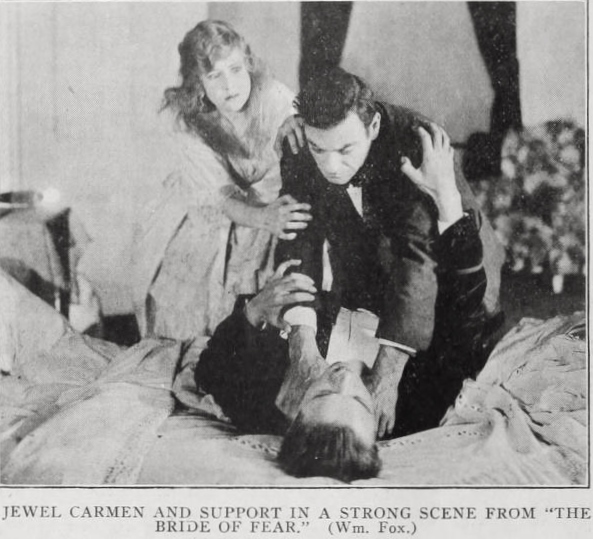
Imagine, if you will, a chiaroscuro valentine slipped under the door of your worst nightmare—its paper smelling faintly of gun oil and wilted orange blossoms. That valentine is The Bride of Fear, a 1920 one-reel whisper that somehow screams louder than most two-hour talkies. Forgotten by the masses, it festers in the vault like a locked diary whose key has been melted into a bullet. Watching it today feels akin to exhuming a crime scene: every frame is evidence of an era that believed virtue could be extorted at knifepoint.
Director Sidney Franklin, years before he glossy-coated Quality Street with MGM rouge, already understood that terror is most corrosive when it masquerades as rescue. His camera lingers on Ann Carter’s gloveless fingers as they hover above the river—an image so intimate you half expect the water itself to recoil. There is no orchestral swell, only the dry rustle of acetate; yet the silence detonates inside your skull like tinnitus. This is horror before horror had a marketing department, and it is exquisite.
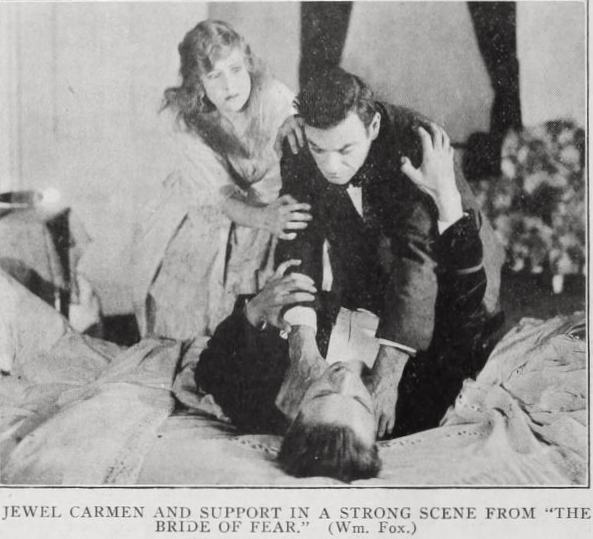
Charles Bennett’s Hayden Masters arrives with the swagger of a man who has already memorized your pulse rate. His fedora tilts at an angle that suggests both Broadway and gallows; when he clasps Ann’s wrist you can practically hear cartilage protest. Bennett never goes full-snarl; instead he gifts us something infinitely more unsettling: courtesy. Each time he utters "my dear" the term of endearment lands like a brand on cattle. The performance is so calibrated that later, when steel doors slam on him, you almost feel the void he leaves behind—a void that immediately fills with dread.
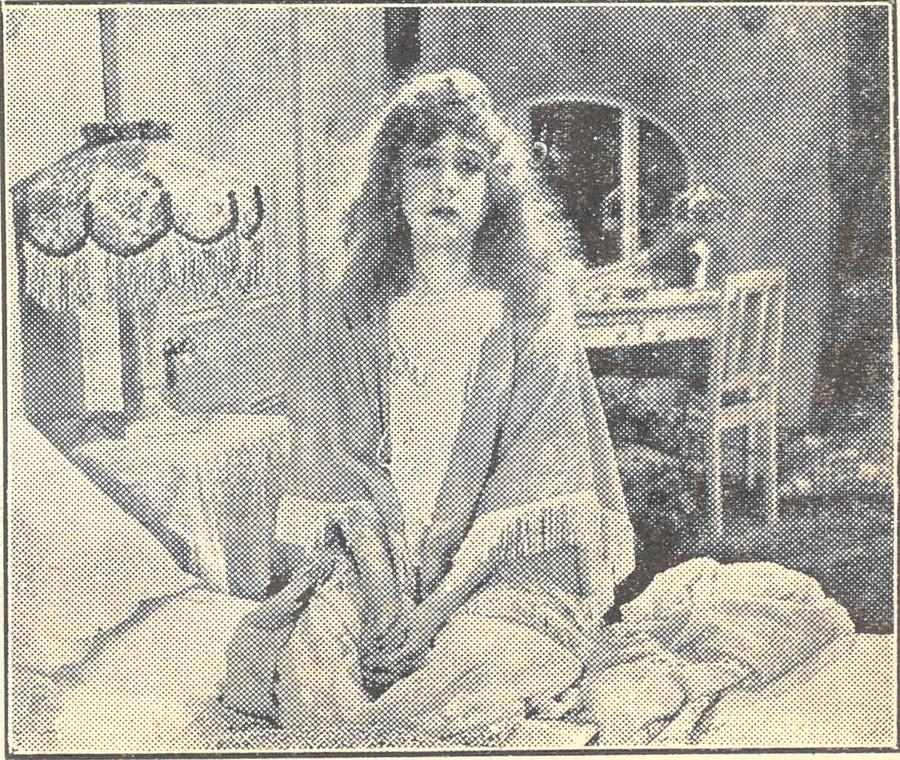
Jewel Carmen’s Ann is no wilting lily, though the censors of 1920 would prefer you believe otherwise. Watch her pupils in the close-up after the prison telegram arrives: they dilate not with relief but with the feral calculation of someone realizing the witness-protection program is a joke. Her subsequent courtship with Donald—played by Charles Gorman with the naïve luminosity of a boy who has never had to buy his own drinks—should feel like sunlight breaking through. Instead it resembles a photographic negative: all the right hues, inverted, sickly. Every time Donald kisses her knuckles you sense Ann mentally cataloguing exits.
Franklin and co-scenarist Bennett Cohen structure the narrative like a three-act fever dream compressed into a scant twenty-four minutes. Act I: the river, the rescue, the coercion—economy of storytelling so brutal it could be a bank heist in itself. Act II: the bourgeois cocoon, the illusion of rehabilitation, the telegram that tastes like cyanide-laced champagne. Act III: the return of the repressed in a tuxedo, the final marital vow sharpened to a stiletto. Intertitles appear sparingly, often white letters on black, as though the film itself is afraid to speak too loudly lest it wake something.
Visually the picture borrows more from Weimar street melancholia than from the sun-dappled pastures of Culver City. Cinematographer (uncredited, as was custom) floods the bridal boudoir with tallow-thick shadows; the wedding dress seems to float in its own nimbus of doom. Compare this to the lurid carnivals in The Wildcat of Paris or the sermonizing glow of The Moral Fabric—both contemporaneous yet eons apart in temperament. Where those films lecture, The Bride of Fear insinuates. It slides a gloved hand around your throat and calls it courtship.
The film’s true coup de grâce arrives via editing: a match cut from the prison gate clanging shut to the corporate office elevator gate sliding open. In that splice, freedom and imprisonment become synonyms; the only variable is the width of your cage. Modern viewers will detect pre-echoes of Hitchcock’s Shadow of a Doubt and even Fincher’s Gone Girl, proving that patriarchal terrorism ages like absinthe—only more toxic with time.
Yet the picture is not flawless. The intertitle announcing Masters’s death carries the subtlety of a brick through stained glass, and the final tussle—rendered in silhouette against a burning fireplace—leans toward the Grand-Guignol. Still, these are quibbles. What lingers is the aftertaste: a recognition that the most intimate coercion often arrives gift-wrapped in gallantry.
Restoration-wise, the surviving 16 mm print at the Eye Filmmuseum in Amsterdam is speckled like a leopard, but the damage amplifies authenticity. Each scratch feels like a scar voluntarily shared. Scores of enthusiasts have attempted to graft modern soundtracks onto the reel—solo piano, glitch-hop, even doom-metal—but silence remains the most blood-curdling accompaniment. Every creak of your own house becomes a footstep in Masters’s prison corridor.
For contextual counterweight, pair a viewing with Beating Back, another 1920 curio where redemption arrives on horseback rather than handcuffs. The double bill will leave you questioning whether early cinema was more obsessed with salvation or with the repeated failure thereof. Alternatively, chase the film with Der stumme Zeuge for a German expressionist chaser; together they form a diptych of continental despair.
Academically, the movie is a Rosetta Stone for understanding how the post-suffrage era processed the specter of female autonomy. Ann’s employment as a secretary is no throwaway detail; it is the first gust of oxygen into the vacuum left by Masters’s incarceration. Yet the film refuses to celebrate this independence, hinting—none too subtly—that a woman’s wage is merely a down-payment on the next predator. Such cynicism feels almost anachronistically modern, as though the reel were composed yesterday and back-dated to fool archivists.
So, is The Bride of Fear a feminist parable smuggled past censors, or is it a patriarchal cautionary tale warning women that the streets are paved with wolves? The answer, deliciously, is yes. It occupies that Schrödingerian sweet spot where every reading is simultaneously validated and undercut. Much like the zeppelin hovering in The Zeppelin’s Last Raid, the film hangs above us, inflammable and ominous, daring viewers to strike a match.
In the end, the greatest terror the picture wields is the implication that Ann’s ordeal is cyclical. Masters may be cuffed, shot, resurrected, or buried; the interchangeable faces of Donald, the river, the prison, the altar—they are mere stations on a Möbius strip. The final intertitle, half faded, reads: "And she knew the vows would never cease." The words hover like smog, refusing to dissipate even as the projector’s bulb cools. Long after the credits—yes, silent films had closing bills—you may find yourself checking the locks, convinced that somewhere a charming stranger is calculating the angle of your wrist as you grip a pen, or a bridge, or your own despair.
Seek it out. Brave the mildewed archives, the password-protected digital vaults, the hushed whispers of librarians who regard the canister as contraband. When the film unspools, let its brittle images fracture if they must; the cracks merely reveal the abyss behind the emulsion. And remember: every time you reassure yourself that coercion on this scale could never happen today, somewhere a bride—veiled in algorithmic match suggestions and crypto-romance scams—signs her name on a dotted line she cannot quite read. The river is still under the bridge, the gate still clangs, and Masters, in some incarnation, always shows up at the altar with a ring he forged from your own heartbeat.
IMDb —
1929
Community
Log in to comment.