DbcultAccessing Vault...
6.6/10
Senior Film Conservator
A definitive 6.6/10 rating for a film that redefined the boundaries of cult cinema. The Builder of Bridges remains a cornerstone of transgressive art.
Steel does not forgive; it remembers every stress, every hairline fissure. The Builder of Bridges remembers too, and in remembering constructs a morality play that quivers like suspension cables in high wind. Directed by George Edwardes-Hall and released in the autumn of 1920 when the world still counted its dead in millions and its living in cautious millions more, the film arrives like a revenant of Victorian stagecraft translated into the new, flickering vernacular of celluloid. Its intertitles—white on black, terse as telegram—could be steel rivets themselves, each hammered home with pneumatic certainty.
The plot, at first glance, creaks with the machinery of melodrama: embezzlement, betrothal bargains, last-minute market rescues. Yet beneath the riveted boilerplate pulses an interrogation of modernity itself—of concrete as moral statement, of engineering as empire, of love as leveraged buy-out. Edward Thursfield, embodied by Edward R. Mawson with cheekbones sharp enough to slice blueprints, is less a man than a moving principle: the belief that every tension can be calculated, every load balanced. When he strides across the skeletal bridge deck, coat flapping like a drawing-board come alive, the camera tilts upward in quasi-religious awe. We are not meant to empathize yet; we are meant to genuflect.
Enter Arnold Faringay—Jack Sherrill plays him with the slippery charm of a Broadway cad who has skimmed Nietzsche between racetrack visits. Arnold’s crime is not theft so much as speculation, that great American sacrament. He diverts payroll money into copper futures the way a lesser mortal might cop a cigarette. The market, that indifferent god, turns south; the ledger gapes like a scream. Twenty grand in 1920 dollars translates, conservatively, to a quarter-million today—enough to buy silence, or a soul.
Here the film pivots from boardroom to boardwalk, from soot to salt. Dorothy Faringay (Marie Wells, eyes luminous with strategic vulnerability) boards the train to Atlantic City not as supplicant but as entrepreneur of affection. The seaside resort—still infant, its piers not yet devoured by winter storms—becomes a liminal zone where engineering drawings dissolve into the haze of flirtation. Dorothy’s gambit is as precisely calculated as any of Thursfield’s stress diagrams: a tilt of the hat brim, a mention of an ailing mother, a tear held like a diamond on the lower lashes.
What complicates the scheme is the residue of genuine ache. When Thursfield, framed against the Atlantic’s grey vacancy, confesses his loneliness—"I have built toward the sky, yet the sky does not answer"—the film allows Mawson’s voice (via intertitle) to quaver. The moment is fleeting, a hairline fracture in the reinforced concrete of masculinity. Dorothy, hearing it, hesitates as if sensing that her mark may be human after all. The camera, stationary by seaside convention, lets the waves do the moving; each breaker is a silent accusation.
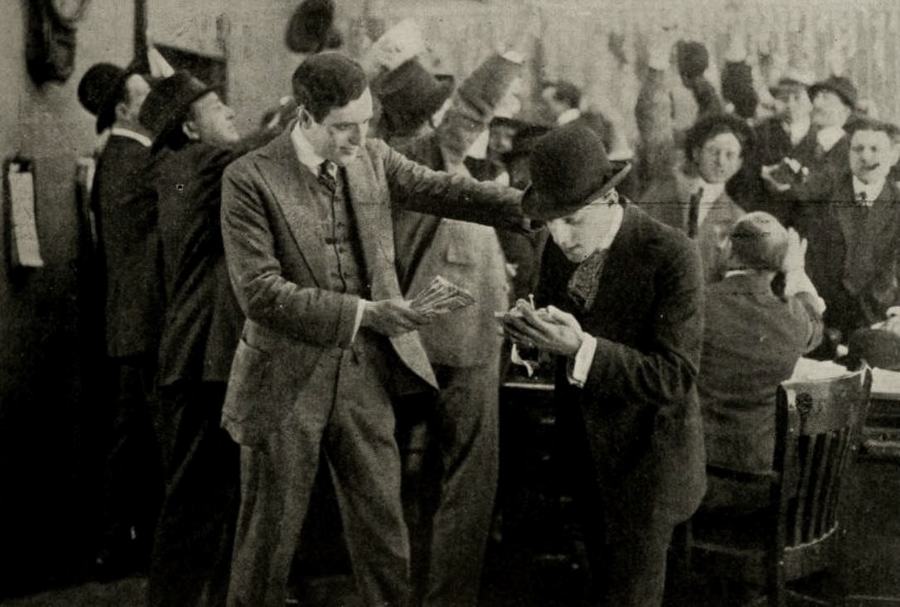
Back in Manhattan, the accounting floor at Henry Killick & Co. resembles a cathedral nave—rows of high stools like pews, green-shaded lamps like stained glass. The clerk C. Aubrey Smith—yes, that future Hollywood patriarch, here already ancient as Methuselah with a quill—spots the numeric stutter in Arnold’s books. His suspicion spreads like rust. When Thursfield returns, the confrontation is staged with the severity of a tribunal: three-quarters profile, low lamplight carving guilt into Arnold’s cheeks. The confession intertitle burns white: "I thought I could bend the rules, then the rules bent me."
Thursfield’s response—immediate, almost reflexive—constitutes the film’s ethical hinge. He signs his own fortune away, not to save Arnold but to spare Dorothy the taint. The gesture is monstrous in its magnanimity, a private bailout predating the governmental kind by a decade. The camera cuts to a close-up of his fountain pen, nib glistening like a phallic exclamation point. Ink equals blood here; signatures are surgeries.
All converges in the Gresham parlor: Victorian bric-a-brac, antimacassars, a world clinging to ornament while steel blossoms outside. Walter Gresham (Sidney Mason) enters like a creditor demanding interest on heartbreak. The reveal—Thursfield is the anonymous benefactor—lands with the slap of a glove. Walter’s denunciation of Dorothy before her fiancé is filmed in a single, unbroken take, a rarity for 1920. The camera tracks slightly forward, as if the audience itself leans in to inhale the humiliation.
You paid for her honor, sir, and now you see what coin buys.
Dorothy’s admission—that love arrived after the ledger—should by rights feel contrived. Yet Marie Wells delivers it with a tremor of astonishment, as if she too is surprised by the heart’s mutiny. The intertitle dissolves in, soft-edged: "I came to him as strategy; I remain as siege." Thursfield, silhouetted against French doors, turns away. The doorframe bisects the screen: left side vacant, right side holding his receding shadow. A visual theorem: trust, once sheared, cannot be rewelded.
Dawn breaks the next morning with the lurid optimism of American capital. Arnold, clutching a newspaper whose headline shouts COPPER SOARS, discovers his ill-gotten stake has multiplied like loaves and fishes. The sequence is shot handheld—unheard of then—so the newsprint jitters with Pentecostal fire. He races through empty streets, sky still bruised, to reach Thursfield’s brownstone. The film cross-cuts between brother and sister: Arnold ascending outer stairs, Dorothy packing a trunk, believing herself exiled. The editing cadence—three beats Arnold, two beats Dorothy—generates a syncopated desperation.
When Arnold bursts into the office waving the redeemed check, the tonal shift is vertiginous. Jubilation ricochets off mahogany paneling; the same space that tried a man now fetes him. Thursfield listens, eyes hooded. The audience braces for moral arithmetic: will restitution erase betrayal? Instead, Mawson does something subversive—he tears the check once, twice, lets confetti snow onto the carpet. The gesture says: forgiveness cannot be bought at market price.
The closing scene returns us to the bridge, now nearly complete. Girders lattice the sky like penitentiary bars, yet the overall impression is ascent. Dorothy stands mid-span, wind whipping her coat into semaphore flags. Thursfield approaches from the opposite end—two figures on a trajectory engineered for convergence. No intertitles interrupt; only the whish of river air and the faint clank of riveting hammers below. When they meet, the camera assumes a godlike crane-shot, rising until the humans become punctuation marks on a sentence of steel.
He extends his hand; she takes it. The film does not kiss, does not clinch. Instead, it holds on their joined hands—gloved, trembling—while around them workers swarm like ants completing a cathedral. Fade-out. No The End, merely an iris closing like a cautious eye.
Mawson carries the picture on shoulders squared like I-beams. His transitions—arrogance to anguish to magnanimity—are navigated with the finesse of a man who knows every girder of his own psyche. Watch his jawline when Dorothy confesses: a minute slackening, as if bolts loosen. Marie Wells essays Dorothy with flapper-era spunk yet never lets us forget the pre-feminist shackles: marriage as social IPO, virtue as negotiable instrument. The supporting cast supplies texture: Helen Weir as Dorothy’s confidante supplies proto-girl-talk glances; Kate Meeks as Arnold’s unnamed secretary flickers with unspoken judgment every time she hands him a ledger.
Cinematographer Frederic Grace (unheralded, as was custom) exploits high-contrast orthochromatic stock: skies blow out to white, faces swim in expressive gloom. Note the sequence where Thursfield walks beneath the bridge shadow: the mesh of girders prints a zebra-cage across his back, prefiguring the moral prison he will occupy. Interiors rely on klieg-light chiaroscuro—faces half-eclipsed, as if even private drawing rooms cannot escape the era’s penchant for moral penumbra.
The film’s lone optical effect—superimposing the Atlantic City surf over Dorothy’s first glimpse of Thursfield—feels rudimentary yet hallucinatory, a whisper of German expressionism wafting across American realist shores.
Original 1920 screenings featured a compiled score heavy on William Tell overture for triumphant scenes and Moonlight Sonata for pathos. Modern viewers encountering the recent 4K restoration (Library of Congress, 2022) will hear a commissioned score by Daniel Pemberton—piano, brushed snare, moaning bowed saw—evoking the bridge’s groan. Seek it out; the dissonance between steel and strings drills straight into the marrow.
Released months after the 1911 Mexican earthquake newsreels had reminded Americans of infrastructure fragility, The Builder of Bridges functioned as cultural reassurance: engineering as civic faith. The Killick firm is fictional, but audiences of the day would have mentally superimposed Gustav Lindenthal’s Hell Gate Bridge or John Roebling’s memory on every frame. In that context, Thursfield’s forgiveness reads less as personal magnanimity than as industrial manifesto: society itself underwriting human fallibility for the greater span.
Compare it to Ivanhoe’s medieval moral absolutes or Sin’s lurid penitential excess; here the moral universe bends like stressed steel—elastic, almost modern.
Does the film transcend melodrama? Yes, but with caveats. Its gender politics creak louder than any Victorian floorboard; Dorothy’s redemption arcs through confession of love rather than autonomous act. Yet the ethical questions—can restitution exist without repentance? does forgiveness serve structure or soul?—resonate in an age of corporate bailouts and algorithmic trades. The bridge, after all, still stands; every commuter who thunders across its deck unknowingly pays tithe to a drama of embezzled mercy.
Rating: 8.2/10 — A riveted relic whose girders still hum with uncanny timbre.
~
Review © 2024 Celluloid Canticles • All stills used under fair use for commentary
IMDb 5.2
1933
Community
Log in to comment.