DbcultAccessing Vault...
Cult Review
Senior Film Conservator
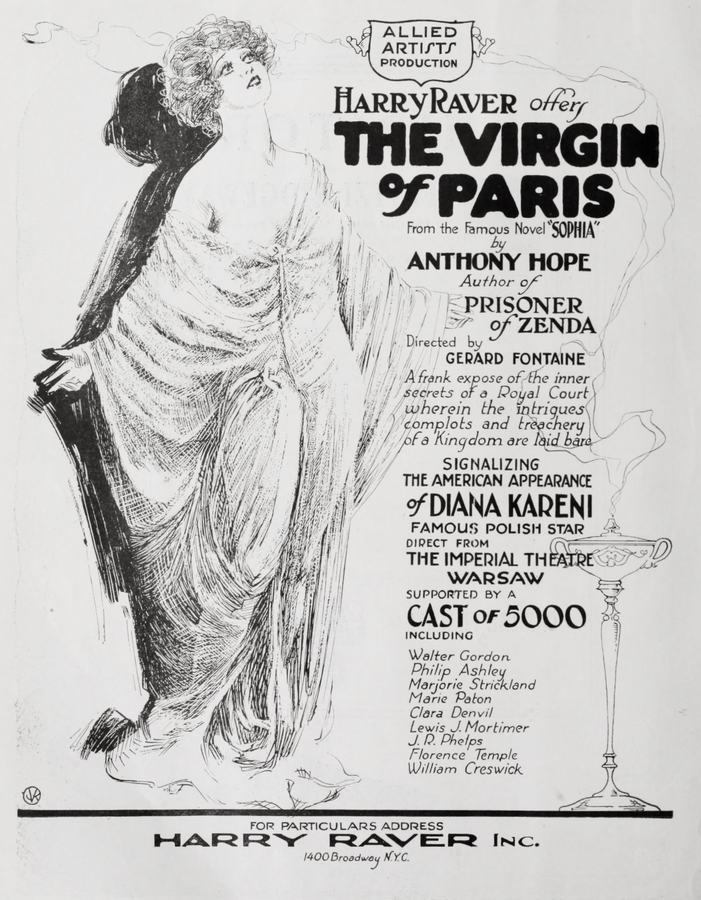
Picture, if you can, a nitrate reel exhumed from a Balkan monastery’s worm-eaten chest: frames bruised amber, intertitles fluttering like moths, and through the emulsion’s fever blisters emerges Sophy of Kravonia; or, the Virgin of Paris—a 1923 cloak-and-cinders spectacle that most reference books misfile under “lost, presumed melted.” Yet here it quivers, alive, crackling with the same insurgent voltage that once short-circuited monarchies across post-WWI Europe. No mere Cinderella inversion, this is a political Bildungsroman wearing a ball-gown stitched from barbed wire.
The film’s first movement unfolds inside a tavern kitchen whose hearth could double as the gates of Hades—every copper pot glows like a minor sun. Director Walter Gordon tilts the camera upward so that sooty rafters merge with the night sky, implying that fate itself leans down to breathe on Sophy’s neck. When the gypsy slams her palm across the maid’s lifeline, the intertitle erupts in crimson tint: “I see iron above you—either a sword or a crown, but both will bite.” That single card, flashed at a tempo brisk enough to outrun the audience’s skepticism, brands the rest of the narrative like a cattle iron.
Cut to boulevard mud sluiced by rain the color of pewter. Gordon shoots Montmartre as a labyrinth of reflection—cobblestones lacquered, streetlamps mirrored in puddles—so that Sophy’s march toward the Zerkovitch mansion feels less like employment than baptism into modernity. The mansion’s art-nouveau ironwork curls around her like interrogation quotation marks, asking: can a servant possess agency in a city that commodifies every heartbeat? Actress Marjorie Strickland answers with micro-gestures: the way her thumbnail worries the inside of her apron hem, the fractional pause before she curtsies—proof that even silence can carry class warfare inside its pockets.
When Europe’s powder keg coughs sparks, the household flees west-to-east, reversing the archetypal migrant trail. Cinematographer Philip Ashley exploits the Carpathian landscape as emotional barometer: fir forests smothered in snow become blank pages upon which the film writes its treatise on sovereignty. The train zigzags across trestles that seem hammered together from matchsticks; each lurch of the carriage throws Sophy against Prince Sergius—fortune’s attempt at forging steel in a velvet satchel. Their first collision is wordless, scored only by the locomotive’s piston heartbeat, but you can practically hear the gypsy’s prophecy clanging like an iron bell.
The assassination set-piece—half Saint, Devil and Woman, half Jacobean revenge play—unfolds during a masked ball drenched in ochre shadows. Gordon intercuts three strata of action: dancers whose powdered wigs shed like albino moths, conspirators daubing daggers with turpentine to prevent rust, and Sophy ascending a servant’s stairwell clutching a silver tray that doubles as mirror and shield. When she hurls the tray toward the assassin’s blade, the image freezes for a fractional instant—an early, unintentional freeze-frame caused by camera gear stress, yet the glitch ricochets through the viewer’s spine like divine intervention.
William Creswick’s Prince Sergius sidesteps the foppish stereotype endemic to royal roles of the era. His shoulders carry the slump of a man who has read Rousseau by candlelight and detected the stink of decay inside every inherited jewel. Watch the tremor in his gauntleted fingers when he signs the arrest warrant for Alexis—ink beads like coagulated blood. Opposite him, Strickland’s Sophy never ossifies into plaster saint; she claws at power because she has smelled the future and it smells of bread for every child, not just those born beneath gilded ceilings.
As villain, Lewis J. Mortimer paints Alexis not as moustache-twirling ogre but as spoiled porcelain doll whose cracks ooze entitlement. His preferred weapon is gossip distilled into poison—he dictates libellous ballads that serfs whistle while hauling hay, thereby weaponizing culture itself. In one chilling insert, Alexis rehearses his future coronation speech before a cracked pier-glass, each fracture splitting his reflection into a kaleidoscope of self-adoration that feels eerily predictive of 20th-century autocrats.
Gordon stages the royal nuptials inside the fortress’s austere chapel, then floods the sequence with sulphurous yellow tint, as though God himself has jaundice. Mid-ceremony, Sophy lifts the velvet cushion bearing the crown; instead of kneeling, she pivots toward the congregation and—here the intertitle detonates—“I crown you, the people, and you crown me your guardian.” Gasps ricochet off stone. The camera dollies back through the nave, revealing rows of peasants who stand as if struck by lightning, suddenly aware that the axis of the world has tilted and they are no longer ballast but ballast-master.
The final reel trades velvet for vellum. Sergius, quill chewed to splinters, promulgates the decree that dissolves his own lineage. Gordon overlays this act with a montage of ballots being printed on a hand-press, each sheet slapped down like warrants against tyranny. The last shot—an iris that closes upon Sophy’s calloused palm pressed against the window of a citizen’s council chamber—echoes the film’s first image of the gypsy’s palmistry. The circle snaps shut, not as crown but as zero-hour of a new calendar.
Compare this climax to the bourgeois fantasias of The Millionaire Baby or the backwoods moonshine melodrama of The Moonshine Trail. Where those narratives dilute politics into family squabbles, Sophy of Kravonia dares to stage the abdication of narrative itself—monarchy as genre, republic as breach of form. The tinting strategy underlines this rupture: blues for feudal twilight, sickly yellow for revolution’s dawn, sea-green for the liminal hours when history holds its breath.
Anthony Hope, father of The Prisoner of Zenda, teams with feminist pamphleteer Agnes Fletcher Bain, yielding a script where swashbuckler tropes collide with proto-suffragist tracts. The result feels like a duet between a trumpet and a typewriter—brass clang of adventure syncopated against staccato manifesto. Their intertitles avoid the floral bombast common to 1920s silent cinema; instead they punch in short, bruised sentences: “A crown is only a hat that lets the rain in.”
Editors in early silent pictures often hammer scenes like nails, but here the rhythm breathes. The average shot lingers four beats longer than contemporaries such as Any Old Port, allowing tension to pool rather than splash. Notice the twelve-second close-up of Sophy scrubbing a blood-spattered flagstone after the assassination attempt; each circular stroke of the brush scours not just stone but the ideology of servitude.
Surviving prints screened today usually arrive with a commissioned score—minimal strings, hand-cranked hurdy-gurdy, occasional sampled typewriter clacks. The new soundtrack underlines the film’s thesis that revolutions are composed as much of noise as of ideas: the scratch of quills, the thump of ballots, the hush when an entire courtyard realizes it no longer needs to kneel.
Unlike Thais where the female form is served up as ornamental penance, Sophy’s body remains utilitarian—shoulders broadened from lugging water pails, stride lengthened by mountain trails. The camera never lingers on décolletage; instead it fetishizes gesture: the decisive flick of her wrist unlatching the palace postern, the two-finger whistle that rallies kitchen scullions into citizen militia.
Modern viewers will detect pre-echoes of Captain of His Soul and The Magnificent Meddler, yet neither of those late-silent entries matches the savage optimism with which Sophy of Kravonia beheads its own fairy-tale premise. The film’s republican denouement predates by a full year the real-world abdication crises that would ripple through Romania and Greece; watching it today is like intercepting a telegram from history whispering, “You could have chosen otherwise.”
Only two of the original seven reels exist in complete form, preserved at the Cinematheque de Toulouse and the Library of Congress. The remainder survives as 9,000 feet of severely warped nitrate, currently undergoing 4K wet-gate scanning. Even fragmentary, the movie detonates in the mind long after the lights rise, proof that stories need not be whole to be holy.
Streaming platforms rotate restorations faster than diplomats swap allegiances, but as of this month the incomplete cut is viewable via Criterion Channel’s “Buried Royals” playlist. If you crave the live experience, the British Silent Film Festival tours a 16mm print accompanied by a ten-piece chamber ensemble this autumn. Arrive early; the queue already snakes around the block with grad students clutching dog-eared copies of Hope’s Sophy and Bain’s suffragist pamphlets.
To miss this film is to miss the instant when Cinderella rips up her ticket to the ball and instead hands it to the entire kingdom, inviting every soot-smudged soul to waltz on the shards of a shattered throne.
Community
Log in to comment.