DbcultAccessing Vault...
Cult Review
Senior Film Conservator
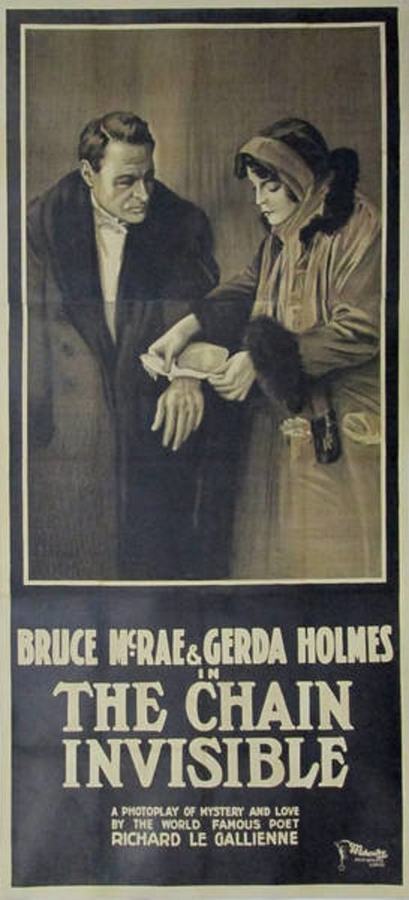
In the annals of early cinema, where moral boundaries were often blurred and narrative daring frequently tested the sensibilities of nascent audiences, certain films emerge as fascinating, if sometimes troubling, artifacts. Among these stands The Chain Invisible, a 1916 production that, even a century later, still provokes a potent cocktail of intrigue and discomfort. This is not merely a forgotten silent film; it is a profound, albeit problematic, exploration of human obsession, the malleability of affection, and the extreme lengths to which one individual might go to secure another’s devotion. The film, written by Richard Le Gallienne and Roy L. McCardell, plunges us into a narrative abyss that challenges our understanding of romance, consent, and survival, all wrapped in the melodramatic flourishes characteristic of its era.
At its core, The Chain Invisible presents us with James Wadsworth, portrayed with a compelling, if unsettling, intensity by Bruce McRae. Wadsworth is not merely smitten with Anna Dalton (Lorna Volare), a woman of considerable societal standing; he is utterly consumed by her. This isn't the gentle, hesitant admiration of a suitor, nor the ardent pursuit of a conventional romance. No, Wadsworth’s desire is an all-encompassing, almost pathological fixation, a singular objective that eclipses all ethical considerations. His determination to marry Anna is not a wish but a decree, a self-imposed mandate that sets the stage for the film’s extraordinary, and deeply disturbing, central conceit.
Wadsworth’s pursuit of Anna is relentless, a shadow across her every path. This relentless tracking culminates in a voyage to South America, where Anna, perhaps seeking respite from his persistent presence, finds herself inadvertently trapped in his meticulously orchestrated design. It is aboard this ship that Wadsworth unleashes his audacious, morally bankrupt plan: he throws Anna overboard. This act, an overt abduction disguised as a life-threatening incident, is immediately followed by his own plunge into the ocean, a calculated move to position himself as her sole savior, her only hope. Together, they are swept to a deserted island, a tabula rasa where Wadsworth intends to rewrite the narrative of their relationship, away from the constraints and judgments of civilization.
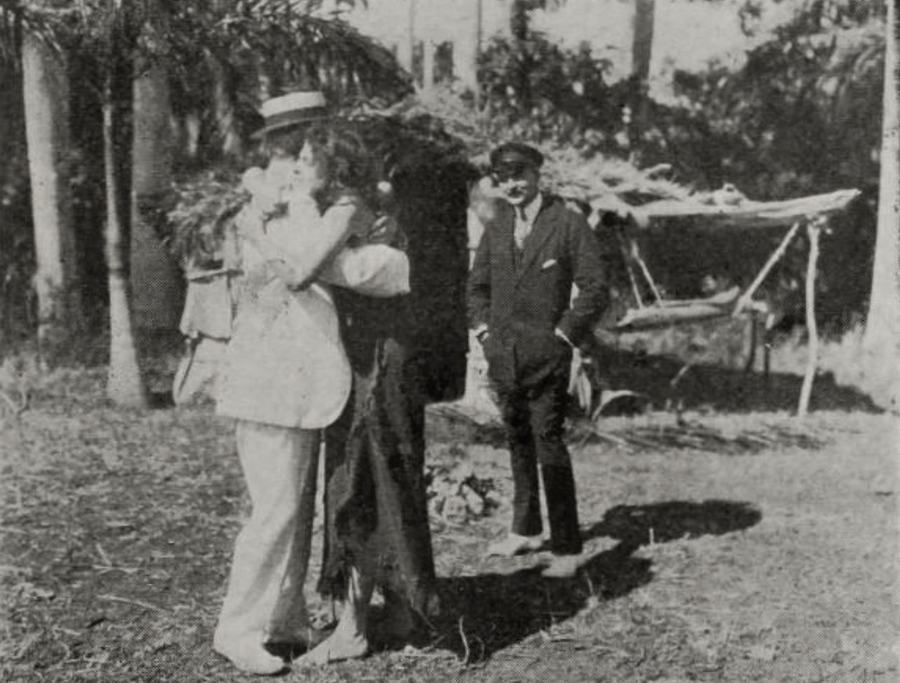
The island sequence is where The Chain Invisible truly distinguishes itself, for better or worse. Stripped of their societal accoutrements, their roles as 'society girl' and 'persistent suitor' dissolve into the more primal identities of 'survivor' and 'rescuer.' Wadsworth’s 'unorthodox method,' as the plot succinctly puts it, hinges on the psychological impact of shared trauma and absolute dependence. He forces Anna into a situation where her survival is inextricably linked to his actions, where gratitude and relief might, under extreme duress, be reinterpreted as affection. And, remarkably, it works. The film posits that in this isolated crucible, Anna’s initial terror and justifiable outrage give way to a genuine, if deeply complicated, love for Wadsworth. This transformation is the film’s most provocative element, inviting viewers to grapple with the disturbing implications of a love born from coercion, a bond forged through an act of extreme, calculated violence.
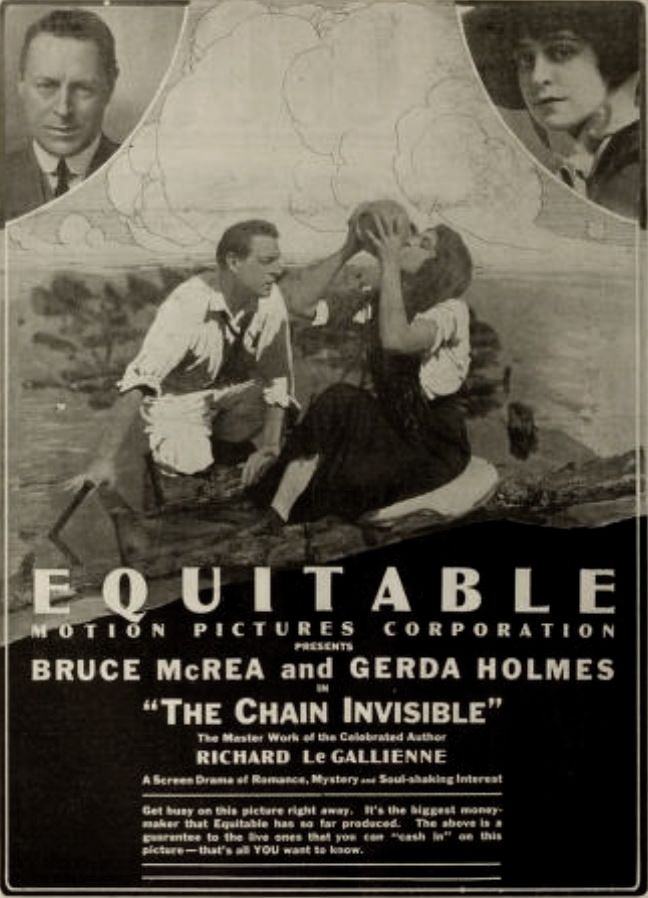
Bruce McRae, as James Wadsworth, delivers a performance that must have resonated with a chilling intensity in its time. His portrayal isn't that of a cartoonish villain, but rather a man driven by a singular, unyielding vision, one that blinds him to the ethical chasm he willingly leaps across. McRae conveys Wadsworth's conviction, his unwavering belief in his own righteousness, even as he commits an act of profound violation. It's a testament to his skill that he manages to imbue such a character with a degree of human complexity, making him more than a mere antagonist but a force of nature, albeit a destructive one. His silent expressions, the subtle shifts in his gaze, communicate a blend of possessiveness, determination, and perhaps, a misguided tenderness.
Lorna Volare, as Anna Dalton, faces an even more formidable task. Her character arc is one of drastic psychological transformation, moving from initial horror and resistance to eventual, if ambiguous, affection. Volare navigates this treacherous emotional landscape with considerable grace. Her early scenes likely convey the shock and terror of her abduction, followed by the raw struggle for survival. The gradual shift in her feelings towards Wadsworth, however, is where Volare’s performance truly defines the film’s audacity. How does one convincingly portray Stockholm Syndrome before the term even existed? Volare’s challenge was to make Anna’s eventual love believable within the context of the story, without trivializing the trauma. This delicate balance, conveyed through silent expressions and physical reactions, is crucial to the film’s success in its own twisted terms. While modern audiences might recoil at the premise, Volare's performance invites us to consider the psychological intricacies of survival and the formation of bonds under duress.
The supporting cast, including Lillian Paige, Victor Benoit (as the fiancé Richard Towne), Margaret Livingston, Thomas McGrath, Gerda Holmes, and Alfred Hickman, round out the narrative, though the core drama undeniably hinges on the central duo. Victor Benoit, as the searching fiancé, represents the conventional world and its expectations, providing a stark contrast to the wild, untamed romance blossoming on the island. His eventual discovery of the pair forms the inevitable collision of these two disparate worlds, forcing a confrontation with the consequences of Wadsworth's radical actions.
While the plot of The Chain Invisible is undeniably sensational, a deeper examination reveals intriguing thematic undercurrents. The film grapples with the age-old question of whether love can be truly forced or if it must arise organically. Wadsworth’s belief that by stripping away all external influences—wealth, society, other suitors—he can reveal Anna’s 'true' feelings for him is a perverse experiment in human psychology. It suggests a cynical view of societal romance, implying that true connection can only be found in a state of primal vulnerability. This theme echoes, in a bizarre way, narratives of self-discovery through hardship, though here, the hardship is deliberately imposed by one partner on another.
The title itself, The Chain Invisible, is remarkably evocative. It speaks to the unseen bonds that connect people, whether those are chains of societal expectation, emotional dependence, or, in this case, a twisted form of psychological enslavement. Is Anna’s eventual love a genuine connection, or merely the invisible chain of gratitude, Stockholm Syndrome, and a profound lack of alternatives? The film, operating within the constraints of its era, doesn't explicitly answer this, leaving it to the audience to ponder the uncomfortable implications. This ambiguity is perhaps its greatest strength, elevating it beyond mere melodrama into a more unsettling psychological study.
Comparing The Chain Invisible to other films of its period reveals both its uniqueness and its place within broader cinematic trends. While films like A Factory Magdalen or Her Secret explored women facing dire circumstances and making difficult choices, they typically depicted external societal pressures rather than internal psychological manipulation on such a grand scale. Even films that dealt with moral ambiguity, such as The Good Bad-Man, tended to focus on characters whose actions, while questionable, stemmed from more conventional motivations. The Chain Invisible pushes the envelope much further, daring to suggest that extreme measures, even criminal ones, could lead to a 'happy' romantic outcome. This makes it a fascinating precursor to later, more nuanced explorations of psychological drama.
It is crucial to view The Chain Invisible through the lens of its historical context. The early 20th century was a period of rapidly shifting social norms, particularly concerning gender roles and romantic relationships. While the film’s premise is undeniably shocking by modern standards, it likely tapped into contemporary anxieties and fantasies about powerful, assertive masculinity and the idea of 'taming' a woman. The romanticization of a dominant male figure, even one who resorts to such extreme tactics, was not entirely alien to the popular culture of the time. However, even within its era, the film's premise must have raised eyebrows, marking it as a truly audacious piece of storytelling. The writers, Richard Le Gallienne and Roy L. McCardell, demonstrate a willingness to explore the darker, more uncomfortable facets of human desire, pushing the boundaries of what was considered acceptable romantic narrative.
The silent film medium itself lends a particular quality to the storytelling. Without dialogue, the burden of conveying complex emotional shifts falls entirely on the actors' physicality, facial expressions, and the director's visual language. The melodrama, often exaggerated in silent cinema, might have softened the edges of Wadsworth's actions, allowing audiences to suspend disbelief more readily. The lack of explicit verbal protest from Anna, for instance, might be interpreted differently in a sound film, where her voice would add another layer of agency or lack thereof. In the silent era, the visual poetry of the deserted island, the raw struggle for survival, and the intimate moments between the two characters would have been paramount in conveying the narrative's progression.
The island idyll, born of such fraught circumstances, cannot last. The arrival of Richard Towne, Anna’s fiancé, introduces the inevitable conflict. His relentless search, a testament to conventional devotion, shatters the fragile world Wadsworth and Anna have constructed. This confrontation forces Anna to choose, or at least to confront the reality of her situation. Does she return to the safety and familiarity of her former life, or does she embrace the unconventional, even disturbing, love she has found with Wadsworth? The film’s resolution, however it plays out, is critical in determining its overall message about agency, fate, and the true nature of love.
For contemporary viewers, The Chain Invisible serves as a powerful, albeit uncomfortable, reminder of how much our understanding of consent, healthy relationships, and ethical behavior has evolved. It’s a film that demands critical engagement, not just passive consumption. It forces us to question the narratives we accept as romantic and to consider the psychological complexities that can arise in extreme situations. While its premise is undeniably problematic by modern ethical standards, its historical significance and its audacious storytelling make it a compelling subject for study. It stands as a testament to the early cinema's willingness to push boundaries, to explore the darkest corners of human desire, and to present narratives that, even today, refuse to be easily categorized or dismissed. It is a cinematic experience that, once seen, is difficult to forget, leaving an invisible chain of thought lingering in the mind.
IMDb 3.3
1911
Community
Log in to comment.