DbcultAccessing Vault...
Cult Review
Senior Film Conservator
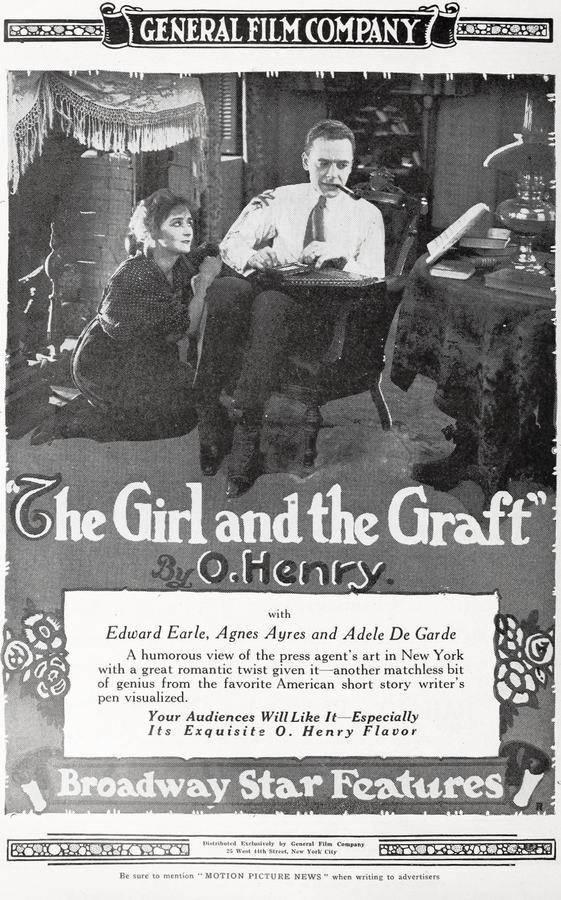
In the annals of early cinema, where narratives often hinged on grand gestures and clear-cut moralities, there occasionally emerged a picture that dared to toy with the audience's expectations, presenting a world where human desires were more complex, and outcomes delightfully unpredictable. Such is the case with 'The Girl and the Graft,' a film that, even a century later, retains a charmingly cynical wit and a sophisticated understanding of human foibles. This cinematic endeavor, penned by the masterful storyteller O. Henry and adapted by Stanley Olmstead, transports us to a realm where the pursuit of notoriety becomes an art form, and the machinations of the heart prove to be the most formidable of all forces.
At the core of this engaging narrative is Poque, portrayed with a subtle blend of quiet ambition and street-smart cunning. He is not your archetypal villain, nor a conventional hero; rather, Poque embodies a unique breed of dreamer, one whose aspirations for a coveted New York vacation are inextricably linked to his proficiency in the delicate art of 'graft.' This isn't graft in its most insidious sense, perhaps, but rather a spectrum of ingenious, albeit ethically nebulous, schemes designed to yield a comfortable profit. His cross-country peregrinations are a testament to his resourcefulness, each interaction a potential avenue for a carefully orchestrated transaction. Poque's journey is a fascinating exploration of the American spirit of enterprise, albeit one operating firmly within the grey areas of legality and moral convention. His ultimate goal, a leisurely escape to the bustling metropolis, serves as a surprisingly relatable anchor for his otherwise questionable professional pursuits.
The film truly ignites when Poque's path intersects with that of Vancross, a millionaire businessman whose immense wealth has paradoxically left him yearning for something more—not respect, nor influence, but a peculiar brand of fame: notoriety. It's a fascinating psychological portrait, this longing for public attention, even if it stems from scandal or controversy. Vancross, depicted by Edward Earle, presents a figure who has conquered the financial world but remains curiously unfulfilled, seeking validation through the very public spectacle he imagines Poque can orchestrate. This premise immediately elevates 'The Girl and the Graft' beyond a simple caper, delving into the peculiar anxieties of the affluent and the often-bizarre nature of human desire. Poque, initially hesitant to lend his talents to such an ostensibly unpretentious figure, eventually succumbs to the allure of the challenge, recognizing in Vancross a canvas for his own peculiar brand of social engineering. It's a partnership born of calculated risk and mutual, if divergent, ambition.
Poque’s genius lies in his ability to perceive the mechanics of public perception and manipulate them with a surgeon's precision. His plan for Vancross is a masterclass in manufactured scandal: a staged romance, a jilted lover, and a sensational breach-of-promise lawsuit. To execute this intricate ballet of deception, he enlists the aid of a girlfriend, a character whose initial role is that of a mere pawn in his elaborate game. This element introduces a layer of cynical manipulation, highlighting how individuals can be reduced to instruments in the pursuit of larger, self-serving objectives. The film, in its silent era elegance, communicates these complex intentions through nuanced performances and well-placed intertitles, allowing the audience to appreciate the cleverness, and indeed the moral ambiguity, of Poque’s scheme. One might even draw parallels to the intricate deceptions found in films like The Third String, where protagonists similarly navigate social landscapes through cunning and calculated risks, albeit often with more overtly comedic undertones.
However, the true brilliance of 'The Girl and the Graft' resides not in the execution of Poque’s scheme, but in its spectacular, ironic unraveling. The human heart, it turns out, is a far more capricious and unpredictable variable than any meticulously planned blueprint can account for. The girlfriend, initially a willing participant in the charade, finds herself genuinely captivated by Vancross. What began as a performance gradually blossoms into authentic affection, transforming the carefully constructed façade into a genuine connection. This unexpected turn of events is the film’s narrative fulcrum, pivoting from a tale of cynical manipulation to one of surprising romance. The planned lawsuit, designed to generate headlines and notoriety, is abandoned in favor of an engagement, a development that simultaneously thwarts Poque’s immediate goal and delivers Vancross a different, arguably more profound, form of fulfillment.
The influence of O. Henry, the celebrated master of the short story with a penchant for ironic twists, is palpable throughout 'The Girl and the Graft.' His signature style, characterized by unexpected narrative reversals and a profound understanding of the human condition's inherent contradictions, is expertly transposed to the silver screen. The film’s resolution, where Poque receives his substantial payment despite his original scheme collapsing, is pure O. Henry. He achieves his financial objective, but the path to it is entirely unforeseen, a delightful subversion of his meticulously laid plans. This ironic conclusion elevates the film from a mere comedic romp to a poignant commentary on fate, free will, and the often-serendipitous nature of life itself. It reminds us that while we may plan and scheme, the universe, or perhaps simply the unpredictable currents of human emotion, often has its own, more poetic, designs.
This narrative structure, where the protagonist's well-intentioned (or self-serving) plans go awry in a charmingly ironic fashion, finds echoes in other silent era comedies. One might consider the chaotic yet ultimately rewarding misadventures in films like A Night Out, where Charlie Chaplin's tramp character often finds his best efforts leading to unexpected, often humorous, outcomes. While 'The Girl and the Graft' operates on a grander, more conspiratorial scale, the underlying comedic engine of human fallibility and the universe's mischievous hand remains consistent. The film’s ability to deliver a satisfying, albeit unconventional, resolution underscores its enduring appeal and its clever adherence to O. Henry's narrative philosophy.
The success of a silent film, especially one reliant on intricate plot points and character motivations, rests heavily on the expressive capabilities of its cast. Adele DeGarde, Florence Deshon, Edward Earle, and Agnes Ayres, though their specific roles might be difficult to delineate without more detailed historical context, undoubtedly contributed to the film's vibrant tapestry. Silent acting, with its emphasis on exaggerated facial expressions, precise body language, and carefully choreographed movements, was an art form unto itself. The actors had to convey complex emotions and subtle shifts in character without the aid of dialogue, relying instead on visual cues and the power of pantomime. The film's ability to communicate Poque's cunning, Vancross's peculiar longing, and the girlfriend's evolving affections speaks volumes about the talent of these early performers.
The direction and cinematography of the era, while perhaps lacking the sophisticated camera movements and intricate editing of later decades, possessed a raw charm and an emphasis on clear visual storytelling. Each shot had to serve a purpose, each intertitle precisely worded to advance the plot or reveal inner thoughts. The film's pacing would have been crucial, balancing moments of comedic tension with the unfolding drama of the romantic entanglement. The very constraints of the silent medium often forced filmmakers to be more inventive, to think visually, and to rely on universal human emotions to bridge the gap of spoken language. This inherent challenge often resulted in films that, like 'The Girl and the Graft,' possessed a unique clarity and directness in their narrative approach.
Beyond its engaging plot and charming twists, 'The Girl and the Graft' offers a fascinating glimpse into the social fabric and cultural anxieties of its time. The early 20th century was a period of rapid industrialization and burgeoning media, where the concept of 'fame' was becoming increasingly accessible, and the lines between genuine achievement and manufactured notoriety were beginning to blur. Vancross’s desire for infamy, rather than legitimate recognition, speaks to a nascent cultural preoccupation with celebrity for its own sake, a phenomenon that has only intensified in the intervening decades. The film, therefore, acts as a surprisingly prescient commentary on the commodification of public image and the lengths individuals might go to achieve it.
Moreover, the film subtly explores themes of social mobility and the pursuit of the American Dream, albeit through unconventional means. Poque's graft, while ethically dubious, is his chosen path to personal fulfillment (a New York vacation). The film doesn't overtly condemn his methods but rather presents them as a fact of his existence, allowing the audience to ponder the morality of his actions within the context of his aspirations. This nuanced approach to character and motivation is a hallmark of more sophisticated storytelling, distinguishing 'The Girl and the Graft' from simpler morality plays of the era. The unexpected romantic resolution further complicates these themes, suggesting that genuine human connection can emerge from the most unlikely, and even manipulative, beginnings.
The narrative threads woven into 'The Girl and the Graft' resonate with several other cinematic works, both contemporary and subsequent. The intricate plotting and the high stakes involved in Poque’s scheme bear a resemblance to the dramatic machinations seen in films like The Pawn of Fortune, where characters often find themselves caught in complex webs of financial and social maneuvering. Similarly, the exploration of wealth, ambition, and the lengths people go to secure their desires can be found in the more dramatic narratives of films such as The Gilded Spider, which often delve into the moral compromises inherent in the pursuit of affluence.
While 'The Girl and the Graft' leans heavily into comedic irony, its underlying exploration of manufactured realities and the shifting landscape of public perception has a timeless quality. It reminds us of the power of storytelling, both within the film's plot (Poque's attempt to craft Vancross's story) and in the film's own construction. The film's unique blend of cynical planning and romantic serendipity offers a refreshing take on traditional narrative arcs, proving that even in the earliest days of cinema, filmmakers were capable of crafting tales that were both entertaining and thought-provoking. Its legacy lies in its ability to charm, amuse, and subtly challenge our assumptions about ambition, love, and the unpredictable journey of human experience. It's a delightful testament to the enduring power of a well-told story, especially one with an O. Henry twist.
In a world increasingly saturated with information and the relentless pursuit of public validation, 'The Girl and the Graft' serves as a quaint yet poignant reminder that genuine connection often emerges from the most unexpected of circumstances, effortlessly dismantling even the most meticulously constructed facades. It’s a film that, despite its age, speaks to the perennial human fascination with fame, the complexities of our desires, and the delightful, often ironic, ways in which life unfolds.
IMDb 6.3
1931
Community
Log in to comment.