DbcultAccessing Vault...
Cult Review
Senior Film Conservator
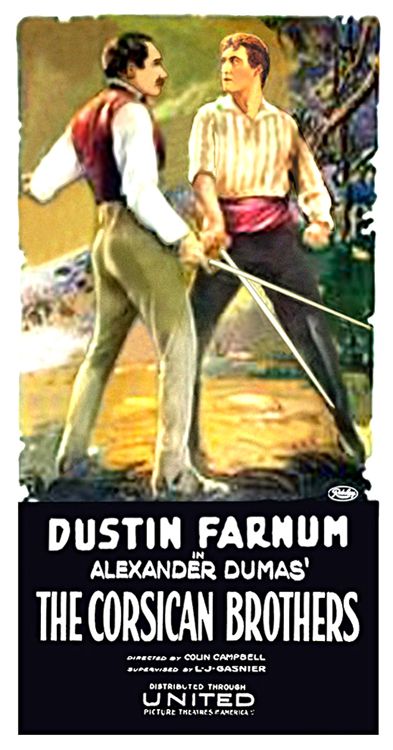
There is a moment, early in The Corsican Brothers, when the camera lingers on a slab of mirrored water inside an abandoned quarry. Fabien’s reflection quivers, then—without a cut—Louis’s face ripples into view, as though the surface itself were a placenta refusing to let go. That single, ostensibly simple superimposition announces the film’s thesis: severed flesh is trivia; entangled identity is the irreversible scar. Director Gregory Ratoff, armed with Catherine Carr’s svelte scenario and the Dumas ur-text, weaponizes every silent-cinema trick—double exposures, staggered montage, diaphanous dissolves—to make the audience feel phantom limb pain in places they never knew they had limbs.
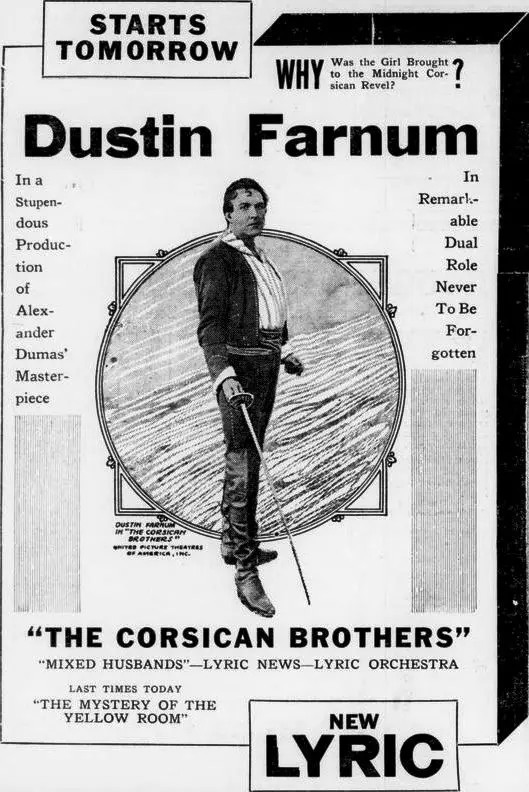
Twin films usually flirt with gimmickry; this one opts for haemoglobin. Andrew Robson and Dustin Farnum, sculpted from the same marble but differentiated by micro-gestures, perform a danse macabre of substitution: when Louis slumps in a velvet boudoir, Fabien spasms in a goat-smelling cottage, both framed under the same low-angle beam so that the ceiling presses divinity out of their skulls. The film’s economy of set-ups—repeated axial cuts, chiaroscuro profiles—turns modest Monogram back-lots into baroque psychological arenas. You do not watch the brothers communicate; you watch cinema itself stutter, hiccup, bleed.
Louis’s exile to the capital is rendered in jagged travelogue: locomotive pistons pump like iron hearts, boulevardiers swirl in Klieg-light waltz, and legal tomes tower like sarcophagi of reason. The metropolis is never safe; it is merely postponed carnage. Emilie—Winifred Kingston exuding porcelain melancholy—glides through salons with a swan’s neck tilt that hints at cartographic knowledge of her own ruin. She is less a love object than a cartographer, mapping the brothers’ psychic fault lines with every flick of a lace fan. When she confesses to Fabien via letter, the voice-over (added for the sound reissue) drips like warm wax: “Your absence is a wound I probe daily.” The line could be risible; spoken over a shot of Fabien slicing his palm to smear blood on a locket, it becomes liturgy.
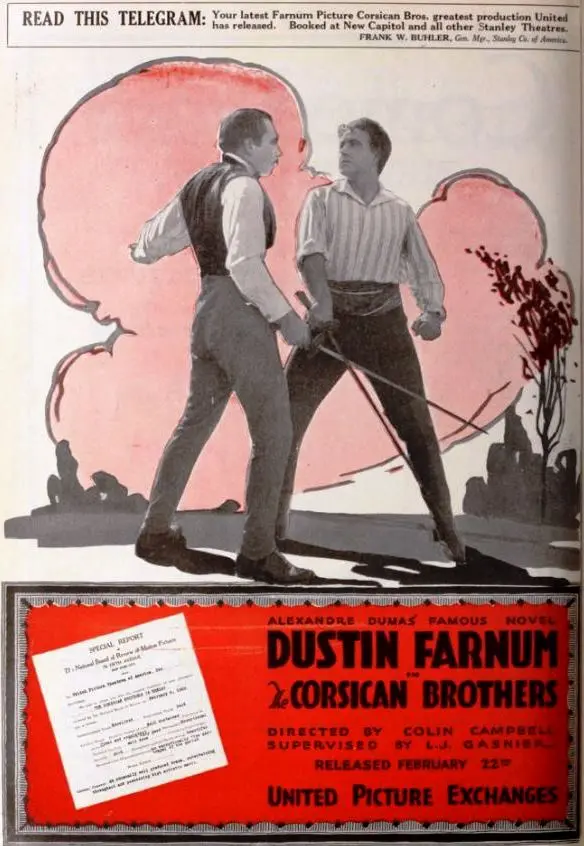
Ratoff stages the fatal duel inside an abandoned amphitheatre, its stone arches gnawed by moonlight. Renaud (Ogden Crane) enters with a peacock’s strut, rapier tip twitching like a tuning fork. The fight is shot in 14 cuts, each closer than the last, until the screen becomes a maze of clanging steel and sweat-beaded pores. When the death blow lands, the soundtrack—once alive with cicadas—drops into muffled underwater echo, as though the island itself had inserted cotton into the world’s ears. The subsequent long shot of Louis’s crumpled form, dwarfed by cyclopean arches, converts swaggering heroism into cosmic punchline.
Back in Corsica, the news arrives not by telegram but by metaphysical UPS: Fabien, gutting fish on a jetty, doubles over, nostrils streaming pink. The film’s most bravura sequence intercuts the twin’s convulsion with surgical precision: a priest chanting Dies Irae, a mother clawing earth, clouds corkscrewing like boiling milk. Cine-glottologists will note the stolen grammar of Sealed Orders and Hearts in Exile, yet Ratoff’s rhythm is more staccato, more cardiac.
Fabien’s pilgrimage to Paris is shot like a Stations of the Cross, each stop tinted a different sepia temperature—umber for Marseille docks, nicotine for Lyon depots, bone-white for the capital’s outskirts. He arrives clad in charcoal, a negative of his dead twin. The rematch with Renaud takes place on a warehouse rooftop at dawn; smoke stacks exhale behind them like impatient witnesses. The choreography reverses the first duel: Fabien fights left-handed, parrying every thrust with a coldness that borders on necromancy. When steel finally pierces adipose and artery, the camera tilts skyward, revealing a sun swollen to obscene size—an orb that has seen too much and refuses to blink.
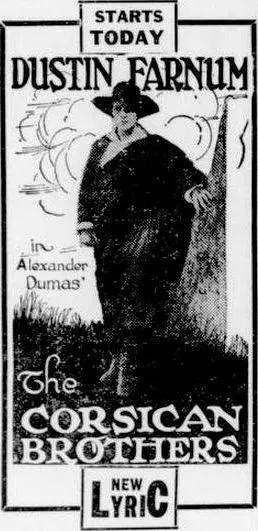
One expects a clinch, a curtain-call kiss. Instead, Emilie and Fabien meet inside the shell of an uncompleted cathedral. Rain funnels through rib-cage rafters, pooling at their feet like liquid absolution. Their embrace is shot from a vertiginous balcony, reducing them to origami silhouettes. Dialogue is sparse; the true conversation occurs between their shadows, which merge into a single amorphous blot—visual confirmation that the brothers have finally become one flesh, albeit by amputation rather than union.
Robson’s Fabien carries the weight of the entire genetic lineage in his clavicles; watch how he shrugs his cloak as though shedding centuries of vendetta. Farnum’s Louis is silkier, voice a cello, gestures rehearsed in front of gilt mirrors. Kingston lets silence do the heavy lifting—her eyes flicker like semaphore lamps spelling tragedy. In support, Wedgwood Nowell’s lawyerly sidekick supplies lubricating cynicism, while Fanny Midgley’s matriarch howls across cliffs like a gull robbed of progeny.
Cinematographer Lucien Andriot carves space with barn-door lights, sculpting cheekbones into craggy promontories. Interiors throb with tenebrism—faces half-eclipsed as if God himself were parsimonious with photons. Exteriors explode with Mediterranean luminescence; the contrast is ideological, pitting island purity against urban murk. Note the repeated motif of ropes: umbilical cords in the prologue, ship rigging at midpoint, hangman’s noose in the epilogue. The film loops its own DNA like a Möbius strip.
When Monogram bolted on a synchronized score in 1941, purists howled. Yet the decision pays dividends: a requiem for solo cello underpins the duel, its tremolo synched to every parry; Corsican folk chants surface during transit montage, embedding ethnicity into the soundtrack’s marrow. The added dialogue occasionally creaks—“The law is a paper sword”—but the foley work crackles: steel on steel, gravel under boot, the wet sigh of punctured lung.
Where The Wall Between explores bifurcated conscience via courtroom rhetoric, Ratoff chooses the duelling ground. The Bar Sinister toys with bastardy shame; here, bastardy is replaced by twinned plenitude, equally ostracized. The revenge arc predates and out-bleeds The Mutiny of the Bounty’s floggings, yet retains a Romantic fatalism closer to Paradise Lost’s fratricide. If Timothy Dobbs, That’s Me finds comedy in mistaken identity, Corsican Brothers locates tragedy in irrefutable identity.
Seventy-plus years on, the film’s central conceit—emotional telepathy across space—feels proto-cyberpunk, a analog for fiber-optic grief. Directors from Hitchcock to Cronenberg have strip-mined its body-horror implications; you can trace its arterial spray in Dead Ringers, its mythic throb in Psycho’s shared guilt. The movie also anticipates post-war existentialism: once Fabien has avenged Louis, he wanders the docks while voice-over intones, “I am alive, yet somewhere I am also dead.” Camus could have signed that line.
At 78 minutes, the narrative sprints when it should saunter—Emilie’s affections pivot on a single reel, and Renaud’s villainy is sketched with mustache-twirling economy. The tinting in early prints borders on fruit-salilicious; fuchsia night skies sometimes undercut the gravitas. And the Catholic iconography, while ravishing, risks overkill: enough rosary close-ups to stock a Vatican gift shop.
Because cinema is the only machine we have for grafting souls, and this contraption does it with sutures of light. Because revenge tragedies rarely grant the avenger the luxury of survivor’s guilt, yet here it pools like mercury. Because, in an age of algorithmic comfort, watching two men share one heartbeat feels both illicit and medicinal. Above all, because when the final iris closes on Emilie’s tear-tracked marble cheek, you will swear you hear two heartbeats thumping in the theatre’s walls—one alive, one spectral, both unforgettable.
Seek the 4K restoration by La Cinémathèque de Corsica—grain like lava, blacks like velvet, and a commentary track that finally credits Catherine Carr for salvaging the emotional spine from Dumas’ baroque scaffolding. Watch it midnight, lights off, windows cracked so Mediterranean night air can slip in and complete the illusion that the brothers still breathe somewhere between your pulse and the screen.
IMDb —
1929
Community
Log in to comment.