DbcultAccessing Vault...
6.2/10
Senior Film Conservator
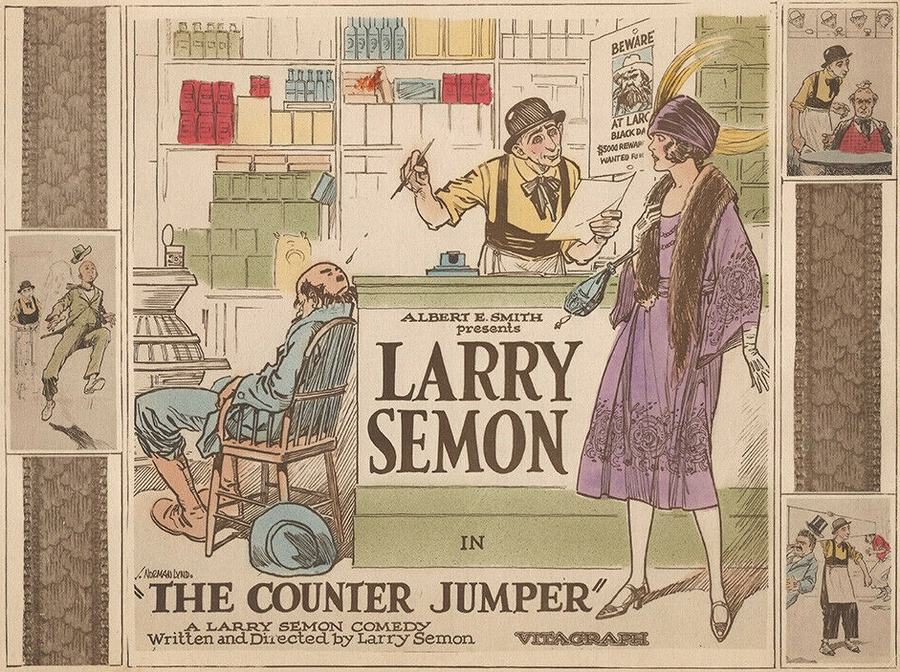
A definitive 6.2/10 rating for a film that redefined the boundaries of cult cinema. The Counter Jumper remains a cornerstone of transgressive art.
The first time you witness Larry Semon’s The Counter Jumper, you half-expect the celluloid itself to sweat. Shot under the San Fernando sun in 1922, this one-reel marvel crackles like bacon on a tin roof, its images flickering between vaudeville anarchy and mercantile ballet. Semon—clown, writer, director, and human cyclone—turns a sleepy general store into a kinetic cartoon long before cartoons learned to talk. The film survives only in patchwork prints, yet even scratched emulsion can’t dull its centrifugal swagger.
Plot, on paper, sounds almost quaint: a hapless clerk protects a millionairess from a top-hatted predator. But Semon never let paper restrain him. His screenplay—really a storyboard of explosions—treats narrative like a trampoline: necessary only for higher bounce. Within ninety seconds we’ve met Larry, sleeves rolled to the elbow, necktie corkscrewing outward like it’s trying to escape his collar. He enters the store not through the door but via a ladder tumbling from the loft, a gravitational joke that signals physics will be optional today.
Semon shoots the emporium like Griffith filmed Babylon: every shelf, pickle barrel, and pickle is primed for pandemonium. The wide counter—equal parts altar and barricade—dominates the frame, its scarred wood grain a topographical map of past massacres by cheese wheel and coffee sack. Note the way cinematographer H. F. Koenekamp (uncredited but unmistakable) lets dust motes swirl in the projector beam, turning sunlight into a secondary cast that applauds each pratfall. Silent cinema rarely gets credit for its environmental acting; here the store itself hams it up, creaking, sighing, finally disgorging every commodity like a piñata with a grudge.
Lucille Carlisle, often dismissed as "the girl," actually supplies the film’s emotional gyroscope. Arriving in a roadster that looks stolen from a fairy tale, she glides across the sawdust in a white dress whose hemline brushes morality itself. Watch her eyes—wide, unblinking, yet always calculating risk—when Larry accidentally douses her in molasses. Instead of shrieking, she wipes a finger across the goo, tastes it, grins: a silent promise that she can stomach any absurdity the plot dishes out. In a genre where heroines exist to be rescued, Carlisle’s heiress engineers her own salvation, commandeering a delivery bicycle and leading the villain on a chase that prefigures Keaton’s Sherlock Jr. by two years.
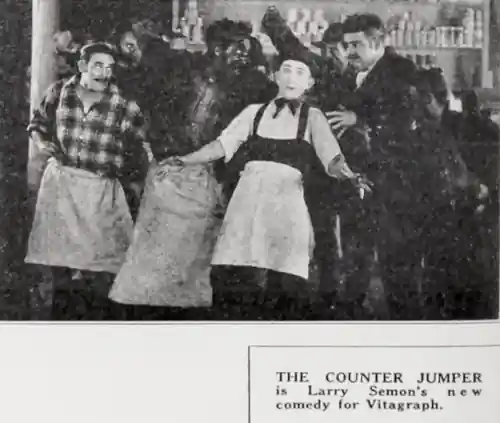
Spot Oliver Hardy—credited as Babe Hardy—and you glimpse the moment before immortality found its rhythm. He plays the store’s butcher, a role that requires little more than bluster and a blood-spattered apron, yet Hardy turns every shrug into a sonata of arrogance. Lean closer: see how he weighs a sausage like it’s Hamlet’s skull, then flings it with disdain worthy of a prince. The partnership with Stan Laurel is still four years away, but the oafish majesty is already marinated in place.
If you hunger for more Semon-style bedlam, detour to The Concert (1921), where symphony and slapstick collide, or The Westerners (1919) for prairie dust kicked into whirlwinds of parody. Both share Semon’s creed: if it can move, it must detonate; if it detonates, it must rhyme.
Semon’s comic vocabulary predates the vernacular of animation: the squash-and-stretch of his limbs predates Mickey’s; the pop-eyed take, jaw unhinging like a cash drawer, is a meme before memes. In The Counter Jumper he perfects the elastic prop: a tape measure that rockets across the store, lassoing ankles, yanking trousers to half-mast, transforming a mundane measuring task into a lashing ballet. Notice, too, the delayed reaction—he’ll duck a flying ham, straighten his tie, then the ham’s impact registers three beats later, a triplet of shock, pain, and acceptance.
No honest review can skip the cringe. Curtis "Snowball" McHenry appears as a stock boy whose screentime is shorter than a sneeze and twice as insulting. The nickname alone, a racial epithet disguised as affection, lands like a brick. History won’t absolve Semon here, yet we must archive the wound with the wit. Likewise, Eva Thatcher’s gossipy spinster trades in shrewish clichés, her girth played for punchlines. These caricatures remind us that even anarchists inherit the bigotry of their age.
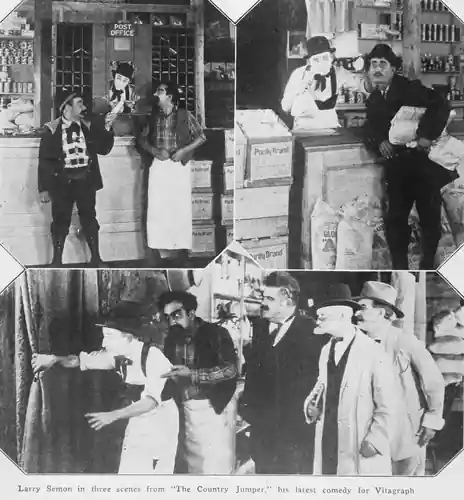
Watch the climactic chase: 46 cuts in 72 seconds, a staccato rhythm that anticipates modern action montage. Semon alternates between wide shots that map geography and insert close-ups of gears, boots, and flapping ties, creating a cubist sense of space. The villain’s pursuit of the heiress on a runaway delivery wagon cross-cuts with Larry roller-skating while steering a horse by its tail—an impossible concatenation of limbs and momentum. Soviet montage theorists preached intellectual juxtaposition; Semon practiced pratfall dialectics.
Though devoid of synchronized dialogue, the film drips with aural suggestion. Each crash lands in your inner ear like a tuning fork struck against the skull. Contemporary exhibitors would have sent a pianist pounding out "Chase" or "Tempest" cues; today, mute it and you still hallucinate the thud, the clang, the kazoo of chaos. Silence becomes a character—an accomplice that amplifies the absurdity until laughter feels like a percussion instrument.
Fast-forward to After the Show (1921) and you’ll spy DNA strands of Semon’s kinetic DNA replicating in everyone from Harold Lloyd’s bespectacled daredevil to the elaborate set-piece ballets of Buster Keaton. Even Looney Tunes owes a bar tab: the way Elmer Fudd’s shotgun swivels back to blast him? Pure Semon geometry.
Surviving prints hover in 16mm reduction, some digitized by European archives. The image flickers, emulsion cracked like drought-riven earth, yet the slapstick survives the bruise. Kino Lorber’s Slapstick Symposium box offers a serviceable Blu-ray; however, purists crave a 4K scan of the 35mm nitrate held in the BFI’s vault. Until then, YouTube rips circulate, watermarks and all, begging for a righteous crowdfunding rescue.
The Counter Jumper is less a story than a chemical equation: one part hubris, two parts gravity, detonated by a man who refuses to acknowledge either. It’s 24 minutes that remind you cinema’s primal promise: to make the impossible look like Monday morning. Watch it once for the acrobatics, twice for the architecture of anarchy, a third time to measure how far we’ve slid into respectability—and how badly we need another clerk to saw through the floorboards.
Grade on a curve of carbonated joy: A-. The minus is for the racial shorthand we can no longer unsee. Yet even that caveat feels like scolding a firework for not filing flight plans. Light the fuse already.
IMDb 4.1
1932
Community
Log in to comment.