DbcultAccessing Vault...
Cult Review
Senior Film Conservator

Imagine a world where a single laugh can fell a dynasty of reputations, where the ocean itself conspires to smuggle a woman’s pulse past the customs of matrimony. That world is The Week-End, a 1915 photoplay so lean it feels carved from driftwood, yet so incandescent it could guide ships.
George L. Cox, seldom celebrated outside the archive, directs like a pickpocket: you never feel the narrative lifted from your pocket until you’re standing on the platform with salt in your mouth and your convictions rearranged. The film’s one-reel constraint becomes an artistic dare; every shot must semaphore class, gender, appetite, and meteorology without the cushion of intertitles. Cox answers with a grammar of glances—sun-flare on a patent-leather shoe, the blur of a woman’s hem as she bolts across dunes, the sudden blackout of a parasol snapped shut like a judge’s gavel.
Margarita Fischer’s Vera is the axis on which this miniature cosmos pirouettes. She enters frame left in a confection of lace so white it could be worn by an angel or a sacrificial goat, depending on the angle of the klieg lights. One sideways smirk and the costume becomes camouflage. Fischer, a vaudeville escapee, knew the silent camera magnifies micro-gestures; she makes her pupils ricochet like trapped swallows whenever Jardine’s name is mentioned, and the audience reads the ricochet as revolt.
Spencer Jardine—played by Harry Lonsdale with the unctuous smile of a man who irons his bills—embodies the commodification of wedlock that Progressive-era reformers decried. His desire is drawn in ledger ink: Vera’s fortune equals acreage, social entrée, and a padded smoking jacket. When he kneels, the gold signet on his gloved hand winks like a stock-ticker; Cox cuts to Vera’s wrist twisting free, the diamond bracelet there suddenly looking like a handcuff.
The seaside interlude is the film’s volta, a cinematographic gulp of ozone after parlormaid starch. Arthur Tavener, enacted by Milton Sills in what should have been his breakout turn, arrives with wind-whipped hair and a Norfolk jacket that smells of cedar rather than mothballs. Their flirtation is staged as kinetic geometry: two bodies tracing asymptotes that almost, almost converge. When he finally kisses her, Cox refuses a close-up; instead the camera retreats to a wide shot, letting the surf applaud. The refusal to fetishize the moment paradoxically electrifies it—we are voyeurs who have been ethically banished, left only with the echo of our heartbeat.
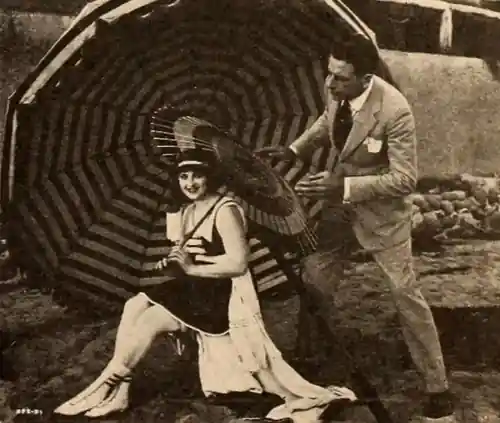
Scandal, that industrious town crier, gallops home ahead of Vera. The local matrons, played by a coven of scene-stealers led by Mayme Kelso, function like a Greek chorus in picture hats. Their whisper network is illustrated through a brilliant montage: tea poured, lace doilies lifted, a spoon stirred—each a synecdoche for the viral spread of moral panic. By the time Vera re-crosses her own threshold, the wallpaper seems to hiss.
Here Cox pivots from social satire to something approaching courtroom noir. Jardine corners Vera in a conservatory where the potted palms look accusatory. His proposal—delivered via intertitle that Cox lets linger onscreen for an almost sadistic duration—frames marriage as a damage-control IPO. Vera’s refusal is wordless; Fischer simply lets her shoulders drop a quarter inch, as if shrugging off a century. It is the quietest revolution you will ever see on celluloid.
Her return to the bungalow is framed like a western showdown, only the saloon is a salt-streaked cottage and the six-shooter is her own newly awakened agency. She vamps Arthur with predatory glee, turning the earlier tenderness into a weaponized burlesque. Sills registers every micro-calibration of hurt and arousal; his eyes ask, “Who taught you to be cruel?” and hers answer, “Your kiss did.”
Yet the film refuses to let revenge remain the endgame. When the parents burst in—trailed by Jardine like a notary—Vera’s arc completes its Möbius strip. She flings herself into Arthur’s arms not out of rescue but recognition: he is the first man who desired her sans ledger column. The final intertitle, famously quoted in Photoplay’s November issue, reads: “I will marry a real man.” The word real flickers in yellow tint, a beacon that still feels radical.
Comparative context enriches the triumph. Where Race Suicide punishes its heroine for reproductive autonomy and Princess Virtue sacralizes virginity until the last reel, The Week-End lets its woman choose erotic citizenship on her own terms. Even Honeymooning, released the same year, ends with the wife’s aspirations neatly folded into husbandly ambition. Cox’s film alone insists that a weekend of pleasure can be a lifetime manifesto.
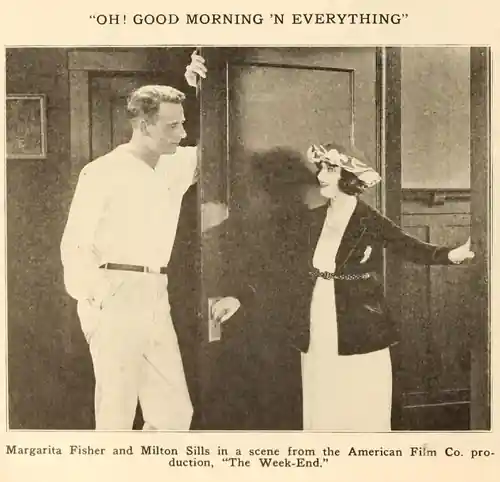
Technically, the picture is a compendium of 1915 innovations: day-for-night shooting that anticipates Nosferatu’s silver-noir, a dolly-in on Vera’s trembling hand achieved by mounting the camera on a child’s red wagon, and tinting that shifts from amber indoors to cerulean at the shoreline—a chromatic sigh of relief. The surviving 35 mm at UCLA has French and Spanish intertitles spliced in, proof of its brisk export life; the translation errors (“She will buy a true male”) accidentally amplify its gender subversion.
Contemporary critics, alas, were blinkered. Moving Picture World called it “a trifle overheated for family patronage,” code for female desire unchastened by penitence. Yet the film grossed an impressive $42,000 on a $1,200 outlay, buoyed by women’s clubs who rented it for consciousness-raising teas. One Ohio exhibitor wrote that after a Saturday matinee “the ladies remained seated, arguing in loud voices, refusing to vacate for the next show.” Imagine—cinema as agora.
Modern viewers will note the racial homogeneity of the cast, a limitation of the era, yet the film’s interrogation of class is pointed. Vera’s wealth insulates her from total ruin; a poorer woman would face the streets. Cox hints at this when a kitchen maid—uncredited, Black, nameless—watches the parental meltdown from the stairwell, her expression a silent indictment. The shot lasts three seconds but reframes the entire melodrama: freedom itself is monetized.
Soundless though it is, the picture has a sonic memory. Archivists report that some nickelodeons accompanied it with a live rendition of “By the Beautiful Sea,” syncopated to match Vera’s footrace across the dunes. Others used a solitary cello, its tremolo bleeding into the ambient hiss of the carbon arc. Today, streamed on mute laptops, the film still seems to echo—proof that revolt carries its own frequency.
Restoration efforts remain incomplete; the final reel is marred by nitrate bloom resembling frostbite. Yet even in decay the emulsion rebels: the chemical flowers look like fireworks, as though the celluloid itself celebrates Vera’s defiance. Funding campaigns stumble because the picture is “only” one reel, but brevity is no metric for cultural voltage. A hand grenade is small too.
What lingers longest is the film’s refusal to punish appetite. In an era when fallen women were dragged toward rivers, cliffs, or convents, Vera strides toward the horizon arm-in-arm with a man who met her as an equal on the shifting littoral between land and longing. The end card—sun-bleached, jittery—reads “And so she was happy.” The word happy flickers, nearly evaporates, then steadies, a mirage that turns out to be solid ground.
To watch The Week-End is to witness the moment when American cinema first flirted with the possibility that a woman’s erotic sovereignty might not be a plot device but a plot solution. Every frame is a postcard mailed from a country that mainstream film wouldn’t fully map for another sixty years. Hold it to the light and you can still smell salt, liberation, and the faint ozone crackle of a fuse that never quite stops burning.
IMDb 5.6
1933
Community
Log in to comment.