DbcultAccessing Vault...
Cult Review
Senior Film Conservator
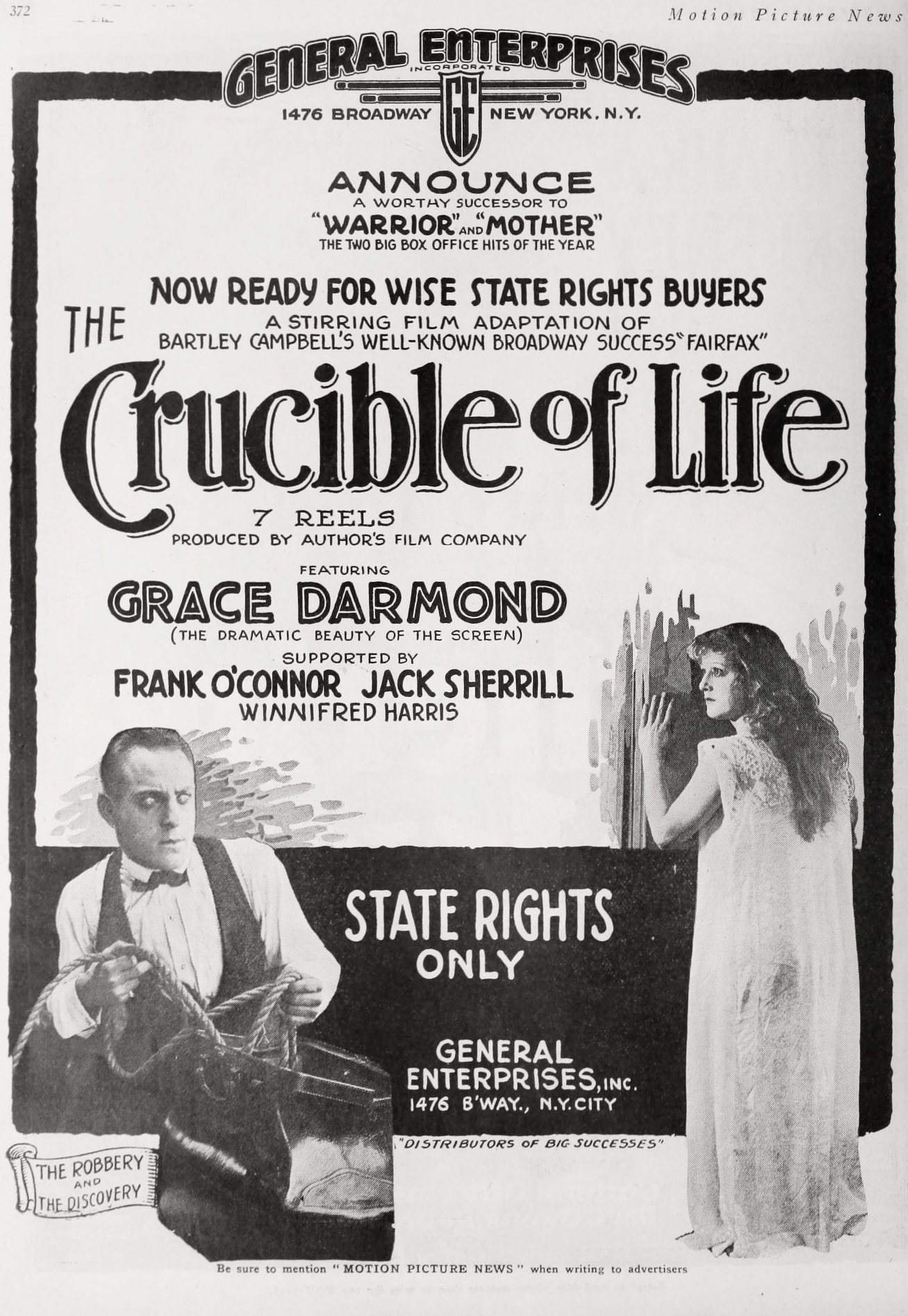
Like nitrate flickering through a carbon-arc, The Crucible of Life survives as a ghostly ledger of America’s pivot from Victorian parlor piety to mechanized carnage. Directed by Frank O'Connor in 1915 but shelved for years after distributor bankruptcy, the picture resurfaced in a 2019 MoMA vault sweep, its tinting so faded that only digital sorcery revived the original amber battlefields and cerulean hospital corridors. What we witness today is less a relic than a time-lapse bruise—purples of disgrace, yellows of hope, reds of shrapnel blooming across nitrate skin.
Bartley Campbell’s scenario, trimmed from a four-reel morality play to this brisk 72-minute cut, grafts Edith Wharton’s social scalpel onto a Griffith-style race-to-the-rescue. Yet the splice feels uncannily modern: Gladys’s fall is less deus-ex-machina than algorithm of gossip, presaging cancel culture by a century. O’Connor’s camera, often hand-cranked by the cast themselves, lingers on thresholds—half-open doors, tent flaps, railway platforms—visualizing how swiftly repute can migrate from salon to sewer.
Interiors drip in topaz lamplight, a nod to the era’s obsession with electric opulence; once we reach the Front, cinematographer Edwin Forsberg swaps gilded warmth for aquatic nocturnes—moonlit mud, field-dressing basins, the ghostly glow of mustard gas. The final hospital reunion is bathed in a bruised lavender achieved by tinting each frame with hibiscus dye, a flourish that anticipates the emotional chiaroscuro of Alsace (1916).
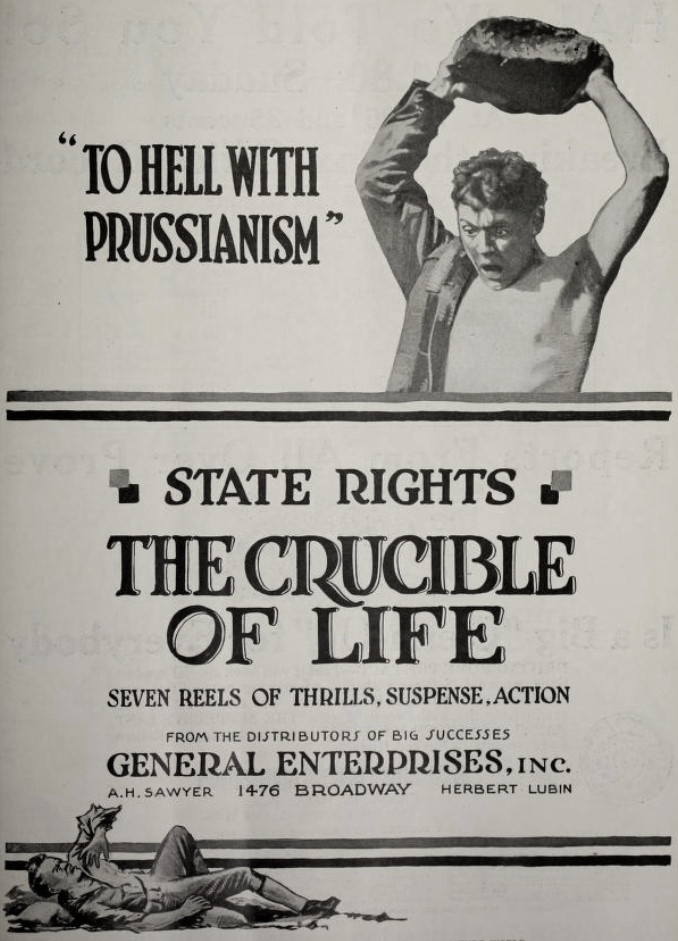
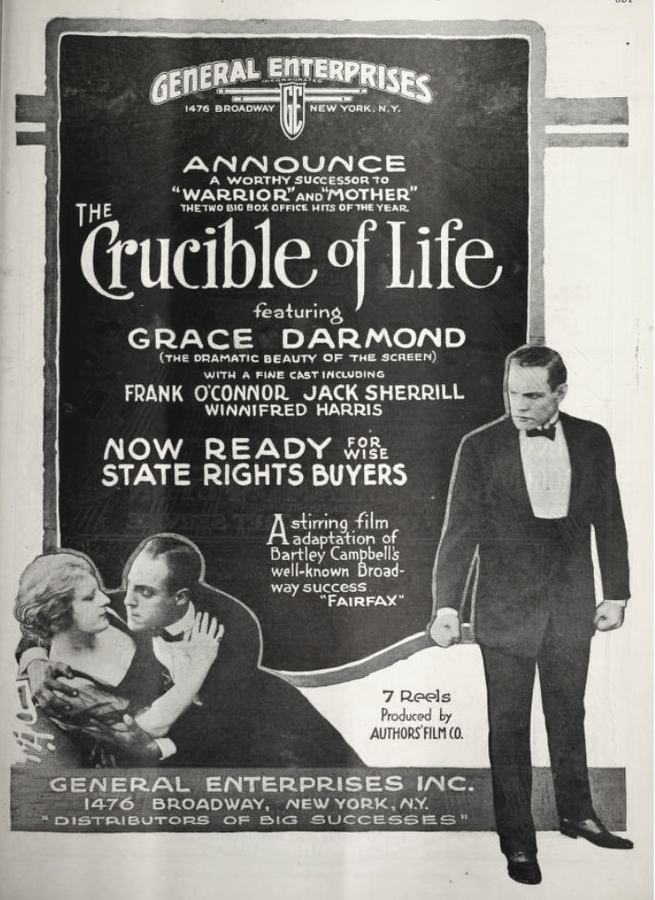
Grace Darmond’s Gladys never succumbs to Victorian vapors; her shoulders square like a sailor’s when she’s falsely accused, only to quiver microscopically in extreme close-ups—an innovation for 1915. Jack Sherrill’s von Hoffbert is silk and shrapnel, bowing with Prussian courtesy while eyes tick like range-finders. The most arresting turn comes from Winifred Harris as Mrs. Dorset: she weaponizes etiquette, each hand-clasp a ledger adjustment, her final collapse upon Robert’s arrest a master-class in silent-film schadenfreude.
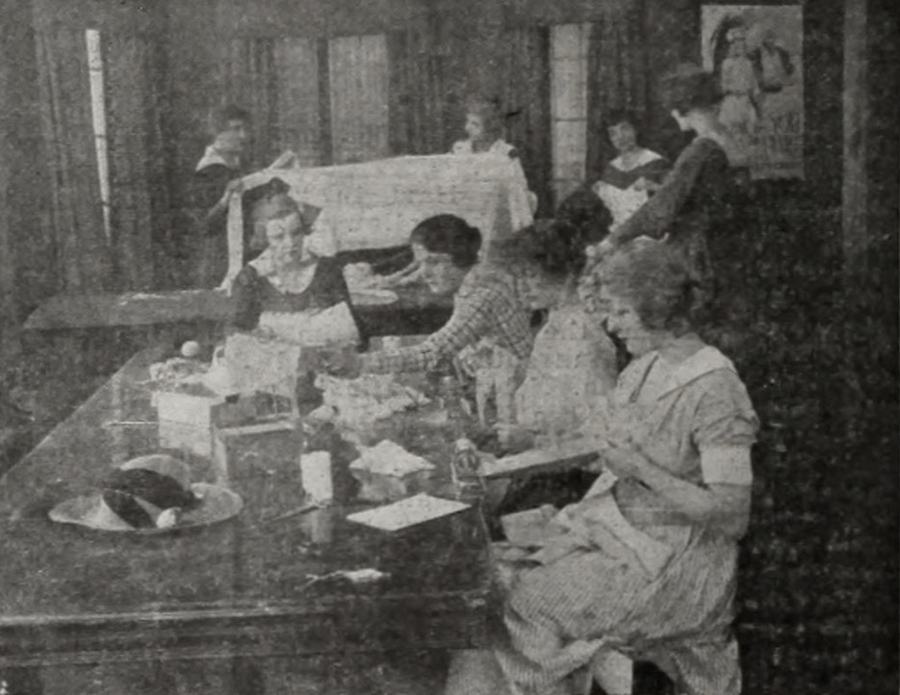
While contemporaries like Divorce and the Daughter moralized female autonomy as pathology, Crucible treats Gladys’s nursing stint not as penance but reinvention. She sutures arteries before a male surgeon concedes competence; she rejects Edwin’s first proposal—not out of coquetry but because trauma has recalibrated her metrics of trust. The film’s true romantic pivot is therefore Edwin’s acceptance of deferred consent—a radical beat for 1915.
Archival cue sheets suggest the original tour featured a celto-maxixe hybrid: parlor cello for Fifth-Avenue salons, shifting to Brazilian maxixe when Robert descends into criminal dens. Modern restorations often default to solo piano, but I’d argue for a prepared-guitar ensemble—scraping metallic strings to echo trench-wire—bridging to a solo flute during Gladys’s first night in France, a fragile truce between clamor and calm.
Released months before Lusitania’s sinking, the picture sidesteps jingoism. German characters are villains not by ethnic decree but by contractual espionage; von Hoffbert could swap uniforms with a Slavic saboteur and the plot would hold. Such elasticity renders Crucible less a recruitment poster than a meditation on surveillance—every ballroom column hides a shadow, every letter may arrive opened.
Where The Island of Desire exiles its heroine onto Edenic sand to ponder erotic autonomy, Crucible thrusts Gladys into a man-made hell where autonomy is measured by triage choices. Conversely, The Trap (also 1915) employs a falsely accused male lead, proving that gendered disgrace crossed chromosomes in early cinema. What distinguishes O’Connor’s effort is the insistence that redemption is communal—Robert’s confession, Edwin’s vulnerability, Gladys’s forgiveness form a chain no single hero could forge.
In an age of deep-fakes and viral half-truths, the film’s core dilemma—how quickly narrative supplants nuance—feels algorithmic. Watch the montage where New York gossip columns sprout like mushrooms after rain: each paper overlapping in a staccato dissolve, a proto-social-media cascade. One can almost substitute Twitter birds for telegraph wires.
The third reel drags; Robert’s second robbery replays the first beat-for-beat, presumably to appease exhibitors demanding "action density." Intertitles occasionally balloon with exposition, betraying Campbell’s stage roots. And Edwin Forsberg’s nighttime battle sequences flirt with incoherence—soldiers vanish between cuts, proving that even 1915 couldn’t quite solve the calculus of chaotic terrain.
The 4K photochemical rescue boasts a DTS stereo score by the Murnau Quartet, yet I pine for a boutique Blu-ray that retains the cyan-shifted gutters between frames—the scars remind us history is fragile. Extras should include the surviving outtake where Grace Darmond breaks character to scold a wayward kitten—proof that even wartime melodrama could be disrupted by feline improvisation.
The Crucible of Life is neither pristine artifact nor dusty curio; it is a palimpsest where Edwardian anxieties bleed into modern fault-lines. To watch Gladys emerge from calumny is to rehearse our own escape from algorithmic judgment. That the escape requires both the surgical precision of a field hospital and the blunt force of a battlefield suggests that truth, like love, is forged at the intersection of tenderness and trauma.
Seek it out—whether in a rep cinema with live accompaniment or a 3 A.M. streaming rabbit-hole—and let its tints of gold, ember, and tempered steel tattoo your eyelids. In the crucible, we are all both alloy and alchemist.
IMDb —
1918
Community
Log in to comment.