DbcultAccessing Vault...
6.7/10
Senior Film Conservator
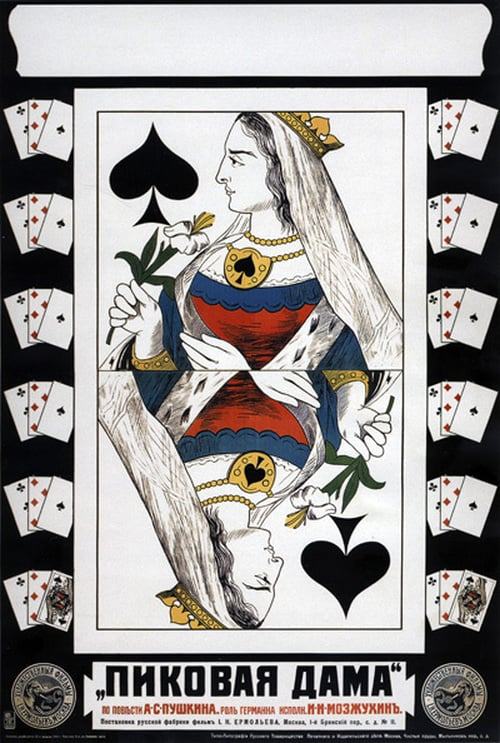
A definitive 6.7/10 rating for a film that redefined the boundaries of cult cinema. Pique Dame remains a cornerstone of transgressive art.
If you have ever stood at a roulette table and felt the ball’s metallic clatter echo inside your ribcage, then Pique Dame will play you like a xylophone of bones. This 1918 German silent, adapted from Pushkin’s 1834 short tale, is less a moral parable than a frost-bitten hallucination—an absinthe-laced waltz through candle-smoke corridors where destiny wears a powdered wig and laughs through broken teeth.
Director Jacob Fleck and his lens-wielding confederate Luise Fleck translate the imperial pomp of Tsarist Russia into jagged silhouettes worthy of Caligari. The cityscape is a fever chart: crooked spires stab pewter skies, canal ice glints like shattered theatre mirrors, and every doorway yawns like a crypt. Into this cardboard St. Petersburg stumbles Johannes Riemann’s Lieutenant Stanislaus Kovolski—eyes ringed with sleepless gamboge, greatcoat threadbare enough to read yesterday’s newspaper through. His purse is emptier than a church during plague years; his heart, however, thrums with the reckless canticle of the born addict.
Pushkin’s prose is famously laconic—three pages of diaries, a letter, a ghost—but here the screenplay distills that narrative spirit into relentless visual rhythm. Intertitles arrive like snapped violin strings: “Three cards will unlock the vault of fate.” The prophecy is delivered by a gypsy crone whose face looks carved from dried apricots; she points a crooked finger and the camera zooms, irising in until her pupil becomes a black vortex sucking Kovolski—and us—into obsession.
The film’s casting ledger reads like a roll-call of Weimar luminaries. Ernst Deutsch plays the foppish confidant with a mascara smirk, half Mephistopheles, half department-store mannequin; Johanna Terwin’s Liza glides through ballrooms like a swan that already intuits the shotgun under the feathers. Yet the performance that lingers like cigar musk is Alexander Moissi as the ghostly Countess—his androgynous frame wrapped in 18th-century pannier skirts, face powdered until it resembles a porcelain fracture. Moissi tilts his head back, eyes half-lidded, and suddenly the screen exhales cold air; you half expect frost to form on the edges of the frame.
German Expressionism lives or dies on shadow geometry, and cinematographer Mutz Greenbaum (later to lens Dietrich vehicles) turns every staircase into a guillotine of light. When Kovolski ascends to the Countess’s boudoir, the banister casts prison-bar stripes across his torso; the camera tilts fifteen degrees off-axis, as though the world itself is sliding into the abyss. It’s the same canted universe that haunts Hoffmanns Erzählungen, yet here the stakes feel rawer—less fairy-tale whimsy, more raw-nerve capitalism.
Silent cinema demands the ear fill the vacuum. In the auditorium, a live orchestra once scraped Tchaikovsky motifs; on your couch, the Blu-ray offers a new electro-acoustic score that pulses like blood in the ears. Listen closely during Kovolski’s final card hand: the mix drops to sub-bass rumble, then a single harpsichord plink—mirroring the fatal flip of the Queen of Spades. It’s the same auditory gambit modern thrillers exploit, yet here the absence of spoken dialogue leaves your brain echo-rich, amplifying every creak of your furniture into the Countess’s spectral footfall.
Pushkin’s original text toys with narrative reliability—diary fragments, second-hand gossip, contradictory testimonies. The Flecks translate that instability into visual stutters: jump-cuts that skip like scratched vinyl, superimpositions where Kovolski’s face dissolves into the card-back pattern of acanthus leaves. One sequence—an opium-dream montage—anticipates the psychedelic overlays of The New Exploits of Elaine yet feels eerily contemporary, predatory. The lieutenant sees himself duplicated across the screen, each doppelgänger placing bets until the table overflows with phantasmal chips. It’s as if capitalism itself metastasizes inside the celluloid.
Compare that to the moral rectitude of The Man Who Could Not Lose, where virtue ultimately trumps vice in a tidy narrative ledger. Pique Dame offers no such comfort. Kovolski’s downfall is not a cautionary fable delivered by a benevolent narrator; it is the cold equation of probability, the math that underwrites every roulette wheel since the 17th century. The film’s final shot—his silhouette retreating across Palace Square as snow erases his footprints—suggests history itself is a croupier, raking in the chips of individual lives.
Early reviewers bristled at the film’s erotic undercurrents. Watch the way the camera lingers on Liza’s fan—ivory sticks flicking open and shut like a heartbeat—while Kovolski whispers the secret of the three cards. The fan becomes a synecdoche for female sexuality, its slats both shield and invitation. When the Countess dies, the fan clatters to the parquet; the sound card instructs the accompanist to strike a cymbal, fusing la petite mort with grand mort in a single sensory jolt. That collision of Eros and Thanatos predates the psychoanalytic boom of the twenties, placing Pique Dame in the same morbid boudoir as La Gioconda’s lethal gaze.
Released in November 1918, while Europe still reeled from armistice and Spanish flu, the film resonated as an allegory of imperial collapse. The Tsarist splendor onscreen—lacquered carriages, champagne-cascade ballrooms—felt as obsolete as the Habsburg palaces that now housed wounded veterans. Kovolski’s addiction mirrors a continent hooked on colonial credit, borrowing against futures it could never repay. The Queen of Spades, that black-gowned regent, becomes the war itself: a random agent of annihilation who visits your trench, flips a card, and then the sky rains shells.
That reading gains traction when you consider the film’s production context. Germany’s economy was already hemorrhaging reparations; paper marks fluttered like wounded butterflies. The set designers could not afford genuine caviar for the banquet scene, substituting black-beaded paste on toast points—an inadvertent metaphor for the sham opulence of the old order. Even the gambling chips were carved from compressed sawdust, their hollow clack a reminder that value itself is a consensual hallucination.
Fast-forward two decades: Hollywood noir is minting hard-boiled nihilists who chase femmes fatales down rain-glossed streets. Trace their DNA and you’ll find Pique Dame’s chromosomes. The chiaroscuro lighting that cloaks Kovolski in the gaming den reappears in Out of the Past; the fatalistic voice-over (here rendered as intertitles) echoes in Double Indemnity. Even the symbolic weight of a single playing card resurfaces in The Caine Mutiny where a pair of aces foreshadows paranoia. Yet few descendants match the Expressionist angularity—the sense that walls themselves lean inward to eavesdrop on mortal folly.
Consider Under galgen: its gallows humor and circular narrative owe a sly debt to the Flecks’ fatal card shuffle. Or Vem skot, whose Scandinavian sleuth confronts the same epistemological uncertainty—eyewitnesses contradict, evidence evaporates, only the gunshot is irrefutable. These films inherited Pique Dame’s core conviction: truth is a roulette ball that never settles where you expect.
For decades the only surviving print languished in a Moscow archive, vinegar-syndrome gnawing its emulsion like Kovolski’s creditors. A 2018 4K restoration, funded by the Deutsche Kinemathek and the BFI, reconstitutes 95 % of the original tinting—amber for interiors, viridian for night exteriors, rose for the Countess’s boudoir. The disc boasts two scores: a reconstructed 1919 salon-orchestra suite, and a new electro-chamber piece by Berghain resident Ena that fuses field recordings of shuffling cards with sub-bass throbs. Viewers allergic to intertitles can toggle English subtitles, though the German cards are terse enough—“Verloren!” (“Lost!”)—to translate themselves.
Cinephiles who devoured the Expressionist box-set that includes Des Goldes Fluch will find Pique Dame the darker sibling, trading adventure-serial cliffhangers for existential vertigo. Meanwhile, fans of Sunny Jane’s Jazz-Age optimism may recoil from its frost-bitten nihilism—yet that contrast illuminates the era’s bipolar psyche, jitterbugging between flapper exuberance and trench-haunted despair.
Because the film is a mirror that shows you the precise shape of your own appetites. Because its shadows still seep into contemporary nightmares—from crypto-casinos to meme-stock manias—proving that the Queen of Spades keeps updating her wardrobe. Because watching Kovolski’s pupils dilate as the ace fails to appear might save you from your own next bad bet, whether on blackjack or on love. And because, at barely 72 minutes, the movie is a bento box of dread: compact, elegant, lethal.
Queue it up after midnight, lights dimmed, headphones clasped. When the final snow-storm silhouette fades, you’ll hear your heart shuffling the deck. And somewhere in the spatter of your bloodstream, the Countess will fan her cards and whisper: “One more hand, lieutenant?”
IMDb —
1933
Community
Log in to comment.