DbcultAccessing Vault...
Cult Review
Senior Film Conservator
Short answer: Yes, but with significant caveats. Is The Cyclone Cowboy worth watching today? For a specific audience, absolutely. This film, a relic from an era long past, offers a fascinating glimpse into the foundational myths of the American West as depicted in early cinema, making it a valuable historical artifact more than a universally engaging narrative.
This film is unequivocally for dedicated cinephiles, historians of the Western genre, and those with an appreciation for silent-era filmmaking. It is emphatically NOT for viewers seeking modern pacing, complex character arcs, or high-fidelity visual and auditory experiences. Approach it as an anthropological study of early Hollywood, and you might just find its dusty charm irresistible.
The allure of the Western genre has always been its ability to bottle the untamed spirit of a burgeoning nation, and The Cyclone Cowboy, despite its age, attempts to do just that. It's a film that operates on archetypes, a cinematic shorthand for good versus evil, rugged individualism versus oppressive greed. Dick Lee, as Buck Rollins, embodies the stoic hero with an almost palpable quiet intensity, a performance style that was common in the era but still resonates with a certain authenticity.
The film’s narrative, while straightforward, feels like a foundational text. It’s the kind of story that would be endlessly reinterpreted and refined in the decades that followed. You can see the nascent DNA of countless John Wayne or Clint Eastwood pictures here, albeit in a more raw, less polished form. The simplicity is both its strength and its weakness.
Dick Lee, in the titular role, carries the film with a physical presence that speaks volumes without uttering a single word. His performance relies heavily on posture, gaze, and decisive action – a hallmark of silent-era acting. There’s a particular scene where Rollins confronts Thorne’s henchmen near the water source; Lee’s eyes, even through the grainy film, convey a simmering resolve that is genuinely compelling. He’s not a man of many gestures, but every movement feels deliberate, economical. This isn't subtle acting by today's standards, but it's effective for its time.
Ann Warrington, as Lily, embodies the spirited, yet vulnerable, frontier woman. Her expressions are often broader, designed to be read clearly from a distance, but she brings a certain warmth to the role that prevents her from becoming a mere damsel in distress. Raye Hampton, as Mrs. Evans, projects a quiet strength, a resilience forged by the harsh realities of the West. While the roles are largely archetypal, the actors inhabit them with a commitment that grounds the fantastical elements of the plot.
Hal Taliaferro and George Magrill, likely playing the villains or their henchmen, deliver performances that are, by design, less nuanced. They snarl, they menace, they epitomize the clear-cut evil necessary for the hero to triumph. It’s a performance style that might elicit a chuckle from contemporary viewers, but it’s crucial for establishing the stark moral landscape of the film. The lack of dialogue, paradoxically, forces a deeper connection to their physical portrayals of villainy.
"The Cyclone Cowboy stands as a testament to the power of pure, unadulterated genre storytelling, even if its narrative simplicity might feel quaint to modern eyes."
The direction in The Cyclone Cowboy, while not groundbreaking, is functional and effective for its purpose. The unnamed director (as Thomas J. Gray is credited as writer) understood the power of the Western landscape. There are numerous wide shots of Rollins on horseback, traversing vast, empty plains, that immediately establish the isolated, often unforgiving, nature of the frontier. One particular sequence, featuring a horse chase across a rocky gulch, showcases a rudimentary but exciting grasp of action filmmaking. It’s less about artistic flair and more about conveying the story with clarity and momentum.
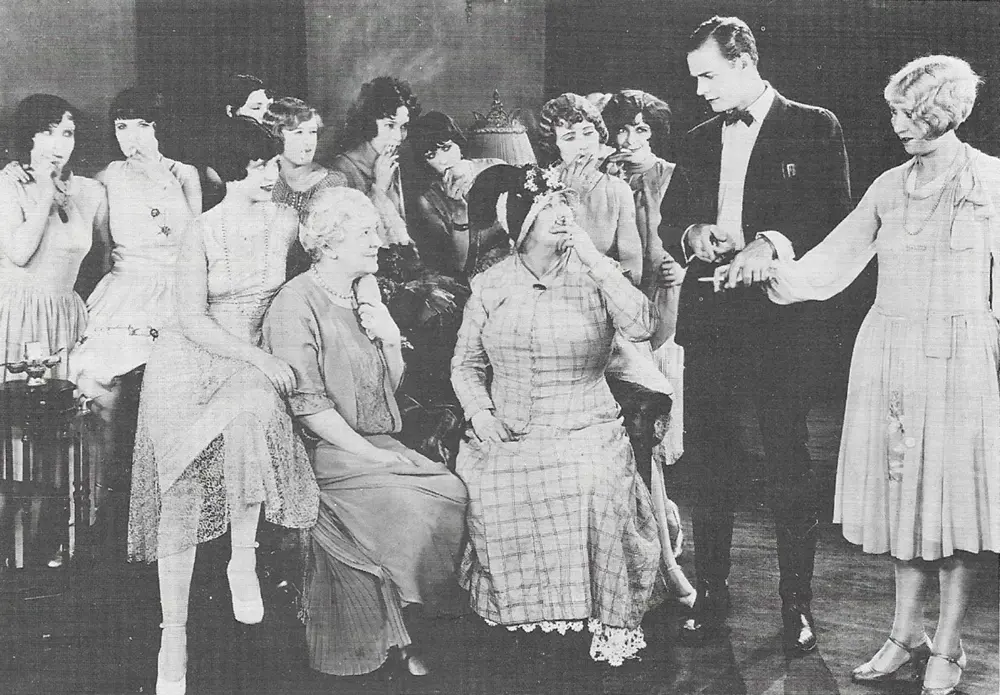
Cinematography, constrained by the technology of the era, still manages to evoke a sense of place. The black and white photography, far from being a limitation, enhances the stark beauty of the natural settings. The way sunlight catches the dust kicked up by horses, or the deep shadows cast by figures against a barren ridge, creates a visual texture that is uniquely of its time. While certainly not on par with the visual poetry of a film like The Mutiny of the Bounty (even an early version) or the more elaborate productions of the late silent era, it possesses an honest, unvarnished aesthetic.
However, it’s worth noting the limitations. Close-ups are often functional rather than artistic, used to emphasize emotion or a key prop. Camera movement is minimal, largely static, letting the action unfold within the frame. This can lead to a certain flatness, but it also forces the viewer to appreciate the composition of each shot as a tableau. It works. But it’s flawed.
The pacing of The Cyclone Cowboy is surprisingly brisk, especially for a film of its vintage. Silent films often relied on a quicker rhythm to maintain audience engagement without dialogue, and this Western is no exception. The narrative moves from introduction to conflict, through rising action, and to its inevitable climax with an almost relentless forward momentum. There's little time wasted on introspection or lengthy exposition; the story is told primarily through action and visual cues.
The tone is one of heroic adventure, tinged with a clear sense of moral urgency. There's no ambiguity here. Buck Rollins is good, Silas Thorne is bad, and the stakes are clear: land, water, and the very survival of honest folk. This unclouded morality is a defining characteristic of many early Westerns, providing a comforting, if simplistic, worldview. It’s a world where justice, though often delayed, will ultimately prevail through the grit and determination of a lone hero. This straightforwardness is, perhaps, its most endearing quality for those looking to escape the complexities of modern cinema.
Yes, The Cyclone Cowboy is worth watching today, but only if you approach it with the right mindset. It is not a film that will captivate a casual viewer accustomed to the high production values and intricate narratives of contemporary cinema. Its appeal lies firmly in its historical context and its pure, unadulterated commitment to the foundational tropes of the Western genre.
For those interested in how the Western evolved, or for anyone who enjoys the raw, visceral charm of silent films, this movie offers genuine insight. It's a testament to the power of visual storytelling before sound became dominant, showcasing how emotions and plot could be conveyed through movement, expression, and the sheer force of a compelling archetype like the 'Cyclone Cowboy' himself. It’s a piece of history, and like any good historical artifact, it demands a certain level of appreciation for its origins and its place in the grand tapestry of film.
One surprising observation is how little the core narrative structure of the Western has actually changed since films like The Cyclone Cowboy. While the execution has become infinitely more sophisticated, the fundamental beats – the lone hero, the encroaching villain, the community in peril, the climactic showdown – remain remarkably consistent. It speaks to the enduring power of these myths, suggesting that certain stories, particularly those about justice and freedom, are hardwired into our collective consciousness. This film, in its simplicity, lays bare that timeless framework with startling clarity. It’s almost a template.
The Cyclone Cowboy is not a film for everyone, nor does it pretend to be. It is a product of its time, a foundational text in the grand narrative of the American Western. For those willing to engage with its historical context and appreciate its unvarnished charm, it offers a deeply satisfying, if simplistic, cinematic experience. It’s a film that reminds us where it all began, stripping away the layers of complexity and polish that would come later, to reveal the raw, beating heart of a genre.
I argue that its very datedness is its greatest asset. It forces a viewer to consider the evolution of storytelling, the impact of technology, and the enduring power of myth. While it might not be a "good" film by contemporary metrics of sophistication and nuance, it is undeniably an important one. It's a dusty old photograph that, upon closer inspection, reveals a vivid, if faded, portrait of a bygone era. Don't expect My Hero! or even Pals First in terms of dramatic flair; expect a straightforward, earnest adventure that laid the groundwork for countless Westerns to follow. It’s worth the journey, if you’re prepared for the ride.
IMDb 6.6
1935
Community
Log in to comment.