DbcultAccessing Vault...
Cult Review
Senior Film Conservator
In the annals of early cinema, certain films emerge not just as entertainment, but as profound sociological documents, capturing the zeitgeist of an era while plumbing the depths of the human condition. Rupert Hughes's "The Danger Signal" stands as one such compelling artifact, a surprisingly nuanced character study cloaked in the guise of a dramatic narrative. It invites us into the desolate inner world of Danny Canavan, a towering figure whose physical presence belies a soul fractured by relentless emotional abuse. This isn't merely a story of one man's misfortune; it's a stark examination of societal pressures, the corrosive power of familial contempt, and the quiet, often unacknowledged struggle for self-worth in a world that seems determined to deny it.
From the outset, Danny's life is presented as a suffocating tableau of oppression. As the "big son" of an Irish-American blacksmith, he is expected to embody strength, resilience, and an unyielding masculinity. Yet, this expectation is a cruel irony. He is not the stoic, unyielding patriarch his father demands; instead, he exists as a punching bag, both literal and metaphorical. His father's scorn, sharp as any chisel, carves away at his spirit daily, while the employees, perhaps sensing his vulnerability, echo their master's disdain. But it is his wife, whose constant haranguing and dismissive demeanor, that delivers the most insidious blows, chipping away at his dignity with every cutting remark. This isn't just domestic discord; it's a systematic emasculation, a slow, agonizing process that leaves Danny hollowed out, a shadow of the man he could be. The blacksmith's forge, a place of immense power and creation, becomes a symbol of his entrapment, a crucible where his spirit is not tempered but broken.
The narrative, however, refuses to condemn Danny to this perpetual state of misery. A sudden, jarring incident shatters the monotonous rhythm of his suffering and unexpectedly sets him on a path towards an unforeseen redemption. One day, while navigating the chaotic urban landscape, Danny is tragically struck by a carriage belonging to Rodman Cadbury, the formidable president of an insurance company. This accident, far from being just another misfortune, serves as a brutal yet necessary turning point. It incapacitates him, stripping him of his ability to perform the physically demanding work of a blacksmith. In a cruel twist, his wife seizes upon this new vulnerability, weaponizing it against him with renewed fervor, using his inability to work as a constant point of derision and scorn.
The irony here is palpable: what appears to be a debilitating setback, an exacerbation of his already dire circumstances, ultimately frees him from the very chains that bound him. The blacksmith's hammer, once a symbol of his expected prowess but also his servitude, is now beyond his grasp. This forced detachment from his inherited fate, while initially a source of immense shame and further abuse, subtly begins to loosen the psychological shackles that have held him captive. The collision, therefore, is not merely a physical event; it’s a symbolic shattering of his old life, paving the way for a metamorphosis that neither he nor those around him could have ever anticipated. One might draw a parallel to the transformative power of crisis seen in films like The Price of Crime, where individuals are forced to confront their circumstances head-on, leading to profound shifts in character.
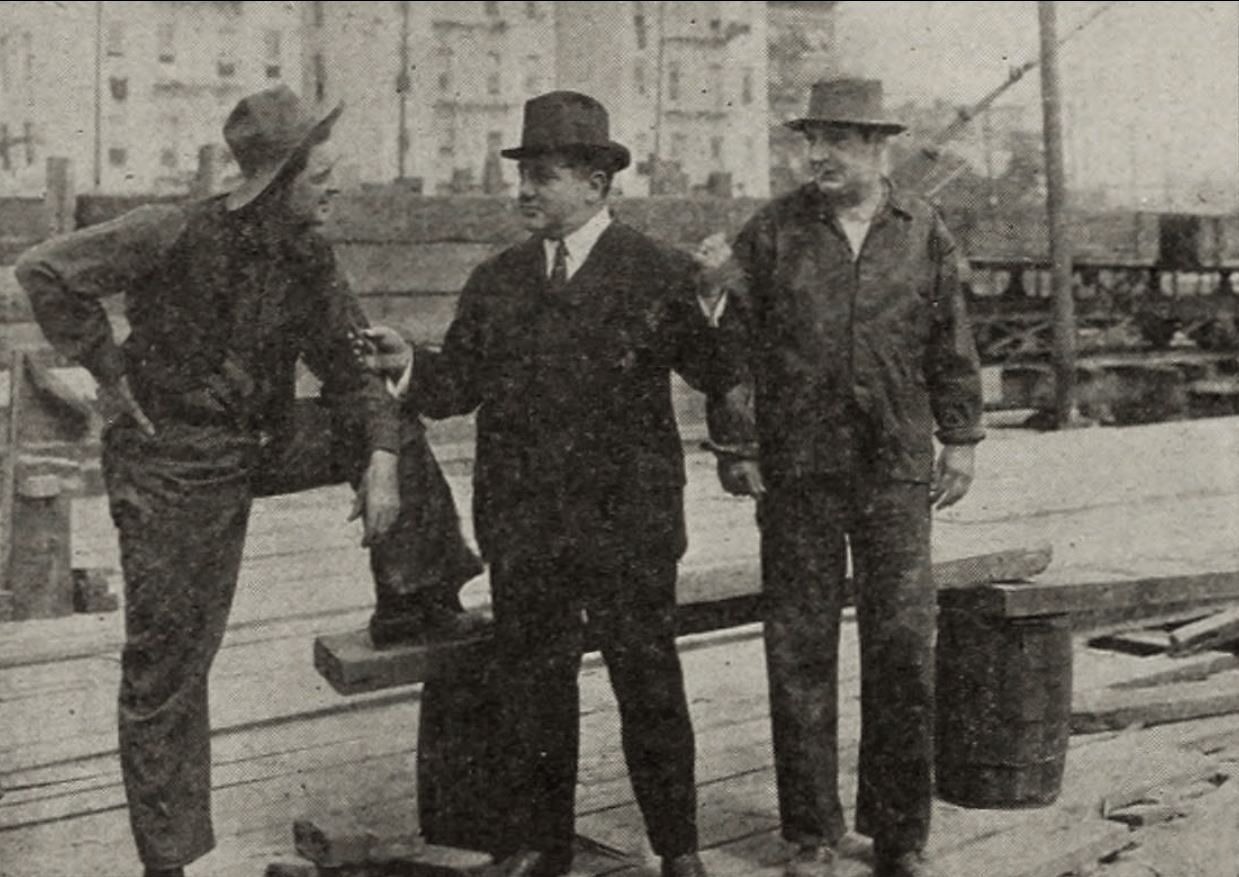
Unable to continue his trade, Danny finds himself adrift, until he secures a seemingly menial position on the subway as a flagman. His duty: to warn traffic of upcoming dynamite blasts. On the surface, this job appears to be a demotion, a fall from the perceived dignity of a skilled laborer to a mere signal-bearer. Yet, this is where the genius of Hughes's narrative truly shines. Far from being a further descent, this unassuming role becomes Danny's unlikely sanctuary, a crucible for profound self-discovery. Removed from the toxic environment of his home and the forge, he is suddenly endowed with a quiet, yet critical, responsibility. He is no longer defined by his physical strength, nor by the expectations of others, but by his vigilance, his attention to detail, and his capacity to protect.
The act of holding that flag, of signaling danger and ensuring safety, imbues Danny with a sense of purpose he had never known. The rhythmic clang of the blacksmith's hammer is replaced by the rumble of the subway and the distant echo of explosions, sounds that, ironically, bring him a strange sense of peace and agency. He becomes a guardian, a silent sentinel, and in this newfound role, a quiet dignity begins to blossom within him. The film subtly suggests that true strength lies not in physical dominance, but in responsibility, in contributing to the common good, and in the quiet resolve of one's character. This transformation is a testament to the idea that sometimes, the most profound changes occur not through grand gestures, but through the patient, diligent execution of seemingly small tasks. It's a powerful counter-narrative to the societal pressures of the time, where a man's worth was often tied directly to his physical labor and his ability to provide in a traditionally masculine way.
The effectiveness of "The Danger Signal" hinges significantly on its cast, who, despite the stylistic conventions of early silent film, manage to convey a remarkable depth of emotion. While specific details about individual performances are often lost to time or overshadowed by the broader narrative, the ensemble collectively contributes to the film's poignant atmosphere. John Davidson, presumably in the role of Danny Canavan, must have conveyed the crushing weight of his character's initial despair and the subtle, slow unfurling of his inner strength. His physical presence, as described, would have made his emotional vulnerability all the more striking. Florence Coventry and Ruby Hoffman, likely portraying the wife and perhaps another significant female figure, would have been tasked with embodying the abrasive forces that shape Danny's torment, demanding a nuanced portrayal that avoids caricature.
The supporting cast, including Della Connor, Arthur Hoops, William Sherwood, Frank Belcher, and Tom Walsh, would have filled out the world of the blacksmith shop and the burgeoning industrial landscape, lending authenticity to Danny's surroundings. Rupert Hughes's writing, though translated through visual storytelling, clearly prioritizes character development and thematic depth. His ability to craft a narrative where a seemingly minor accident leads to such profound personal growth speaks volumes about his storytelling prowess. The film, in its quiet exploration of Danny's internal world, echoes the societal discussions of individuality and personal agency that were also finding voice in works like Your Girl and Mine: A Woman Suffrage Play, albeit from a different perspective on societal roles and expectations.
At its core, "The Danger Signal" is a profound exploration of masculinity in crisis and the redemptive power of self-reliance. Danny's journey challenges the traditional notions of what it means to be a "man" – not through brute force or dominance, but through quiet perseverance and a commitment to duty. The film skillfully navigates the often-unspoken trauma of emotional abuse, demonstrating its insidious capacity to erode one's sense of self. It highlights the often-overlooked struggles of the working class in an era of rapid industrialization, where individuals could easily become cogs in a larger, impersonal machine. Danny's transfer from the artisan's forge to the anonymous, yet vital, role of a flagman reflects a broader societal shift, where the individual's worth was being redefined by the demands of a modernizing world.
Moreover, the film's title itself holds significant symbolic weight. "The Danger Signal" is not just about the literal warnings Danny gives on the subway; it's a metaphor for the warning signs in his own life, the signals of his escalating despair, and ultimately, the signal of his awakening. It's a reminder that sometimes, the greatest dangers are internal, and the most crucial signals are those we send to ourselves, acknowledging our needs and taking steps towards healing. The transformation of Danny is not a sudden, cinematic epiphany but a gradual, believable process, demonstrating the slow, arduous work of rebuilding a shattered psyche. This nuanced approach to character development sets it apart from more melodramatic contemporaries, allowing its message to resonate with a quiet, enduring power. It speaks to the universal human desire for purpose and recognition, especially when one feels utterly invisible.
While details of the cinematography are scarce, one can surmise that the visual language of "The Danger Signal" would have played a crucial role in conveying Danny's internal state. The grim, perhaps claustrophobic, atmosphere of the blacksmith's shop would contrast sharply with the expansive, open-air environment of the subway tracks, symbolizing his newfound freedom and perspective. The visual motif of the flag, a simple piece of cloth, becomes powerful in Danny's hands, representing his agency and his vital connection to the safety of others. This visual transformation from a man constantly under pressure to one who holds a position of quiet authority is fundamental to the film's impact.
In conclusion, "The Danger Signal" is far more than a period piece; it is a timeless narrative about the human spirit's capacity for resilience. It reminds us that dignity can be found in the most unexpected places and that personal transformation often springs from adversity. Danny Canavan's journey from a broken man to a quiet guardian is a powerful testament to the idea that even when life deals its harshest blows, there remains an opportunity for self-reclamation. It's a film that, despite its age, speaks volumes about the enduring human quest for purpose, respect, and the courage to redefine one's own destiny, making it a compelling watch for anyone interested in the depths of early cinematic storytelling and its timeless themes.
IMDb 6.5
1929
Community
Log in to comment.