DbcultAccessing Vault...
Cult Review
Senior Film Conservator
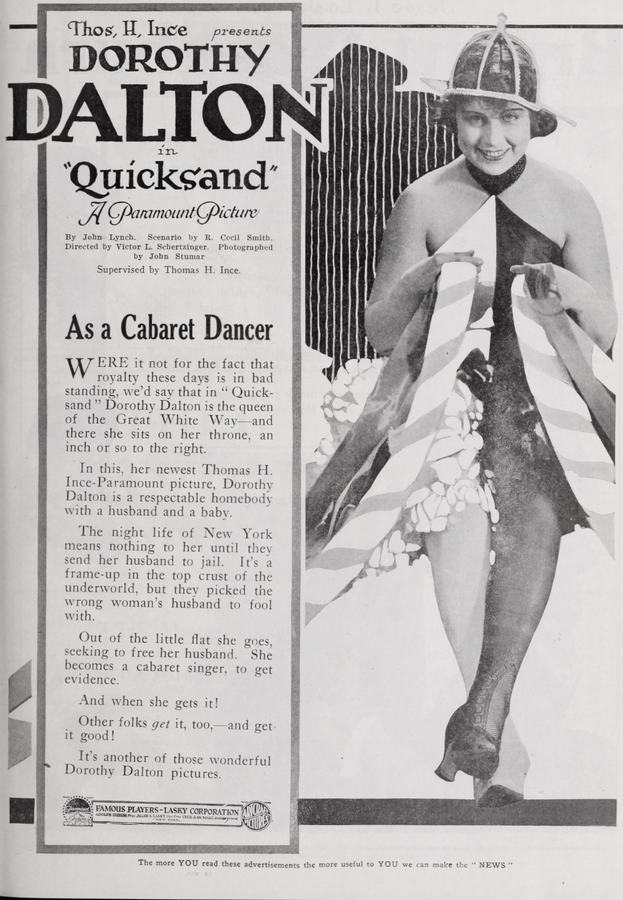
There is a moment, early in Quicksand, when the camera lingers on Jim Bowen’s ink-stained fingers as he tallies another day’s receipts; the celluloid seems to inhale the very scent of ledger paper, and in that hush you sense the fragile membrane separating respectability from ruination. One blot, one smudge, and the whole arithmetic of bourgeois comfort dissolves into a maw of accusation. Director John Lynch—working from R. Cecil Smith’s sinewy scenario—understands that the true villain is not merely Alan Perry’s dissolute grin but the invisible quicksand of class leverage: the power to forge reality itself, to turn a clerk’s diligence into evidence of graft.
Lynch’s visual grammar is less the stately tableaux of 1910s melodrama than the twitchy chiaroscuro that would later seduce Lang and Wilder. Note the sequence where Mary, played by Dorothy Dalton with a combustible mix of rectitude and recklessness, first descends into John Boland’s cabaret. The camera tilts slightly, as though the world itself has lost its moral plumb-line; cigarette haze swirls like ectoplasm around saxophones that bleat sour promises. Dalton’s eyes—two shards of obsidian—reflect every predatory smile in the room, yet she advances, a reluctant Amazon armed only with necessity.
The film’s racial memory of post-war America seeps through its intertitles: references to "liberty bonds" and "confidence men" root the narrative in a nation still tallying the cost of its own promotional rhetoric. Jim’s imprisonment is staged in a panopticon whose upper tiers dissolve into darkness; inmates’ faces emerge from the murk like half-remembered statistics. Here, Lynch anticipates the expressionist penitentiaries of The Grasp of Greed and even the cavernous courtrooms in Murnau’s phantom fables. Yet the film never succumbs to Teutonic gloom; instead, it pulses with a distinctly American velocity—swift, merciless, enamored of the getaway.
Edward Coxen’s Jim Bowen is a marvel of calibrated panic. His body, once habituated to the repetitive calm of an adding machine, now vibrates at a frequency that threatens to splinter bone. Watch the way his shoulders ride up toward his earlobes when the prison gate clangs; the sound is not on the soundtrack (there is none) yet you hear it through the cartilage of his posture. Coxen belongs to the school of anatomical acting, where sinew and tendon do the talking. Compare him to Henry A. Barrows’s Boland, a political fixer whose corpulence is itself a form of bribery; Barrows moves through space like a man test-driving his own coffin, every handshake a down-payment on silence.
Philo McCullough’s Alan Perry is the idle filament that ignites the whole powder keg. With his lounge-lizard grin and cigarette holder cocked at a jaunty sin angle, Perry embodies what Fitzgerald would soon dub the "careless people." McCullough has the gift of conveying moral stench through charm; when he leans toward Mary in the cabaret, the space between them seems to blister. His eventual confession—wrung from him not by jurisprudence but by the spectacle of his own blood—carries the sickly catharsis of watching a peacock devoured by foxes.
Dorothy Dalton, alas, remains criminally under-discussed in the pantheon of silent sirens. Where Swanson traded on opulence and Gish on virginal luminosity, Dalton specialized in the thermodynamics of desperation: the moment when a woman realizes that decorum is a luxury she can no longer invoice. Her Mary Bowen is no suffering footstool; she orchestrates her own undercover operation, weaponizing the male gaze until it recoils on itself. In one electrifying close-up, Dalton’s pupils dilate to absorb the reflected glow of a police badge—an image that condenses the entire moral arc into a single black hole.
The screenplay, attributed to Smith and Lynch, is a jagged poem of economic anxiety. Notice how every transaction—be it a forged check, a cabaret tip, or a bribe—functions as a social ECG, tracing the arrhythmic heart of capitalism. The titular "quicksand" is not merely metaphoric; it is the liquidity of value itself, that moment when paper promises turn to sludge beneath your shoes. In this, the film dovetails with the contemporaneous Danish thriller Professor Nissens seltsamer Tod, where scientific rationality likewise drowns in fiscal murk.
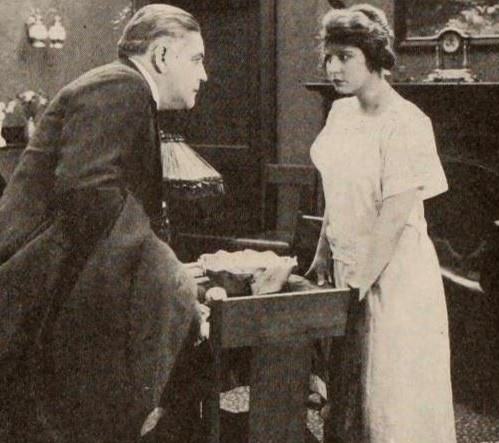
Technically, the picture flaunts several bravura flourishes. A dolly shot—virtuosic for 1920—tracks Mary through the cabaret’s gantlet of tables, the camera itself seeming to pant in sync with her heartbeat. Elsewhere, a double-exposure dream shows Jim shackled to a giant fountain pen that drips not ink but molten gold, a surreal indictment of the alchemy that transmutes handwriting into wealth. The tinting strategy is equally eloquent: nocturnal scenes bathe in cerulean, while domestic interiors bask in amber, as though home were a perpetually sunlit lie.
Yet for all its visual bravura, Quicksand is most piercing in its sonic absence. The silence forces us to become auditors of gesture: the rasp of Perry’s glove as he twists Mary’s wrist, the hush of fabric when Boland collapses. I first screened the film at a rep cinema where the accompanist improvised a minimal motif—two dissonant chords that never resolved. That unresolved tension is the film’s true score, aural quicksand that swallows every reassurance.
Comparative contextualization enriches the experience. Fans of Camille (1915) will recognize the lethal calculus of desire and debt, though Quicksand replaces consumptive glamour with actuarial dread. Likewise, the film’s proto-noir DNA anticipates the bureaucratic nightmares in The Scarlet Sin and the colonial guilt seething beneath Uncle Tom’s Cabin (1918). Even the Antipodean caper The Hayseeds’ Melbourne Cup shares this film’s conviction that horseplay and high finance are estranged siblings.
Restoration status remains spotty. The surviving 35 mm print, housed in the Library of Congress, bears the scars of nitrate burnout—gashes that flicker like lightning across Perry’s confession scene. Some cinephiles argue these scars enhance the film’s theme of moral corrosion; others lobby for digital interpolation. I side with the scars. Let the emulsion carry its own stigmata.
Reception history offers a cautionary parable. Trade papers of 1920 praised the film’s "nerve-jangling realism" yet box-office returns were hobbled by a concurrent scandal: the star’s divorce proceedings eclipsed the picture’s publicity cycle. Thus Quicksand sank into the very obscurity it dramatized, a victim of the same gossip economy that Perry exploits within the narrative. The irony is almost obscene.
Contemporary resonances proliferate. In an era when algorithmic credit scores determine life trajectories, Jim’s plight feels less antique than prophetic. The film whispers that innocence is no longer a static trait but a commodity whose value can be shorted by those who hold the ink. Every time a data broker sells a dossier, a new Alan Perry smiles.
So, is Quicksand a masterpiece? The term feels brittle, too monumental for a film that thrives on its own granular instability. Call it instead a fever chart of American vertigo, a blueprint for how quickly the ground can liquefy beneath the ostensibly secure. It will not comfort you, nor will it deliver the cathartic purge of a courtroom triumph. What it offers is more unnerving: the recognition that acquittal is not the same as exoneration, that a name scrubbed clean still smells of the stain.
Watch it, then, at 2 a.m. when the city outside your window hums like a distant cabaret. Let the silence pool around your ankles. Feel the slow drag of something wet and greedy. When the final intertitle fades, you may find yourself checking your own signature—just to be sure the ink has not begun to spread.
IMDb —
1920
Community
Log in to comment.