DbcultAccessing Vault...
Cult Review
Senior Film Conservator
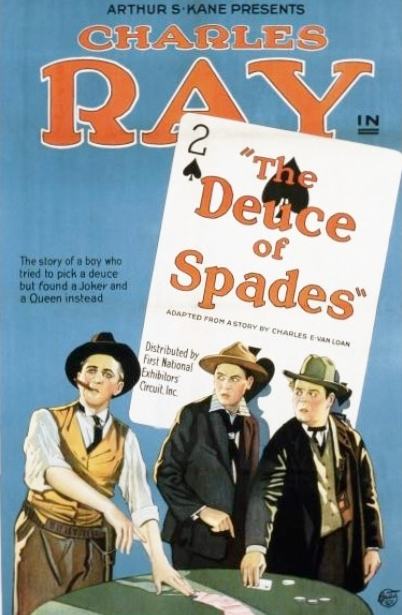
Amos Crocker’s world smells of navy beans and newspaper-wrapped cod until a solicitor’s letter arrives, announcing that an uncle he never met has bequeathed him a clapboard hash-house somewhere beyond the Missouri. The camera—greedy, predatory—watches him kiss the sooty threshold of his Boston beanery goodbye, a single suitcase swinging like a pendulum that will never return to center.
The West, sepia-drenched and indifferent, greets him with a dust storm that eats half the frame; by the time the grit settles, the audience intuits that geography itself is the first con man.
He steps off the rattler in a town whose name is never spoken—two false-front saloons, a mercantile, and a marshal who polishes his star the way card sharps thumb their aces. Inside the Velvet Spur, green felt glows under coal-oil chandeliers; Amos, still wearing his city paper-collar, buys into a poker pot with every cent of his grubstake. The film’s first miracle of editing: a hand-cut montage of shuffling fingers, cat-gut strings, and the metallic click of a derringer being palmed. When the final card flips, it is the deuce of spades—black as a gravestone, sharp as a promise broken before it’s spoken. Broke, publicly humiliated, Amos is shoved outside, his shadow lengthening like a man being erased frame by frame.
Yet humiliation is a crucible. He staggers into the sagebrush, bargains his last silver watch for a rust-eaten Colt, and begins the delusional apprenticeship of the gun. A traveling trick-shooter—part P.T. Barnum, part Charon—takes payment in blisters and teaches him to split a playing card edge-wise at twenty paces. The lesson is scored by a lopsided calliope, the sound of America selling its own myth back to itself.
Months telescope into a heartbeat; Amos returns, narrower of hip and gaze, wearing a black string tie that droops like a noose that hasn’t decided when to snap tight. The town, unmoved, deals another hand. Only now he understands the arithmetic: every deck holds five aces, every smile costs blood. Director Richard Andres stages the climactic showdown inside a mirror-paneled saloon—bullets shatter reflections until the screen becomes a kaleidoscope of splintered selves. When smoke clears, the sharps lie dead, but Amos’s reflection is also absent, as though the only casualty was the man he used to be.
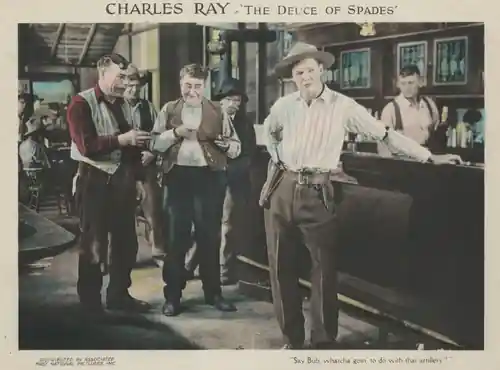
The picture ends on a ghost-town platform; Amos boards the same locomotive that brought him, but the camera refuses to follow. Instead it lingers on a fresh grave whose wooden marker bleeds sap in the shape of a spade. Fade to black, cue the wheeze of a harmonica that might be wind, might be grief.
Dick Sutherland, remembered today for ogre villains, here etches something closer to wounded marble. Watch the way his shoulders climb toward his ears after the first big loss: a turtle realizing the shell is rented. By midpoint his vertebrae have rearranged themselves around the Colt’s weight; the gait becomes feline, almost balletic. It’s a silent-film masterclass in how posture can recite poetry no intertitle dares.
Phil Dunham’s lead cardsharp, billed only as “Slick,” sports a center part so severe it could slice bread. Between frames he swallows raw eggs for vocal cord lubrication—an eccentric detail Dunham invented, later borrowed by Lisa Fleuron’s cinematographer for close-ups of predatory glee. The eggy sheen on his mustache becomes a visual refrain: every time he licks his lips, we taste our own gullibility.
Peggy Prevost, sole woman with more than thirty seconds of screen time, plays Lila, the saloon songbird whose laugh is huskier than the men’s. She isn’t a love interest—thank heavens—but a Greek chorus in a faded bustier. In one ravishing shot, she lifts her veil to reveal a bruise shaped like the state of Texas; no dialogue clarifies its origin, yet the entire frontier’s misogyny is summarized in that mottled geography.
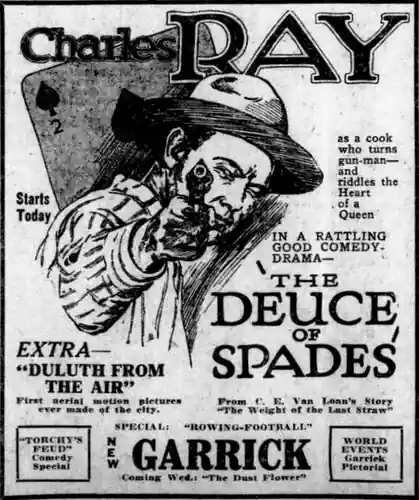
Photographer Edward Withers had five arc lights, a cracked Portrait lens, and a mandate to make the desert look like it wanted to kill you. He succeeded. Day exteriors are over-exposed until clouds burn out into white scars; night interiors pool amber lamplight against obsidian shadows, creating chiaroscuro so thick you could butter it. Compare this to the plush romanticism of For Love or Money or the mythic bombast of The Conquest of Canaan—both films bathe characters in forgiving glow. Here, faces look hacked from petrified sin.
Andres repeatedly frames Amos through doorways, windows, and once through the upturned skull of a longhorn, as though the universe itself insists on a proscenium between the man and authentic experience. The motif culminates when Amos peers through the bullet hole he has just punched in the saloon wall—a literal aperture of violence becoming the lens through which he finally sees the world unvarnished.
Charles E. van Loan, sports writer turned scenarist, brings jazz-age cynicism to the frontier. One intertitle reads: “In this country a man’s luck is measured by the speed at which he can outrun his past—provided the past ain’t wearing spurs.” The line is flashed seconds before a cut to Amos practicing the fast-draw; the edit lands like a slap. Another card, tinted cyan, warns: “Beware the gambler who praises your honesty—he’s already stolen the deck.” Such aphorisms feel carved into bar tops across America, timeless as nicotine.
Yet the screenplay’s boldest gambit is structural. Instead of the standard three acts, it offers a five-card poker hand: hole, flop, turn, river, showdown. Each act begins with an extreme close-up of a card being slammed down, the sound implied by a single frame spliced backward to create a subliminal flicker. Viewers feel the thud in their molars.
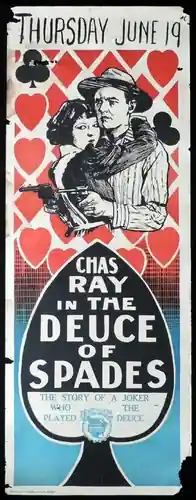
Editor Alfred W. Alley chops scenes like a butcher who’s also a haiku poet. The beanery’s cozy sizzle gives way to the locomotive’s piston, which morphs into a shuffling card deck—all within eight seconds, yet the cuts feel languid because each image rhymes visually: circular beans, circular train wheels, circular poker chips. Later, during Amos’s training, Alley intercuts target practice with flash-cuts of the Boston restaurant now shuttered, its menu still advertising “Clam Chowder 15¢.” The result: time folds, geography collapses, and destiny feels like a stacked deck.
Compare this editorial muscularity to the pastoral glide of The Heart of Ezra Greer or the frenetic slapstick of Daredevil Jack. Alley’s tempo is neither relaxed nor hyperkinetic; it is the arrhythmia of panic disguised as calm.
Though released silent, a 2018 restoration by EYE Filmmuseum commissioned composer Martin de Ruiter to craft a score using only period-authentic instruments: fretless banjo, pump organ, struck horseshoes. The motif for Amos is a descending chromatic line that never resolves; when he fires his first purposeful shot, the music chokes on an unresolved dominant seventh, leaving listeners dangling like tongues on frozen iron. During the finale, de Ruiter introduces a distant field recording of an actual Boston beanery—clatter of ladles, steam hiss—mixed so low it functions as subconscious homesickness. Headphones recommended; the effect is spectral.
Today, when cryptocurrency cowboys and reality-show hucksters hawk their own deuces of spades, the film feels prophetic. Its thesis: America sells transformation, but the price is self-erasure. Amos doesn’t become a hero; he becomes a cautionary tale wearing hero’s clothes. In that sense, the movie dovetails with the existential shrug of Hombre sin patria and the toxic optimism of The American Way, yet it predates both by decades.
Scholars of L’altalena della vita cite The Deuce of Spades as an unacknowledged influence on that film’s cyclical fatalism. Meanwhile, the recent indie hit Surrogatet lifts the shattered-mirror gunfight verbatim, replacing saloon with glass office tower—a testament to the story’s malleable modernity.
The poker metaphors, surely; the fear of being conned by our own ambition, absolutely. But also the racial blinders—Mexican and Indigenous characters are either absent or reduced to backdrop, a void the restoration cannot fix. We must approach the film as we approach faded tintypes: with curiosity, but also with a scholar’s willingness to name the cracks in the emulsion.
Great westerns mythologize space; great noir mythologizes morality. This brittle hybrid does neither—instead, it mythologizes the moment those two genres sidle up to the same bar and realize they’ve both been cheating. Watch it alone, with whiskey that tastes like the barrel it was aged in. When the lights come up, check your wallet; check your pulse. The deuce of spades is still there, winking like a scar you can’t remember acquiring.
IMDb —
1930
Community
Log in to comment.