DbcultAccessing Vault...
Cult Review
Senior Film Conservator
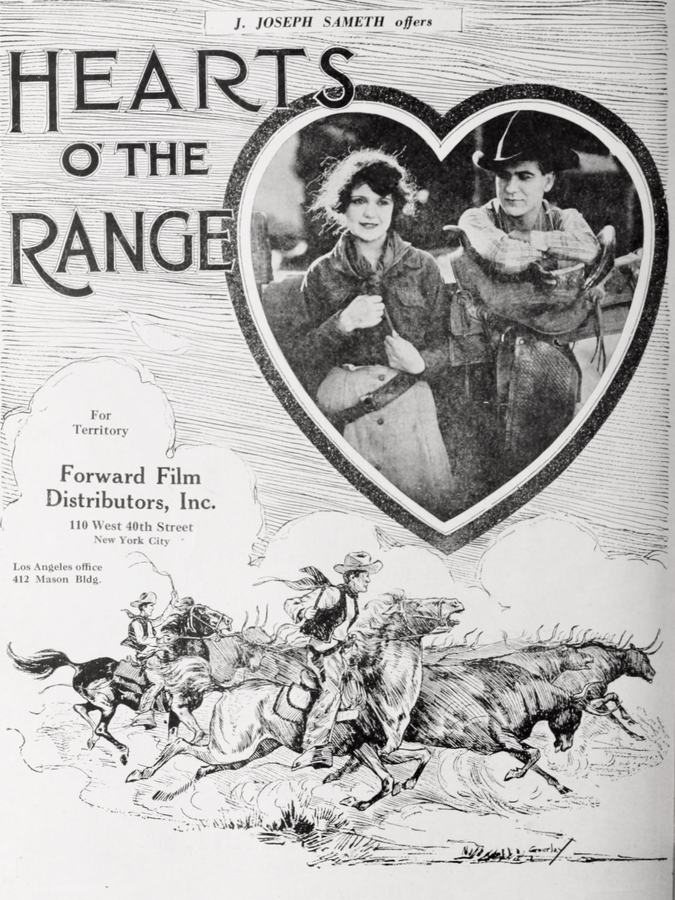
Victor Gibson’s Hearts o’ the Range arrives like a pocket-sized apocalypse: a 50-minute reel that distills the entire emotional algebra of the frontier—greed, honor, and the vertiginous drop-off—into intertitles flickering like Morse code from the unconscious. There is no fat on its bones; every iris-in feels like a gunfighter narrowing his eyes.
Forget the nickelodeon shorthand you expect from 1920; this is a tale that understands rustling as metaphysical rot. Beldon—played with granite-jawed minimalism by Charles Frohman Everett—is less a foreman than an archangel sent to purge Squaredeal’s Eden of its serpentine accountant, Cole (Alfred Hewston, oozing velvet malice). The cease-fire that follows Beldon’s arrival is not narrative convenience; it is the silence after an exorcism.
Yet the film’s true engine is money: a paper serpent coiled in a saddlebag. When Squaredeal—half-blind patriarch and walking embodiment of Manifest Destiny—presses the cash into Beldon’s palm, the gesture carries Old-Testament weight: from this moment forward, the foreman is both steward and scapegoat. The subsequent abduction and shack-bound tension play like a Stations-of-the-Cross rendered in tungsten and shadow.
Cinematographer Milburn Morante (pulling double duty as comic cowpoke) shoots the buttes at dawn so that every mesquite spine becomes a quill dipped in arterial light. Interiors are Caravaggio-dim: a kerosene lantern throws Beldon’s profile onto warped pine like a Wanted poster signed by Satan. The shack sequence—cut with Eisensteinian acceleration—uses match-cuts between Beldon’s rope-burned wrists and Cole’s sneering mug to fuse torment and triumph into a single sinew.
“Violence here is not spectacle; it is liturgy—a staccato hymn sung with fists and gravity.”
Alma Rayford, as Squaredeal’s daughter, owns the most modern face in the picture: her gaze carries the skeptical shimmer of Clara Bow blended with the proto-feminist steel of Just a Wife’s put-upon heroine. She never simpers; she calculates. Watch her pocket the derringer before the ill-fated bank run—an act so casually inserted it feels subversive.
Everett’s Beldon, meanwhile, operates on the Buster Keaton principle: the less he emotes, the heavier the moral tonnage. When he finally hurls Cole off the precipice, the stunt is framed in wide shot—no under-cranking, no trickery—so that the villain’s tumble becomes a Newtonian equation: betrayal plus gravity equals absolution.
Contemporary viewers, marinated in Dolby thunder, may scoff at the idea of tension without decibels. But listen—truly listen—to the phantom soundtrack your brain supplies: the brittle crack of cedar kindling, the wet rasp of rope on skin, the metallic shhhk of a Colt being drawn. The intertitles—laconic, diamond-cut—refuse exposition bloat: “Cole laughed—then the mountain remembered.” Ten syllables that carry the karmic payload of a Greek chorus.
Gibson’s screenplay borrows the moral Manichaeism of The Hiding of Black Bill yet infuses it with the domestic fatalism you’d expect from a Lorca tragedy. Note the dinner scene where Beldon, invited to break cornbread with the rancher’s daughter, hesitates—one beat too long—before accepting. The moment is less about etiquette than transgression: the hired hand fears that to dine is to desire, and to desire is to invite the same catastrophe that befell The Midnight Wedding’s luckless lovers.
Unlike the ornamental heroines of Mohini Bhasmasur or The Clients of Aaron Green, Rayford’s character owns narrative agency. She engineers the search party, brandishes the rifle, and—crucially—believes Beldon’s innocence before any male does. In 1920, that is revolution disguised as romance.
Stack Hearts against Alias Jimmy Valentine’s urban penitential swagger and you see two divergent moral universes: the city allows reinvention; the range demands blood ledger. Contrast it with A Manhattan Knight’s art-deco cynicism and the film’s prairie Puritanism feels almost medieval—yet its emotional transparency is closer to Gräfin Küchenfee’s folkloric candor than to any cowboy serial of its day.
The surviving print—unearthed in a decommissioned church in Osage County—bears scuffs like shrapnel scars. Some reels are vinegar-syndrome amber, others ghost-grey. Yet the defects amplify authenticity: every scratch is barbed wire; every missing frame is a heartbeat skipped. Restoration teams have resisted the temptation to over-polish, wisely leaving the patina intact—unlike the garish tinting that mars certain reissues of The Fox Woman.
Modern festivals often accompany the picture with a live trio—banjo, pump organ, single snare—channeling the jug-band anarchism of Daddy Ambrose. The tempo accelerates at each narrative node: 80 BPM for pastoral lulls, 140 BPM for the shack escape, then an abrupt drop to dirge-time as Cole free-falls. The audience, complicit, finds itself stomping in communal arrhythmia.
Read the film as Calvinist parable: Squaredeal’s ranch is a microcosm of the Elect, Beldon the predestined protector, Cole the reprobate whose fall is forewritten before the first reel. Yet Gibson muddies the doctrine—Beldon’s mercy toward a rattlesnake early on hints at Arminian cracks in the TULIP. The final frame, where Beldon and the girl ride toward a sunrise that looks suspiciously like blood diluted by dawn, suggests salvation is earned, not decreed.
Today, when algorithmic Westerns regenerate clichés faster than a Gatling gun spits lead, Hearts o’ the Range reminds us that myth is not a template but a wound—one we reopen each time we wonder how much of ourselves we must sell to keep the rustlers at bay. It is the missing link between Alice in Wonderland’s dream logic and The Silent Battle’s trench-fatigue nihilism.
Is the film flawless? Hardly. The comic interludes with Morante’s buffoon sidekick feel grafted from a two-reeler, and a continuity jump during the cliff sequence momentarily swaps Beldon’s bandanna from scarlet to dusty rose—an editing hiccup that would scandalise a modern continuity supervisor. Yet these scars humanise the artifact, the way a stutter renders a poet more trustworthy.
What endures is velocity of conscience: the way the picture insists that morality, like a horse, must be ridden hard and put away wet. In an era when every frame of entertainment is focus-grouped into narcotic neutrality, Hearts o’ the Range burns its brand into your retina with a red-hot iron forged in 1920—and the smoke still smells of sin, sage, and the tremulous hope that somewhere beyond the buttes, justice waits like a campfire whose coals never quite die.
IMDb 6.6
1924
Community
Log in to comment.