DbcultAccessing Vault...
Cult Review
Senior Film Conservator
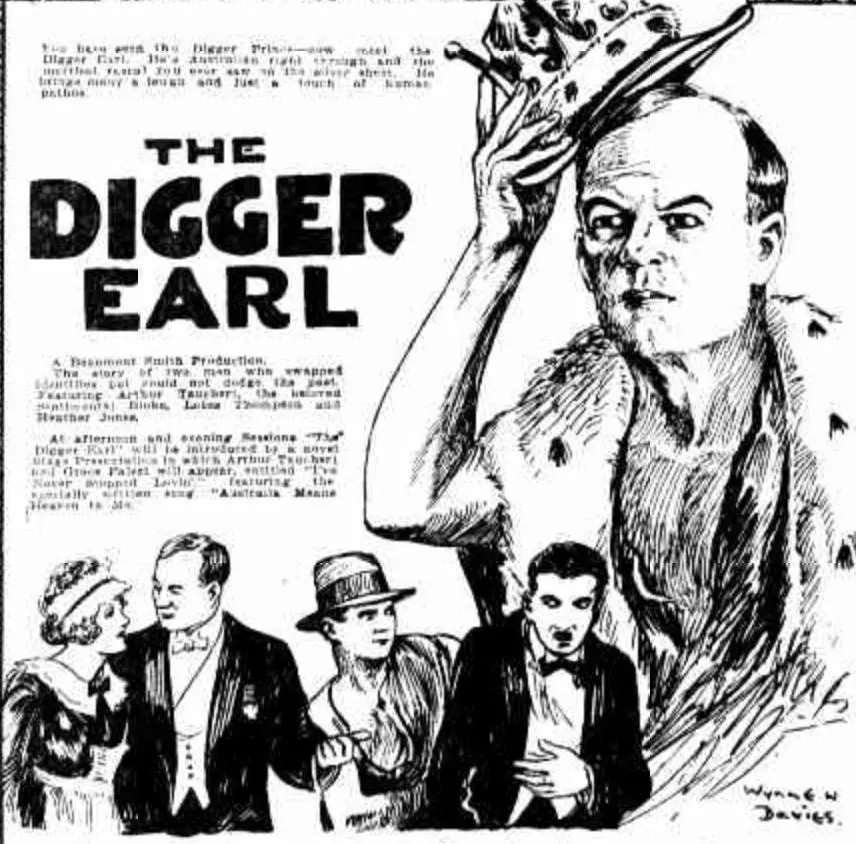
In the annals of silent Australian cinema, few figures loom as large or as industrious as Beaumont Smith. Often referred to as 'one-take Smith' for his legendary efficiency, his 1924 opus, The Digger Earl, remains a quintessential artifact of a nation grappling with its own nascent identity. This isn't merely a film; it is a celluloid time capsule that captures the seismic shifts in social hierarchy following the Great War. While contemporary audiences might initially dismiss it as a lighthearted romp, a closer inspection reveals a work of surprising depth, utilizing the 'fish-out-of-water' trope to dissect the complex relationship between the burgeoning Australian Commonwealth and its colonial progenitor, Great Britain.
The protagonist, Bill, played with a rugged, unpretentious charm by J.P. O'Neill, embodies the 'Digger' archetype—a figure of resilience, laconic humor, and fierce loyalty. When Bill discovers he is the rightful heir to an English earldom, the film shifts from the familiar sun-drenched pastoralism of the Australian bush to the chiaroscuro-laden corridors of an ancestral estate. This transition is handled with a visual sophistication that rivals many international productions of the era, such as The Courtship of Myles Standish, though Smith swaps Puritan austerity for the decadent, often suffocating, trappings of the British upper class.
As Bill and his 'cobber' attempt to navigate this new world, Smith utilizes physical comedy not just for levity, but as a weapon of social critique. Every spilled tea cup and mispronounced title serves to highlight the absurdity of a system built on birthright rather than merit. In this regard, the film shares a spiritual kinship with The Winning Stroke, where physical prowess and inherent character are pitted against the artificiality of high society. The 'Digger' doesn't just enter the aristocracy; he disrupts it, his very presence acting as a catalyst for a broader conversation about what truly constitutes a 'nobleman.'
One cannot discuss The Digger Earl without paying homage to Lotus Thompson. Her performance is a masterclass in silent-era expressive acting, avoiding the histrionics that plagued many of her contemporaries. Thompson possesses a screen presence that is both ethereal and grounded, providing the emotional anchor for Bill’s chaotic journey. Her character is not merely a romantic interest but a bridge between two worlds. Her ability to convey complex internal conflict through a mere tilt of the head or a lingering gaze elevates the film beyond the realm of standard melodrama.
In scenes where she must navigate the predatory social environment of the estate, one is reminded of the tension found in The Girl and the Judge or the moral quandaries explored in The Auction Block. Thompson’s character represents a modern womanhood that was just beginning to assert itself in the 1920s—intelligent, discerning, and unwilling to be a mere pawn in the games of men. Her chemistry with O'Neill is palpable, grounding the film's more fantastical plot points in a relatable human connection.
Technically, The Digger Earl is a triumph of resourcefulness. Beaumont Smith, working with limited budgets compared to his Hollywood counterparts, managed to create a visual palette that feels expansive. The use of natural light in the Australian sequences creates a sense of boundless freedom, which stands in stark contrast to the heavy shadows and ornate compositions used once the action moves to England. This visual dichotomy reinforces the thematic struggle between the 'Old World' and the 'New.'
The editing pace is notably modern for 1924. Smith avoids the static, stage-bound feel of earlier silent works like The Law Decides. Instead, he employs a kinetic energy that reflects the restless spirit of the Digger himself. There is a sequence involving a high-speed chase—or as high-speed as 1920s automobiles allowed—that echoes the visceral thrills of The Speed Maniac, proving that Smith had his finger on the pulse of what audiences craved: spectacle underpinned by character.
When we look at The Digger Earl alongside other contemporary works, its unique position in global cinema becomes even clearer. While German expressionism was exploring the macabre in Die Gespensterstunde or the festive decadence of Fasching, Australian cinema was preoccupied with the construction of a national myth. Smith’s film is less about the ghosts of the past and more about the possibilities of the future. It lacks the cynical edge of Scratch My Back, opting instead for a sincere, if slightly idealized, vision of the Australian character.
Furthermore, the film’s treatment of romance and social climbing offers a fascinating counterpoint to The Loves of Letty. Where 'Letty' focuses on the perils of feminine ambition within a rigid social framework, The Digger Earl suggests that the Australian spirit is inherently incompatible with such frameworks. The Digger doesn't want to climb the ladder; he wants to dismantle it and use the wood for a campfire. This subversive undercurrent is what keeps the film relevant today. It’s a comedy of manners where the manners themselves are the joke.
The supporting cast, including Dunstan Webb and the legendary Arthur Tauchert, provide a rich tapestry of character types. Tauchert, famous for his role in 'The Sentimental Bloke,' brings a grounded authenticity to the screen that anchors the more farcical elements of the plot. The camaraderie between the men feels genuine, a reflection of the 'mateship' that became a defining characteristic of the Australian identity post-1918. This ensemble dynamic is far more successful here than in the somewhat disjointed Cupid Camouflaged, largely due to Smith's clear directorial vision.
Smith’s writing, though broad, possesses a rhythmic quality. The intertitles are peppered with Australian vernacular, which at the time was a bold choice. It asserted the validity of the Australian voice on the global stage. While American films like On the Night Stage were perfecting the grammar of the Western, Smith was creating a new genre: the 'Digger' comedy-drama. It’s a genre that recognizes the trauma of the war—hinted at in the characters' resilience—but chooses to move forward with a defiant grin.
Viewing The Digger Earl today requires a degree of historical empathy. We must look past the occasional flicker of the nitrate stock and the broadness of the comedic beats to see the sophisticated cultural work being done. The film deals with the same themes of sacrifice and societal debt found in The Price They Pay, but it wraps them in a populist package that made it a massive hit in its day. It understood its audience perfectly—a population tired of tragedy and eager to see their own reflection on screen, triumphant and unbowed.
In the broader context of 1920s cinema, The Digger Earl stands as a testament to the power of national storytelling. It doesn't try to be a Hollywood epic or a European art film; it is content to be unapologetically Australian. Whether it’s the chaotic energy of Turning the Tables or the social earnestness of The Black Stork, Smith’s work absorbs these influences and spits them back out with a distinctively local flavor. It is a film that celebrates the 'common man' not by dragging the aristocracy down, but by showing that the Digger is already standing on higher ground.
Ultimately, the film concludes not with a surrender to English tradition, but with a reaffirmation of Australian values. Bill’s journey is a circular one, leading him back to the land that formed him. It is a powerful statement for a young nation: that identity is not something to be inherited from a distant monarch, but something to be forged in the dust and heat of one's own backyard. Beaumont Smith may have been a businessman first and an artist second, but in The Digger Earl, he managed to capture the soul of a country, and for that, it remains an essential piece of cinematic history.
Note: For those interested in the evolution of Lotus Thompson’s career or the technical progression of Beaumont Smith’s filmography, this title serves as the perfect entry point into the vibrant world of 1920s Australian production.
IMDb —
1925
Community
Log in to comment.