DbcultAccessing Vault...
Cult Review
Senior Film Conservator
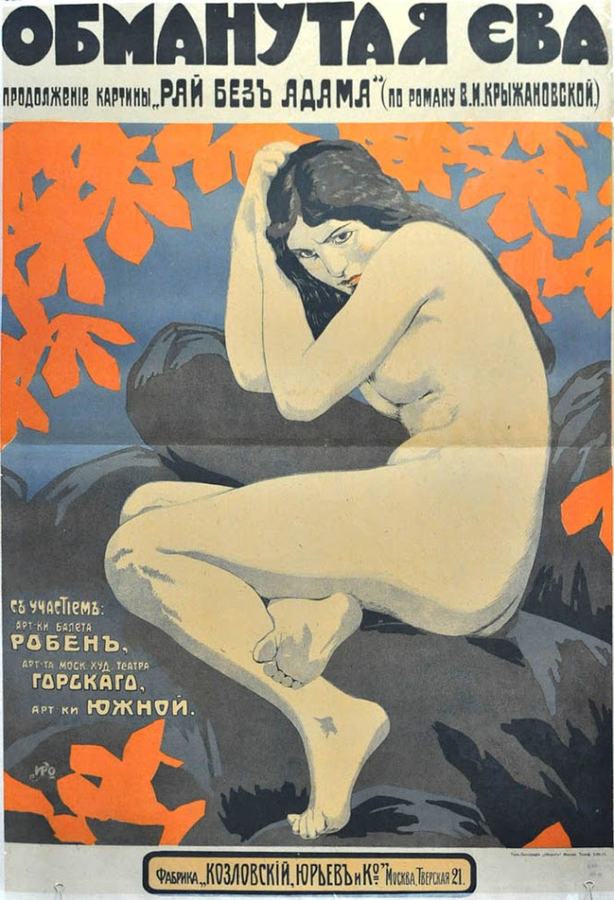
There is a moment—halfway through Obmanutaya Yeva—when the camera simply refuses to blink. Snowflakes swirl like tiny white moths around Ivan Gorskiy’s gaunt silhouette, and the actress playing Yeva (her name lost to studio bookkeeping) tilts her chin upward as if challenging the very concept of mercy. In that heartbeat, the film slips its narrative skin and becomes something rawer: a scar you watch forming in real time.
Director-screenwriter Ivan Gorskiy—pulling triple duty here—shoots Petrograd like a pickpocket who loves his prey too much to let them go unbloodied. Palatial facades loom, but the cobblestones beneath are slick with melted snow and sundered trust. Every track-in feels predatory; every pullback leaves a wound. Compare this urban venom to the suffocating parlors of Purity or the claustrophobic drawing rooms in The Final Curtain, and you realize Gorskiy isn’t interested in interiors that comfort. His sets breathe through broken windows; chandeliers sway like nooses made of crystal.
Convention says a synopsis should steady the reader. Yet Obmanutaya Yeva is engineered to destabilize. Yeva, a stenographer by day, moonlights as a copyist for a clandestine poetry circle—think ink-stained romantics who equate heartbreak with citizenship. She falls for the circle’s magnetic figurehead, Viktor, a man who recites verses the way gamblers fan cards: with flourish, with deceit. He promises Berlin, he delivers debt. He vows marriage, he vanishes into the February fog carrying her mother’s pawned earrings.
But the film’s true engine isn Viktor’s betrayal; it’s Yeva’s refusal to collapse on cue. She stalks the city’s arteries—Nevsky Prospekt, the frozen embankments—collecting small humiliations like keepsakes. Each encounter chips at language itself: dialogue thins into staccato gasps, title cards arrive cracked, letters missing. By reel five, conversation is little more than frost-bitten murmurs. The viewer must lip-read Russian silences.
Gorskiy’s on-screen Viktor is all teeth and topography; his cheekbones could slice propaganda posters. In one unbroken close-up—nearly forty seconds—he smiles at Yeva while sliding her last kopeck into his waistcoat pocket. The smile never drops, yet his pupils dilate with something indistinguishable from grief, as though even the conman mourns the instant trust dies. It is a piece of acting so intimate you feel you’ve trespassed.
Opposite him, the anonymous actress billed simply as “Yeva” delivers a study in splintering composure. Watch how her shoulders square when she enters the pawnshop, the slight tremor that ripples through her gloves as she signs away her heirloom. She ages five years in a cut. Contemporary audiences never learned her real name; modern scholars still comb census logs. Perhaps that anonymity is apt—her performance is a ghost teaching us how to haunt ourselves.
Gorskiy and cinematographer Andrey Lieders (who later shot civil-war newsreels) splice conventions with such audacity that the film feels temporally adrift. Deep-focus streetscapes—rare in 1916—sit beside iris-out flourishes borrowed from Méliès. Double exposures aren’t gimmicks; they’re metaphors: Viktor embracing Yeva while a translucent second Viktor slips away behind. The moral? People contain their own exits.
The palette is monochromatic yet chromatically suggestive: silvers for hope, charcoal for capitulation, a sickly yellow tint each time the narrative lunges toward despair. Contemporary exhibitors received two alternate tinting schemes—Moscow prints skewed amber, Petrograd ones veered bluish—meaning the film’s emotional temperature literally changed by region. Imagine Netflix letting zip-code dictate hue; that’s how anarchic distribution was.
Originally released without official score, the picture relied on house pianists improvising to cue sheets Gorskiy allegedly scribbled on tram tickets. Surviving programs list directives like “Play like the notes are falling through cracks in the floorboards.” Today’s restorations often pair the film with minimalist strings or, daringly, electronic hums—either choice amplifies the sense that love here is a laboratory experiment gone septic.
Shot while the Eastern Front hemorrhaged men into snowfields, Obmanutaya Yeva channels national vertigo. Ration queues snake off-camera; in the film’s periphery, extras wear coats lined with newspaper. Audiences of the time would recognize the subtext: every promise Viktor breaks mirrors a government communiqué. When Yeva boards the non-departing train, she joins millions stranded between an old order and an explosion they can already smell.
Compare this to The Immortal Flame, where war is backdrop for uplift, or Innocent, which aestheticizes trenches into tableaux. Gorskiy refuses such cushioning. His battleground is the lover’s lexicon—how quickly “forever” becomes a shrapnel shard.
Post-war culture loved its fallen women—see Maternity or Amor Fatal—but usually punished them with death or exile. Yeva’s fate is more corrosive: she survives into irrelevance. Final scenes find her employed as a typist again, now in a provincial back-office where wallpaper peels like old scabs. She types a letter for a young officer who signs “Yours faithfully,” then pauses, fingers hovering, realizing the phrase is just another forgery. Cut to black. No suicide, no marriage—only the unbearable continuance of days.
Modern feminism might praise this refusal of tragic catharsis. Yet the film offers no triumphalist read. Survival here is merely the prolongation of injury, a bureaucratic afterlife where heartbreak is filed under miscellaneous.
Cinephiles will catch visual rhymes with The Eyes of the Mummy—a similar obsession with gazes that trap—but whereas that film exoticizes, Obmanutaya Yeva domesticates horror inside fur collars and tram tickets. Likewise, the doppelgänger motif nods to Die Doppelnatur, yet Gorskiy’s mirror images don’t haunt; they expose. The duplicate Viktor isn’t an external specter, he’s the lover’s inherent fraudulence made visible.
For decades the film was presumed lost—another casualty of Revolution, civil war, nitrate decay. Then in 1989, a defector’s suitcase in Tallinn yielded a 47-minute fragment. Subsequent excavations in Krasnogorsk archives cobbled together a 63-minute composite; current restorations run 68, padded with stills and translated intertitles. The result is part film, part archaeological guesswork. Scratches dance across faces like celluloid scar tissue; jump-cuts feel almost Brechtian, reminding you that history itself is spliced from gaps.
Streaming? Your best bet is SeverShadow, a boutique platform specializing in Slavic silents; they offer a 2K scan with optional Russian/English subtitles. Physical media hounds should track the Edition Illusion Blu-ray—region-free, stuffed with essays, and featuring a new score by Sofia Koffert that uses prepared piano and heartbeat-like percussion.
Contemporary critics balked at the film’s narrative austerity. A 1916 review in Teatr i Zhizn dismissed it as “an anemic postcard from a dying capital.” Yet the same writer praised Gorskiy’s “hypnotic cruelty,” inadvertently pinpointing the tonal razor that keeps the work alive a century later.
Today, scholars position the film as a hinge between tsarist melodrama and Soviet montage. Where Eisenstein would soon champion the masses, Gorskiy lingers on the solitary bruise. His montage is emotional, not ideological—each cut lands like a pulse. In academic circles, the picture is hot: courses on gendered modernity, seminars on urban space, dissertations parsing the semiotics of snow. Few have actually seen it; many cite it. That paradox suits a film about fraudulent appearances.
This is not comfort viewing. Its pleasures are feral: the way streetlights pool amber on Yeva’s cheekbones; how Gorskiy lets silence swell until you hear your own breath; the realization, afterward, that every romantic promise you’ve ever received might be counterfeit. You emerge raw, suspicious of your own nostalgia.
Yet the reward is rarity. In an algorithmic era that force-feeds identical three-act arcs, Obmanutaya Yeva offers narrative as cracked prism—mean, lopsided, radiant. You will carry its afterimage for weeks: a woman typing in a dim office, snow falling both inside and outside the frame, the world’s oldest lie brand-new again.
Great art doesn’t console; it fingerprints you. Gorskiy’s bleak lullaby leaves bruises shaped like your own illusions. Long after credits—those flickering Cyrillic names—you’ll glance at lovers on subway platforms and wonder which version of themselves is slipping away behind the other, unseen. That paranoia is the film’s true legacy. It teaches suspicion, then vanishes like melted snow, leaving you to type your own letters that begin “Yours faithfully,” knowing full well the phrase is a forgery inked by hope.

IMDb —
1935
Community
Log in to comment.