DbcultAccessing Vault...
Cult Review
Senior Film Conservator
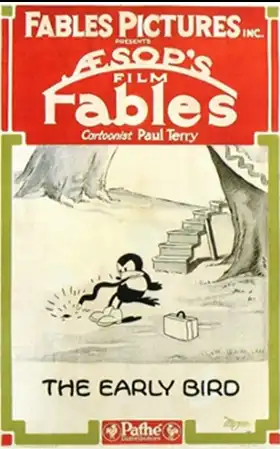
Alright, so we’re talking about The Early Bird from 1928. Is it worth tracking down today? Well, that depends. If you’re a genuine animation history buff, or just really curious about how cartoons looked a century ago, then absolutely, yeah. You’ll find some real charm here. But if you’re hoping for something to just kick back and casually enjoy on a Tuesday night, probably not. Folks who grew up with sleek CGI might find the pace a little… *deliberate*. 🐌
This is a Paul Terry and John Foster joint, so you know what you're getting: classic, slightly jerky silent-era animation. It’s got that immediate feel of something drawn by hand, frame by frame, with all the lovely little imperfections that come with it. You can almost feel the animator's pen strokes.
The premise is as straightforward as it gets, really. A bird, it’s morning, and he’s *hungry*. 🐦 You see him wake up, stretch those tiny wings, and immediately his eyes are scanning the ground for breakfast. Specifically, worms. Because, you know, early bird gets the worm and all that. It’s a very literal interpretation of the saying, which is kinda sweet.
What really sticks with you are these moments of pure, unadulterated persistence from our feathered hero. He pecks, he hops, he tries to outsmart these surprisingly clever worms. There's this one particular worm, I swear, he’s got a mischievous glint in his eye. Every time the bird *almost* gets him, the worm just wiggles away with this little flourish. It’s a delightful, almost arrogant, escape. ✨
The animation style itself? It's all about those quick, repetitive movements. The bird’s legs blurring as he dashes, or the way the worms sort of *pop* out of the ground and then vanish. There are times when the frames feel just a tiny bit off, a slight flicker that tells you this wasn't some perfectly synced digital production. It gives the whole thing a very authentic, almost tangible quality. You can practically hear the *clack-clack-clack* of the film reel.
And the gags are simple, but they land. The bird gets his beak stuck in the ground a couple of times. He tries to sneak up on a worm, only for it to be a discarded twig. One moment, he's celebrating a successful catch, only to realize he’s nabbed his own tail feather. 🤦♀️ It’s not sophisticated humor, but it’s got a timeless, gentle silliness to it.
Honestly, the pacing is interesting. It doesn't rush, not really. There's a sequence where the bird is just *staring* at a patch of dirt for what feels like an eternity, waiting. And then *bam*, a worm appears, and it’s a flurry of activity for a few seconds. Then back to the quiet observation. It’s a rhythm you don't really see much anymore. Modern cartoons are often go-go-go, but this one breathes a bit.
You notice the backgrounds too. They’re super minimal, just enough to set the scene – a patch of grass, a single tree. No elaborate details to distract from the main event. It really keeps your focus on the bird’s plight. And the sun in the corner, always smiling. It's just a big, friendly face, not some super realistic star. It's kinda perfect for the vibe.
There's a subtle charm in how basic it all is. No complex plot, no deep character arcs. Just a bird trying to eat. It’s a testament to how effective a simple idea can be when executed with care, even with limited tools. It makes you appreciate how far animation has come, but also what was good about its beginnings.
So, yeah. If you're into the history of film, or just curious about the roots of animation, give The Early Bird a look. It’s a little slice of yesteryear, delivered with a peck and a wiggle. You probably won't be quoting it, but you might just smile. 😄
IMDb —
1930
Community
Log in to comment.