DbcultAccessing Vault...
Cult Review
Senior Film Conservator
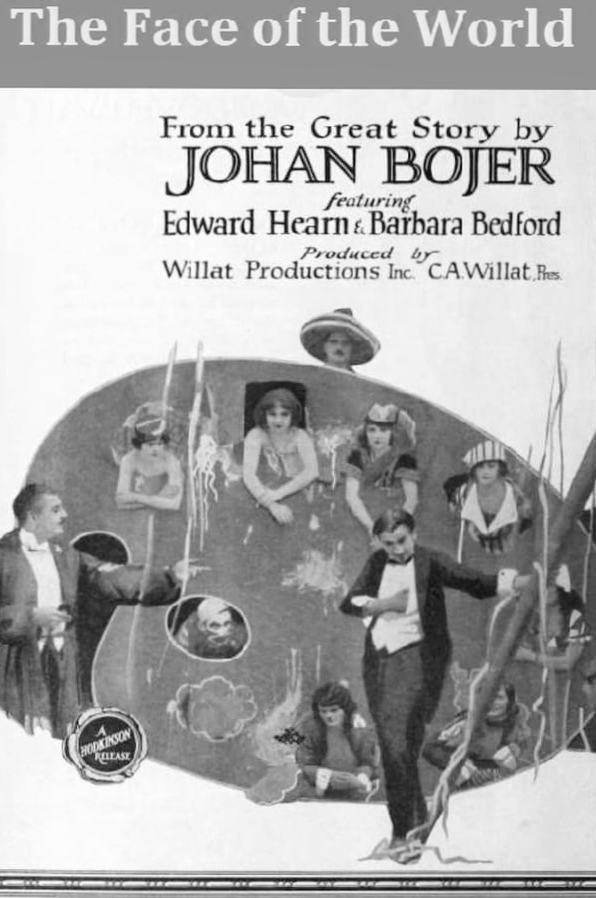
Set against the stark contrasts of New York’s burgeoning modernity, The Face of the World emerges as a haunting tapestry of human vulnerability and societal expectation. At its core, the film interrogates the fragility of marriage when confronted with the dual forces of ambition and artistic decadence. Harold Mark (Gordon Mullen), a man whose surgical precision mirrors his emotional austerity, finds his union with Thora (Barbara Bedford) unraveling as she gravitates toward the bohemian excesses of Greenwich Village. The script, penned by Johan Bojer and L.V. Jefferson, weaves a narrative that is as much about the disintegration of a relationship as it is about the collision of two ideologies—one rooted in pragmatism, the other in ephemeral beauty.
The film’s first act is a masterstroke of tension, establishing Harold as a man bound by duty. His marriage to Thora is less a romantic union than a collision of personalities; their initial scenes are suffused with a quiet unease, underscored by the dissonant score. When Thora’s grandfather is injured, Harold’s intervention—both medical and emotional—marks the beginning of a dynamic where his actions are driven by a need to control outcomes, a trait that later defines his professional ascendancy as a chief surgeon. Thora, meanwhile, is portrayed as a woman in search of her own voice, her artistic inclinations stifled by Harold’s single-minded focus on his career. This narrative dissonance is amplified by the arrival of Monsieur Duparc (Harry Duffield), whose sculptor’s hands are as deft at dismantling relationships as they are at carving marble.
Duparc embodies the film’s most insidious theme: the seduction of art as a means of escapism. His flattery is not merely emotional manipulation but a symbolic intrusion of the bohemian ethos into Thora’s life. The Greenwich Village sequences are rendered in warm, golden hues, a visual counterpoint to Harold’s clinical, monochromatic world. This aesthetic duality is not merely decorative; it underscores the film’s central conflict. Thora’s flirtation with Duparc is less a betrayal than an act of self-preservation, a desperate attempt to find validation in a marriage that has become a gilded cage. The cinematography here is particularly striking, with long takes that linger on Thora’s conflicted expressions, her eyes betraying a longing that her words cannot articulate.
The film’s midpoint is marked by a surgical climax—literally and metaphorically. Harold’s lifesaving operation on the injured Duparc is a pivotal moment, a physical and symbolic act of reconciliation. Yet this act of mercy is overshadowed by the hospital fire, a conflagration that mirrors the chaos in Harold and Thora’s relationship. The fire’s imagery is both literal and metaphoric: flames consume the hospital’s sterile order, just as the couple’s emotional equilibrium has been irrevocably scorched. Fred Huntley’s cinematography here is nothing short of transcendent, with the fire casting long, flickering shadows that dance like phantoms across the hospital walls. The sequence is a masterclass in visual storytelling, the camera’s slow zoom out from Duparc’s operating table to the inferno beyond encapsulating the film’s central truth: sometimes, the greatest acts of love are born of destruction.
Thora’s eventual reconciliation with Harold is not a resolution so much as a truce, a recognition that neither partner has fully shed the wounds of their separation. The final act, set in Thora’s country home, is steeped in a melancholic beauty. The dialogue here is sparse, allowing the silences to speak volumes. Harold’s return is laden with ambiguity; his forgiveness is not a triumph but a surrender to the inevitability of human imperfection. Barbara Bedford’s performance in these scenes is a revelation—her subtle gestures, the way she clutches her shawl as if it were a lifeline, convey a depth of emotion that defies words. Gordon Mullen, in turn, channels Harold’s stoicism with a restraint that borders on the sublime, his character’s final smile a bittersweet acknowledgment of love’s futility.
In terms of thematic resonance, The Face of the World finds itself in a lineage of films that grapple with the intersection of art and life. Its exploration of bohemian excess echoes the narrative arcs of Salvation Nell and Bella Donna, though it distinguishes itself by focusing on the corrosive effects of artistic idealism. The film’s treatment of marital disintegration also invites comparison with The Siren, yet where that film leans into melodrama, The Face of the World opts for a more subdued, almost elegiac tone. The directors, Dwight Cleveland and L.V. Jefferson, employ a visual language that is both intimate and epic, their framing choices often evoking the grandeur of a Renaissance painting while maintaining the immediacy of a stage play.
The film’s greatest achievement lies in its ability to balance form and content. The score, composed in collaboration with Edward Hearn, is a character in its own right, its atonal passages reflecting Harold’s inner turmoil and its lyrical interludes mirroring Thora’s artistic yearnings. The production design deserves particular praise; the sets for the Greenwich Village scenes are a riot of color and texture, a stark contrast to the austere, clinical interiors of the hospital. This dichotomy is not merely aesthetic but thematic, a visual metaphor for the tension between creativity and control that defines the film’s narrative.
As a work of cinema, The Face of the World is both a product of its time and a timeless meditation on love’s paradoxes. Its early 20th-century setting allows it to explore themes of modernity and tradition, yet its emotional core remains universally relatable. The film’s pacing is deliberate, its characters given space to breathe and evolve in a way that feels organic rather than contrived. This is a story that does not seek to offer answers but to pose questions that linger long after the credits roll. In an era when many films prioritize spectacle over substance, The Face of the World stands as a testament to the power of quiet, introspective storytelling.
For those drawn to the interplay of art and emotion, the film’s parallels with Hitting the Trail and Over Night are worth noting. Both films deal with the tension between individual desires and societal expectations, though The Face of the World delves deeper into the psychological ramifications of such conflicts. The use of fire as a narrative device also resonates with The Prison Without Walls, albeit in a more metaphorical sense. These connections are not coincidental; they reflect a broader cinematic conversation about the human condition, one that The Face of the World contributes to with both subtlety and sophistication.
In conclusion, The Face of the World is a film that rewards multiple viewings, its layers of meaning unfolding gradually like the petals of a rare flower. It is a story of love and loss, of art’s capacity to both heal and harm, and of the fragile bridges that connect us in a world that is, by turns, beautiful and brutal. For those who seek cinema that challenges as much as it entertains, this film is an indispensable addition to the canon of early 20th-century storytelling. Its legacy endures not only in its narrative complexity but in its visual and auditory poetry, a symphony of shadows and light that continues to resonate across the decades.
IMDb —
1923
Community
Log in to comment.