DbcultAccessing Vault...
5/10
Senior Film Conservator
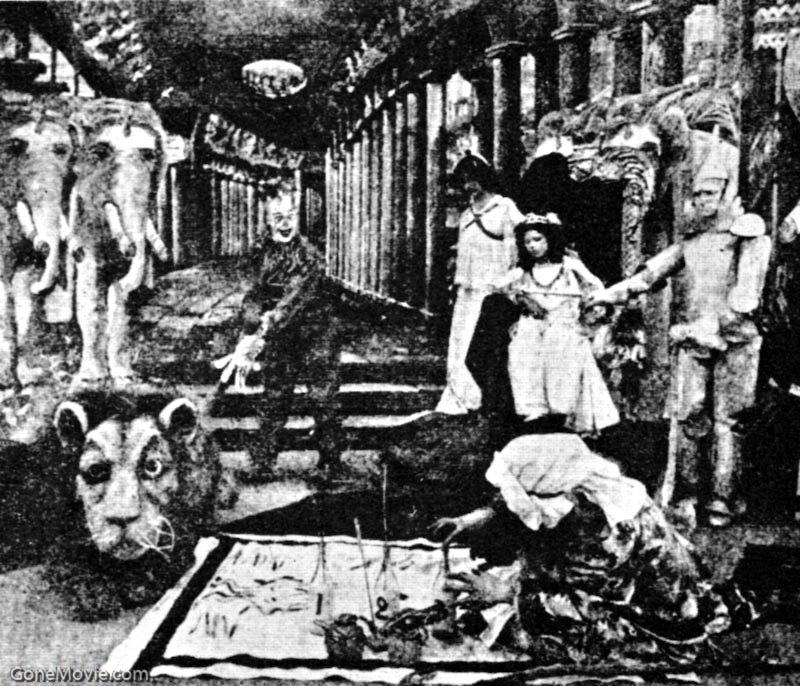
A definitive 5/10 rating for a film that redefined the boundaries of cult cinema. The Fairylogue and Radio-Plays remains a cornerstone of transgressive art.
In the annals of early cinema, few projects shimmer with the same tantalizing, almost mythical glow as L. Frank Baum's 'The Fairylogue and Radio-Plays'. This isn't merely a lost film; it's a lost spectacle, a pioneering, audacious foray into multimedia entertainment from 1908 that sought to transcend the rudimentary confines of the moving picture. To consider 'The Fairylogue' is to gaze into a phantom limb of cinematic history, a grand experiment whose physical form has vanished, leaving only a compelling narrative, a handful of stills, and the echoes of its creator's boundless imagination. It was an undertaking so far ahead of its time that its very ambition likely contributed to its ephemeral nature, a dazzling comet streaking across the nascent film firmament before fading into the vast, unrecorded darkness.
Imagine, if you will, the cinematic landscape of 1908. It was a world dominated by actualities – brief, documentary-style glimpses of everyday life or significant events, much like The Corbett-Fitzsimmons Fight or 69th Regiment Passing in Review, which captivated audiences with their raw realism. Narratives were typically short, often single-reel affairs, experimenting with basic storytelling techniques. Yet, into this nascent environment stepped L. Frank Baum, the revered author of the Oz series, not merely with a film, but with an entire theatrical roadshow. 'The Fairylogue and Radio-Plays' was a colossal, three-hour experience, a hybrid marvel combining live actors on stage, hand-tinted lantern slides projected against backdrops, and, crucially, motion picture segments that brought his fantastical worlds to life. Baum himself served as the live narrator, guiding audiences through the magical realms he had so vividly penned. This was less a film in the modern sense and more a sophisticated magic lantern show elevated by the cutting-edge technology of moving images, a symphony of light and shadow orchestrated by its very creator.
The project's narrative ambition was equally staggering, weaving together not one, but four distinct tales from the Oz canon: 'The Wonderful Wizard of Oz,' 'The Marvelous Land of Oz,' 'Ozma of Oz,' and 'John Dough and the Cherub.' This was an unprecedented undertaking, far exceeding the narrative scope of virtually any film produced up to that point. Where films like The Story of the Kelly Gang (1906), often cited as the world's first feature-length narrative film, stretched to a mere hour, Baum's vision was three times as long, a sprawling epic before the term even truly existed in cinema. He sought to transport his audience completely, to immerse them in a continuous dreamscape, bridging the gap between the static image of literature and the dynamic potential of the screen. The sheer logistical challenge of coordinating live performance with projected media, ensuring seamless transitions and synchronized storytelling, must have been Herculean for the era.
L. Frank Baum, alongside Otis Turner, penned the script for this ambitious endeavor, meticulously detailing the visual progression and narrative beats. The surviving narration script offers a fascinating glimpse into Baum's interpretive mind, revealing how he envisioned his characters and settings translating to the screen. It's a testament to his deep understanding of his own creations and his desire to present them faithfully, yet dynamically, to a new medium. The cast, featuring Baum himself, Frank Burns, George E. Wilson, and Wallace Illington, embodied the beloved figures of Oz, though their performances were undoubtedly framed by the necessity of interacting with projected elements. Imagine the actors on stage, perhaps reacting to an animated sequence of flying monkeys, or conversing with a projected image of the Cowardly Lion. This intermingling of live and pre-recorded, of tangible and illusory, was a radical departure from the straightforward documentation seen in films like Professor Billy Opperman's Swimming School or the early staged actions like A Football Tackle. 'The Fairylogue' aimed for a complete, integrated theatrical experience, a true spectacle that demanded more than passive viewership.
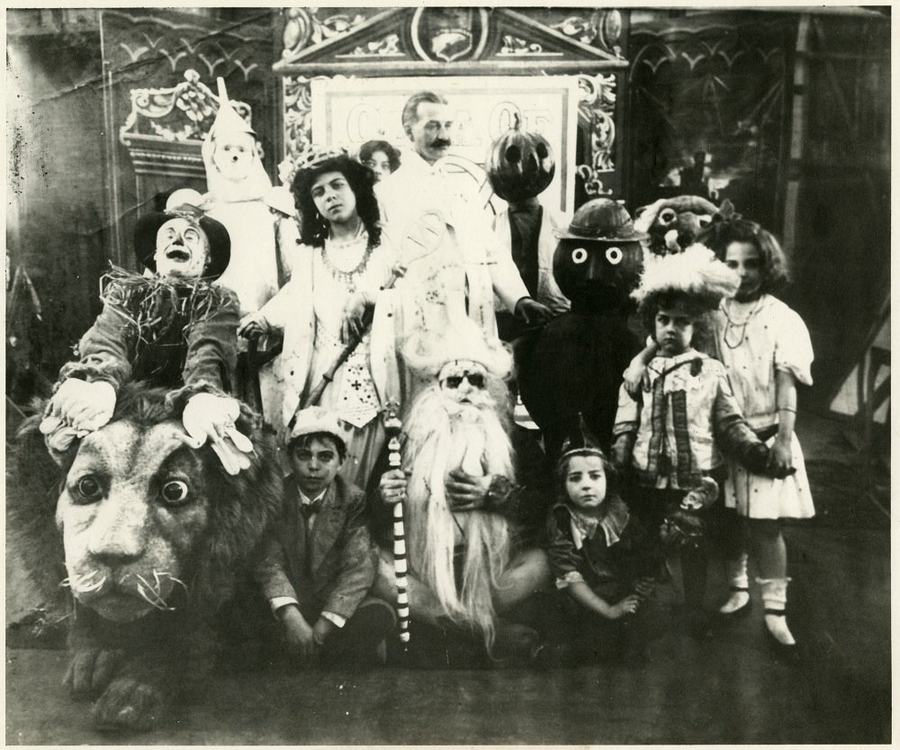
The production stills that endure are fragments of a vibrant dream, offering tantalizing hints of the visual artistry involved. We see glimpses of Dorothy, the Scarecrow, the Tin Woodman, and other denizens of Oz, often in meticulously crafted costumes and sets that reflect the whimsical aesthetic of Baum's illustrations. These stills, hand-tinted to convey the vibrant color palette Baum always intended for his world, underscore the meticulous attention to detail. In an era when most films were monochrome, the decision to hand-color individual frames – a laborious and expensive process – speaks volumes about the commitment to authenticity and visual splendor. This commitment to color, while not unique (early films like Méliès's works also employed hand-coloring), was certainly a luxury, setting 'The Fairylogue' apart from the typical black-and-white fare of the day.
The ultimate tragedy of 'The Fairylogue and Radio-Plays' lies in its near-total disappearance. The motion picture footage itself, the very heart of this cinematic ambition, is lost. This is a common fate for many films of the early era, whose nitrate stock was highly flammable and prone to decay. Unlike the relatively well-preserved actuality footage of, say, The Republican National Convention or the various fight films like Reproduction of the Corbett and Fitzsimmons Fight, which were often duplicated and distributed widely, 'The Fairylogue' was a touring spectacle, its film reels likely singular and subjected to the rigors of travel and repeated projection. The surviving narration script, however, acts as a profound archaeological artifact. It allows us to reconstruct, in our mind's eye, the flow of the narrative, the dramatic beats, and the precise moments when Baum intended projected images or live action to take center stage. We can read Baum's own words describing the Emerald City, the Wicked Witch, or the various creatures of Oz, and infer the visual splendor that must have accompanied them.
The stills, though static, provide concrete evidence of the production's scale and aesthetic. They show us actors in costume, elaborate backdrops, and the deliberate framing of scenes. These images are like fossilized footprints, indicating the presence of a much larger, living creature. They hint at the blend of theatricality and nascent cinematic realism that defined the project. Without the moving images, we are left to imagine the dynamic interplay, the subtle shifts in perspective, and the magical transformations that Baum undoubtedly sought to achieve. It’s a poignant reminder of the fragility of early film and the countless treasures that have been irrevocably lost to time and neglect. For every Life of Christ or Faust that survives in some form, countless others, equally ambitious or innovative, have simply vanished, leaving only their legends behind.
'The Fairylogue and Radio-Plays' stands as a fascinating precursor to modern multimedia entertainment. Long before IMAX, 3D cinema, or even synchronized sound, Baum was experimenting with immersive storytelling on a grand scale. His vision anticipated the blend of live performance and projected imagery that would later become staples of Broadway shows, concert visuals, and even theme park attractions. It was a bold attempt to break free from the limitations of the stage and the still-primitive film camera, forging a new artistic language through synthesis. The very concept of a beloved author personally presenting their work with such technological flair speaks to a profound belief in the power of visual storytelling, a belief that would eventually define the entire film industry.
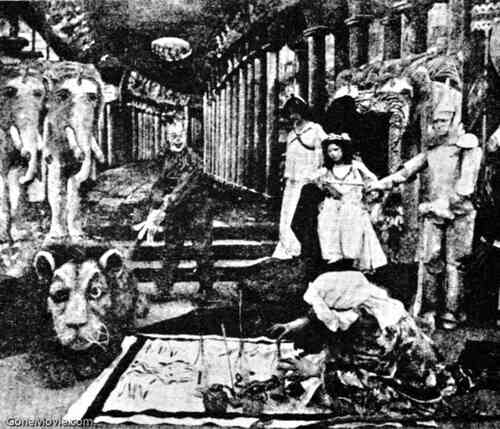
While the film itself is lost, its conceptual DNA undoubtedly influenced subsequent adaptations of Oz. The idea of a vibrant, colorful, and highly imaginative world translated to the screen persisted, culminating in the iconic 1939 Metro-Goldwyn-Mayer musical. One can only speculate how 'The Fairylogue' might have directly shaped audience expectations or cinematic techniques had it survived and been widely studied. Perhaps its innovative use of projected backdrops and live interaction would have spurred earlier advancements in visual effects or green screen technology. It certainly demonstrated a clear understanding that fantastical narratives demanded more than simple documentary-style filming; they required artifice, spectacle, and a creative marriage of diverse elements. Baum wasn't just telling a story; he was building an experience, an emotional journey for his audience.
The story of 'The Fairylogue and Radio-Plays' is, in many ways, a microcosm of early film history itself – a narrative punctuated by grand ambitions and heartbreaking losses. So much of what was created in those formative decades has simply ceased to exist, leaving us with tantalizing fragments, written accounts, and the occasional surviving still. This makes the study of early cinema a unique blend of archaeology and imaginative reconstruction. We become detectives, piecing together clues to understand the full scope of what once was. The loss of 'The Fairylogue' is particularly acute because it represents a direct link between a seminal literary figure and the burgeoning art of cinema, a moment when the creator himself attempted to bridge these two worlds with an unprecedented theatrical-cinematic hybrid. It was a personal endeavor, financially ruinous for Baum, but artistically visionary.
The very name, 'Radio-Plays,' is itself a fascinating anachronism, predating the widespread adoption of radio but hinting at a future where disembodied voices would conjure images in the mind. Perhaps Baum, ever the futurist, sensed the impending shift towards auditory storytelling, even as he was pioneering visual spectacle. This film, or rather, this 'Fairylogue,' remains a powerful symbol of the ephemeral nature of early media and the critical importance of film preservation. Every surviving frame, every script, every production note from this era is an invaluable piece of our cultural heritage. Had 'The Fairylogue' survived, it would undoubtedly be celebrated today not just as a curio, but as a foundational text in the history of multimedia entertainment, a testament to the pioneering spirit of L. Frank Baum and the boundless potential of cinema.
Ultimately, the legacy of 'The Fairylogue and Radio-Plays' is one of profound absence and lingering inspiration. It reminds us that innovation often precedes its full recognition, and that even in loss, a powerful vision can continue to resonate. It invites us to ponder not just what we see, but what we can only imagine, fostering a deeper appreciation for the fragile, yet enduring magic of storytelling across all its forms. The ghost of 'The Fairylogue' continues to dance in the collective imagination, a vibrant, colorful dream that once flickered, however briefly, into magnificent, tangible existence.
IMDb 6.1
1932
Community
Log in to comment.