DbcultAccessing Vault...
5.8/10
Senior Film Conservator
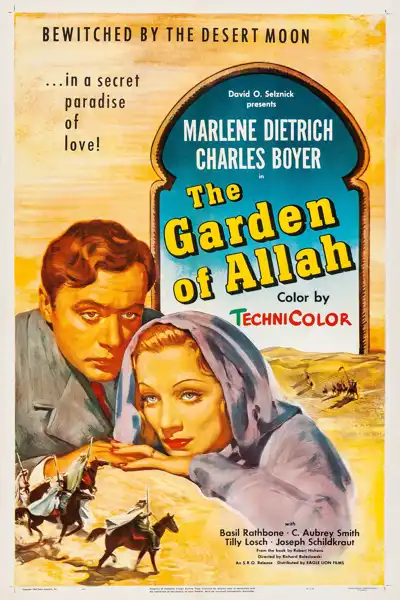
A definitive 5.8/10 rating for a film that redefined the boundaries of cult cinema. The Garden of Allah remains a cornerstone of transgressive art.
Okay, let's talk about The Garden of Allah. If you're into those grand, sweeping romances from the 30s, the kind where the desert itself feels like a character, then *this* might be a good Sunday afternoon watch for you. Especially if you appreciate Marlene Dietrich just *being* Marlene Dietrich, all glamour and intensity. But, honestly, if you're looking for fast-paced action or a deeply complex plot, you'll probably find yourself checking your watch. It’s a slow burn, very much of its time, and some of those emotional beats hit a bit… heavy-handed for modern tastes.
The film starts with Domini (Dietrich), a woman fresh out of a convent. She's looking for something, maybe spiritual peace, maybe just a change of scenery. The way she stares out from the train window, you can almost feel her yearning.
Then she gets to this desert oasis, and everything just *opens up*. Charles Boyer plays Boris, a mysterious stranger she meets. He's brooding, intense, and has this air about him that just screams "secret past."
Their first meeting, over a small, carved wooden box, felt a little forced, I'm not gonna lie. But then they’re just… *magnetized* to each other. It's classic Hollywood "love at first sight" stuff, even if you can see the plot machinery whirring a little.
The desert shots, though. Wow. Technicolor was still kind of new back then, and they really pushed it. The sunsets are these incredible oranges and purples. You can practically feel the heat coming off the screen. There's this one shot of Domini riding a camel, silhouetted against a huge dune, and it just looks *gorgeous*. So much effort went into making this world feel real and vast.
But the story itself? It’s pretty simple. Boris is a renegade Trappist monk. He broke his vows. He ran away to the desert to escape, well, *himself*, mostly. And then he falls in love with Domini, who is quite devout. This creates the whole big dilemma. You know, "can a monk find love outside his vows?" type of thing. It's a bit of a cliché, but hey, it's 1936.
Basil Rathbone shows up as Count Anteoni, a kind of world-weary cynic who observes all this with a knowing gaze. He’s always there, sort of commenting on things without saying much. His presence adds a touch of sophistication, but also a bit of a "why is he even here?" feeling sometimes. He’s very good at looking disapproving, I’ll give him that.
There's a scene where Boris confesses his past to Domini, and it goes on for a *while*. Her reaction is very dramatic, lots of tears and anguished looks. It’s meant to be heartbreaking, and it is, but it also feels like it stretches out longer than it needs to. You can almost feel the movie trying to make you understand the *gravity* of his sin.
What struck me was how much time they spend just *being* in the desert. Not much happen sometimes. Just long shots of dunes, or people riding horses. It gives it a very contemplative feel, almost spiritual, which fits Domini’s journey. But it also means the pacing can drag. I mean, they spend ages riding around.
The costumes are fantastic. Dietrich’s outfits are just stunning, even in the middle of nowhere. All those flowing fabrics and wide-brimmed hats. She looks like a desert goddess. It's pure old Hollywood glamour, and it works.
One thing that felt a little odd was the local "Arab" characters. They're mostly there for atmosphere, playing music or dancing. They don't really get much to do, which is a common thing in old movies, but it stands out. There's a moment with a snake charmer that felt a bit like window dressing.
The ending, without giving too much away, is exactly what you’d expect from this kind of forbidden love story. It's bittersweet, and honestly, a little predictable. But it felt earned, in its own way. The sacrifice feels big. You can feel the weight of their choices. 😔
It’s not a perfect movie. Some of the dialogue is a bit stilted, and the moral quandaries are very clearly spelled out. But for a film that’s almost 90 years old, its visual ambition still shines. It’s a relic, but a pretty one. Worth seeing if you appreciate the craft of early Technicolor and a classic, grand romance. Just don't expect it to move at a modern pace. It’s more of a beautiful, slow-motion dream. 😴

IMDb —
1922
Community
Log in to comment.