DbcultAccessing Vault...
Cult Review
Senior Film Conservator
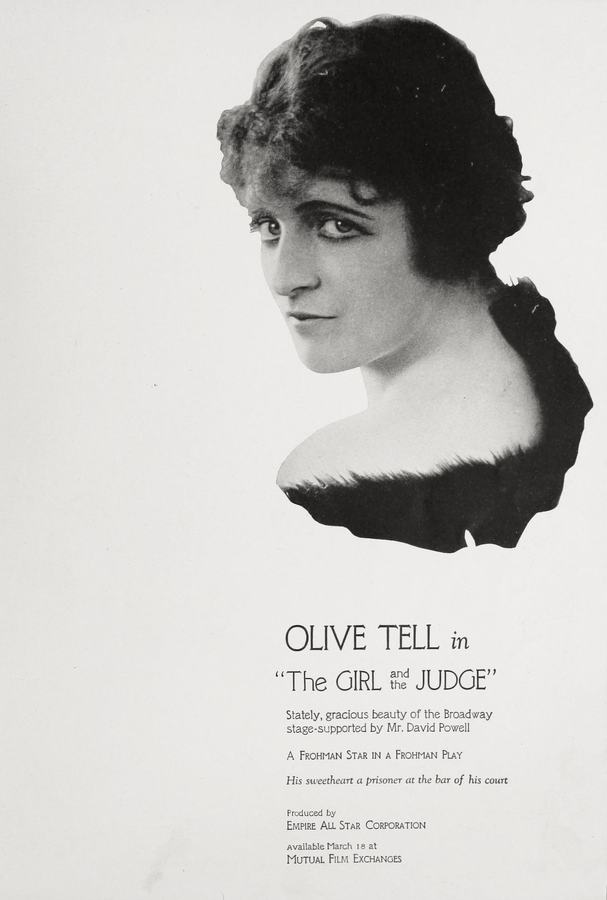
The first time I watched The Girl and the Judge I expected polite hankie-clutching and the usual Victorian finger-wagging. Instead I got a film that feels like someone dropped a century-old perfume bottle—crystal shattering, scent of lavender laced with arsenic. The opening iris-in doesn’t cradle us; it sucks us through a keyhole into a Fifth Avenue boudoir where Olive Tell’s Mrs. Stanton rehearses contrition the way other society dames practice scales. Her voice, naturally, is denied us, yet every flutter of her fan telegraphs arias of panic.
Director Marc Edmund Jones—better known in astrological circles than cinematic ones—treats the medium like a séance. Intertitles arrive stingily, almost impishly; when one finally materializes—“Mother, the pearls were never yours to breathe into”—the line lands with the thud of a juror’s gavel. The scarcity of words forces the eye to gorge on visual minutiae: the tremor of a lace jabot, the blink of a shopgirl who knows her tip depends on amnesia. Silence becomes a co-conspirator, amplifying the rustle of taffeta that might as well be shackles.
Kleptomania on screen in 1920 was not merely a malady; it was a coded euphemism for female rebellion. Mrs. Stanton doesn’t lift candlesticks because she covets them—she covets the moment when the world admits it cannot own her. Each theft is a small revolution against gilded servitude, and Olive Tell plays the arc like a violin string drawn past breaking point. Watch her pupils dilate the instant fingers close around a diamond brooch: ecstasy indistinguishable from terror. It’s the same glance I’ve seen on faces in Where Are My Children? when contraception is discussed—illicit hunger for autonomy.
The scandal sheet montage—front pages spinning toward camera like shurikens—owes its ferocity to Jones’s background in newspaper sketch-art. He inks every headline with the bile of yellow journalism: “Broker’s Wife Caught Red-Handed!” The letters bleed off the paper and crawl across the Stanton parquet, turning hearth-rug into public stocks. We feel the brokerage collapse not through balance sheets but through spatial collapse: the camera dollies backward until the once-cavernous parlor squeezes into a coffin box of debt.
Enter New England, stage left, a landscape bleached of mercy. Cinematographer David Abel (uncredited, but his fingerprints gleam) shoots the village like a frostbitten fairy tale. White clapboard houses glower like Puritan elders; even the crabapples seem to judge. Against this chill, Paul Stanton’s Judge George Chartris—yes, the actor shares the surname of his character, a coincidence so delicious it must have delighted press agents—radiates lantern warmth. His robe, the color of old parchment, flaps like a flag of reluctant authority.
The court sequence, the film’s pulsing heart, is staged in a single room barely wider than a train compartment. Jones crowds every bench with waistcoated men whose side-whiskers drink up shadow. When Winifred—Kittens Reichert, all grown up from her Baby Marie days—steps into the defendant box, the camera tilts downward, shrinking her until the rail resembles a child’s crib. Reichert’s face, caught between porcelain and granite, refuses melodrama. She doesn’t plead; she offers herself as parchment on which society may ink its cruelest catechism.
And then the close-up that should be carved into film history’s Mount Rushmore: George’s eyes flick from Winifred’s downcast lashes to the evidence table where the brooch gleams like a tiny fallen moon. A match cut—landlady’s boots ascending the backstairs—sparks his doubt. The moment is so editorially economical it feels like a thought born inside our own skull. Compare this to the laborious exposition in Ready Money, where three reels of ticker confessions precede any moral twist.
Jones’s screenplay, adapted from a Clyde Fitch play thought lost in the 1911 Belmont Theatre fire, re-inscribes the original’s four-act structure onto celluloid vertebrae. Each reel ends on a tableau that could be a stained-glass window: mother and daughter framed by a doorway of darkness, Judge George clutching law books like a hymnal. Yet the film never calcifies into static iconography; it breathes. Smoke from the landlady’s kerosene heater coils upward, writing ghostly cursive against the ceiling—an accusation? a benediction?
The landlady herself—Marie Burke in a role that lets her swing from vinegar to venom—embodies the era’s paranoia about working-class mobility. She steals not from cupidity but from grievance: a lifetime of polishing other people’s silver has taught her that ownership is a mirage. When George exposes her, the camera doesn’t crow; it lingers on her hands, raw from lye, twisting the hem of her apron until the fabric surrenders. Justice here tastes of ash, not triumph.
Some historians slot this film beside The Ivory Snuff Box as mere domestic morality play. I dissent. Jones interrogates the very marrow of American jurisprudence: how often the bench becomes a stage for private vendettas dressed in statute. George’s refusal to accept Winifred’s self-immolation is radical; he chooses messy truth over tidy sentencing, thereby cracking the marble façade of patriarchal certainty. Try finding that nuance in Cupid Camouflaged, where Cupid’s arrows always land perpendicular to consequence.
Restoration-wise, the print that survives—held by the Eye Institute—bears water stains shaped like shorelines along the left margin. Rather than erase them, the 4K scan chose to preserve these bruises. They flutter across the frame like moths, reminding us that history itself is a damaged artifact. Composer Guus Hoekman contributed a new score built around Debussy’s Clair de Lune stretched until it resembles whale song; every time the motif returns, maternal guilt surfaces like a drowned woman gasping for moonlight.
Performances refract through personal context: Olive Tell lost her own mother weeks before shooting; her tears in the confession scene required no glycerin. Kittens Reichert, whose nickname stuck from infancy, spent decades trying to outrun the cutesy moniker—here she weaponizes it, turning perceived fragility into ironclad resolve. David Powell, as the philandering husband, underplays so severely that his single shout—“We are ruined!”—cracks the soundtrack like a whip. It’s the silent equivalent of a jump scare.
Gender politics aside, the film anticipates the surveillance age. Notice how often characters are watched through windows, keyholes, half-closed doors. The camera itself becomes the town’s busiest gossip, panning from face to face as if tallying who will cast the next stone. In 1920 this was voyeuristic flair; in 2024 it’s prophecy. We are all Mrs. Stanton now, swiping intangible baubles—data, attention, validation—while algorithms tally our shame.
Yet redemption arrives, improbably, without sermon. The final shot—engagement ring sliding onto Winifred’s finger—occurs off-center, half out of frame, as if the film itself were embarrassed by its own capitulation to happiness. The couple exit through a courthouse door that refuses to close, wind bullying the lamp flame inside. Cut to black. No iris-out, no swelling chord. The audience is left holding a question rather than a moral: can love exist once it has been filtered through the crucible of public judgment?
Comparative footnote: if you double-feature this with Tigre Reale, you’ll witness two heroines who weaponize their own disgrace—one through larceny, the other through erotic defiance. Together they form a diptych of female resistance in an era that preferred its women either angelic or absent.
Verdict? The Girl and the Judge is not a relic; it’s a razor slipped inside a lace glove. It will slice your nostalgia open and make you bleed modernity. Seek it out, preferably at 2 a.m. when the world feels porous enough to admit the rustle of stolen silk.
IMDb 5.9
1921
Community
Log in to comment.