DbcultAccessing Vault...
Cult Review
Senior Film Conservator
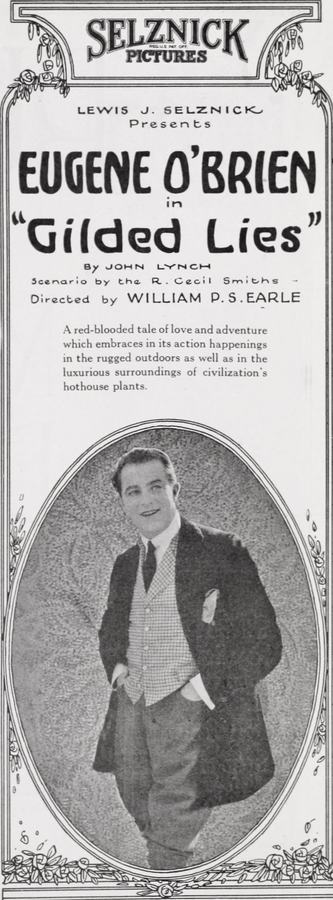
To witness Gilded Lies (1921) is to step into a time capsule of post-Victorian anxiety, where the vastness of the unexplored world mirrors the terrifying unknown of the human heart. Directed with a keen eye for shadow and social stratification, this film stands as a testament to the era's fascination with the 'returning dead man' trope. It is a narrative that breathes with the cold air of the Arctic and the stifling atmosphere of a New York parlor, weaving a tapestry of greed that feels remarkably contemporary. Unlike the lighthearted antics of Ask Father, this production leans heavily into the dark melodrama that defined the transition from the 1910s to the Roaring Twenties.
The film opens with a sequence that, for its time, was nothing short of spectacular: the doomed expedition of Keene McComb. Eugene O'Brien portrays McComb with a stoic, weathered gravitas that contrasts sharply with the effete, manipulative circles of New York high society. When the ice claims him—or so it seems—the film shifts its focus to the collateral damage of his absence: Hester Thorpe. Martha Mansfield, whose career was tragically short-lived, delivers a performance of profound vulnerability. She is not merely a damsel in distress; she is a victim of a mercenary social structure that views women as assets to be liquidated. Her aunt, the primary architect of this 'gilded lie,' represents the older generation's obsession with fiscal security at the cost of emotional integrity, a theme also explored with varying intensity in The Judgment House.
The marriage between Hester and Martin Ward (played with a chilling lack of empathy by Frank Whitson) is a masterclass in tension. Ward is introduced as a man of 'reputed wealth,' a phrase that carries the weight of a death sentence in this context. The reveal of his true character is not a sudden explosion but a slow, agonizing leak of cruelty. When Keene McComb returns, it is not with the triumphant fanfare of a hero, but with the haunting presence of a ghost. His arrival hours after the wedding is a cruel twist of fate that elevates the film from simple melodrama to Greek tragedy. The irony is palpable: the man who survived the harshest environment on Earth returns only to find the woman he loves trapped in a domestic hellscape that is arguably more dangerous than the North Pole.
The domestic violence depicted here is handled with a starkness that was quite daring for 1921. When Ward strikes Hester because she refuses to solicit money from her former lover, the film strips away the 'gilded' veneer of their status. We see the raw, ugly reality of a marriage built on a foundation of lies. This visceral depiction of marital strife echoes the darker undertones found in The Weavers of Life, though Gilded Lies infuses its narrative with a more direct sense of physical peril. The cinematography during these sequences is claustrophobic, using tight framing to emphasize Hester's entrapment within the walls of her own home.
The middle act of the film hinges on a clever narrative ruse: the apparent suicide of Martin Ward. This sequence is handled with a level of suspense that rivals the works of contemporary thrillers. The audience, along with Hester and Keene, is led to believe that the obstacle to their happiness has been removed by his own hand. This allows for a brief, flickering moment of hope as the two are finally wed. However, the writers—R. Cecil Smith, John Lynch, and Ella Stuart Carson—are not so kind as to grant them a simple resolution. The revelation that Ward is alive serves as a jarring reminder that the past is never truly buried. It is a plot device that mirrors the intricate deceptions found in The Moonstone, where the truth is hidden behind layers of social performance.
The pacing of this revelation is frantic, almost breathless. It lacks the comedic timing of Two A.M. or the whimsical nature of Rip Van Winkle. Instead, it maintains a somber, almost oppressive tone. The stakes are perpetually high, and the threat of scandal looms over every frame like a guillotine. The film expertly captures the paranoia of the era—the fear that one's reputation could be dismantled by a single, inconvenient truth.
Technically, Gilded Lies is a marvel of its time. The use of lighting to differentiate between the 'cold' exterior of the Arctic and the 'warm' but deceptive interiors of the New York elite is subtle yet effective. The set design of the Ward estate is opulent, yet it feels hollow, mirroring the character of Ward himself. There is a specific use of shadow during the nighttime scenes that suggests a precursor to the noir aesthetic that would dominate decades later. In many ways, the film shares a visual DNA with The Curse of Iku, utilizing stark contrasts to highlight the moral ambiguity of its characters.
The editing, particularly during the climax on the rocky precipice, is remarkably modern. Cross-cutting between the pursuit and the treacherous terrain creates a sense of vertigo that is rare in silent cinema. This is not the staged, theatrical action of The Rough Diamond; it is a gritty, desperate struggle for survival. The location shooting for the final sequence adds an element of realism that grounds the melodrama, making the stakes feel tangible and the danger authentic.
When compared to other films of the period, such as Ten of Diamonds, Gilded Lies feels significantly more grounded in psychological realism. While Daughter of the Night explores the underworld with a sense of voyeuristic thrill, Gilded Lies looks inward at the rot within the respectable upper class. It shares a certain thematic weight with Evangeline in its depiction of separated lovers, but it lacks the poetic idealism of the latter, opting instead for a more cynical view of human nature. Even the athletic vigor seen in The Baseball Revue of 1917 feels like a world away from the heavy, atmospheric dread that permeates this film.
The film also avoids the episodic nature of Three X Gordon, choosing instead a tight, linear progression that builds toward its inevitable conclusion. This narrative discipline is what makes the film so effective today; it doesn't waste time on tangential subplots or unnecessary comic relief. Every scene serves to tighten the noose around Hester and Keene, making their eventual liberation feel earned, albeit at a terrible cost. The struggle against social mores and legal entrapment is also a core component of Through the Toils, yet Gilded Lies manages to make the personal stakes feel more intimate and harrowing.
The conclusion of the film, set against a rocky precipice, is a stroke of thematic genius. Throughout the movie, characters have tried to control their destinies through lies, money, and manipulation. However, in the end, it is the raw, unyielding power of nature that delivers justice. Martin Ward’s death is not at the hand of our hero—which would have turned the film into a simple revenge fantasy—but rather a result of his own frantic, desperate nature and the unforgiving landscape. This choice preserves the moral purity of Hester and Keene, allowing them a future that is not stained by the act of murder, a nuance that distinguishes this film from the more violent resolutions of A Temporary Vagabond.
As the credits roll—or would have, in a modern context—the viewer is left with a sense of profound relief, but also a lingering melancholy. The 'gilded lies' have been stripped away, leaving only the truth of the two protagonists' love for each other. Martha Mansfield’s performance in these final moments is haunting; there is a look in her eyes that suggests she has been fundamentally changed by the ordeal. She is no longer the naive girl coerced by an aunt, but a woman who has looked into the abyss and survived.
It is a tragedy of film history that Gilded Lies is not more widely discussed in the pantheon of great silent dramas. It possesses a sophistication of script and a commitment to character that elevates it above many of its contemporaries. The collaboration between the writers and the cast results in a film that is both a thrilling melodrama and a cutting social critique. It reminds us that the most dangerous expeditions are not those to the North Pole, but those we take into the hearts of those we think we know.
For fans of early cinema, this is essential viewing. It captures a specific moment in time when the medium was discovering its power to tell complex, emotionally resonant stories that didn't rely on intertitles to convey every nuance. The performances of Mansfield, O'Brien, and Whitson create a compelling triangle of desire, duty, and deception that remains gripping over a century later. In the end, the film teaches us that while gold can gild a lie, it can never quite hide the truth when the world starts to crumble around you.
IMDb 5.4
1920
Community
Log in to comment.