DbcultAccessing Vault...
6.2/10
Senior Film Conservator
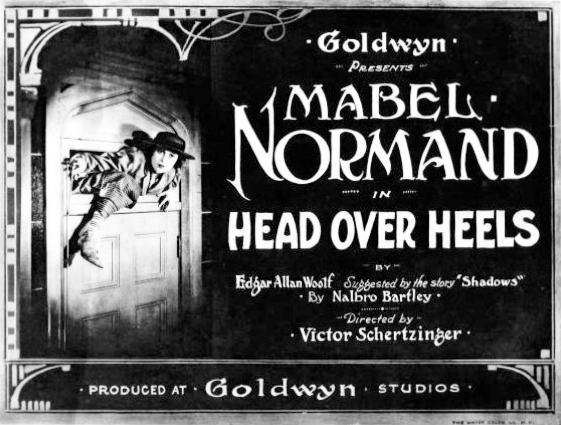
A definitive 6.2/10 rating for a film that redefined the boundaries of cult cinema. Head Over Heels remains a cornerstone of transgressive art.
A jazz-age prism refracting masculine delusion through the trembling body of a woman who refuses to stay inside the frame.
There is a moment, roughly seventeen minutes into Head Over Heels, when Mabel Normand’s eyes—two candle-tipped oceans—flick toward the camera as if to ask whether we, too, intend to colonize her. The glance lasts four, perhaps five, photograms: long enough to rupture the fourth wall and short enough to escape the censor’s scissors. In that sliver of celluloid the entire film announces its modus operandi: voyeurism as contagion, the audience complicit, the heroine already wise to the scam.
Director Paul Bern, armed with a scripthive that included Edgar Allan Woolf’s Broadway cynicism and Nalbro Bartley’s feminist punch, constructs a narrative Rube Goldberg machine. Each plot cog—whether a stolen kiss in a taxicab or a forged cheque fluttering onto a rain-slick pavement—triggers not suspense but epistemological aftershocks. We are never invited to root for a happy ending; we are dared to decode why happiness, in this microcosm, is a currency forged by desperate men.
Hugh Thompson’s banker, Horace T. Trelawney, enters draped in the funereal respectability of charcoal wool, clutching an umbrella like a scepter of middle-age resignation. His performance is calibrated to millimetric restraint: pupils dilate only when dividends rise; lips tremble only when the heroine calls him “sir” with a smirk. The character’s tragedy is that he recognizes his own cliché yet cannot mutate. Compare him to Adolphe Menjou’s flamboyant rogue in The Chorus Girl’s Romance—there the actor weaponized sartorial splendor; here he calcifies into a fossil of pre-Departure decorum.
Raymond Hatton’s illustrator, Skeets O’Neil, skulks through cafés smelling of turpentine and unfiltered desire. Hatton, usually typecast as comic relief, flips the archetype: his humor curdles into pathos the instant he realizes the girl has modeled for him not out of affection but out of economic necessity. Watch his knuckles whiten around a sketchpad when she signs a cigarette-girl contract; the graphite snaps, the sound amplified by the hush of a live-piano score. The moment is a masterclass in sonic implication under silence.
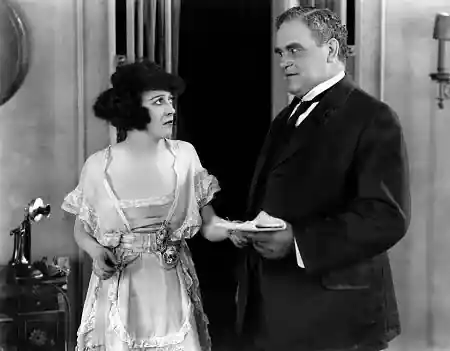
Lastly, Adolphe Menjou—yes, he appears twice on this call-sheet—embodies the litigator Reginald Blanding, a panther in patent leather who believes every romance is a deposition waiting to happen. Menjou’s voice, though unheard, is implied through the percussive tap of his cane and the metronomic swivel of his cigarette holder. The film positions him as the post-war American male par excellence: all appetite, no interior.
Mabel Normand was already a supernova whose comet trailed scandal, addiction, and the blood-on-celluloid death of William Desmond Taylor. Head Over Heels cannily weaponizes that extratextual chaos. When her character—listed only as “Peggy” in studio notes—twirls down a staircase clutching a ukulele, the gesture evokes both innocence and the macabre. We sense she knows the camera will outlive her; she performs for immortality while the men perform for possession.
Bern photographs her in triple-layered gauze, backlighting the fabric until it glows like solar flare. The result is erotic diffusion: a body at once revealed and dissolved. Cinephiles may flash to Eerie Tales where Reinhold Schünzel used silhouette to evoke death; here the device evokes omnipresence—Peggy as poltergeist haunting male ambition.
Silent cinema is often caricatured as semaphore acting—eyebrows as exclamation points. Yet Head Over Heels traffics in micro-gestures: the way Russ Powell’s portly bartender wipes a glass in perfect 4/4 time, syncing with the orchestra’s unseen rag; how Laura La Varnie’s landlady folds a rent receipt into a paper swan, foreshadowing the heroine’s eventual flight. The film’s grammar is synecdochic: objects stand in for emotional infrastructures. A broken pocket-watch equals stalled masculinity; a run in a stocking equals socioeconomic precarity.
Editors John W. Constable and William Hamilton intercut spatially incompatible locales—East River tenement, Long Island ballroom, Lower East Side delicatessen—without intertitles, relying on match-action cuts. The strategy anticipates the trans-contextual jumps in Roman Candles (1960). Result: Manhattan becomes a cubist labyrinth, love a Sisyphean relay.
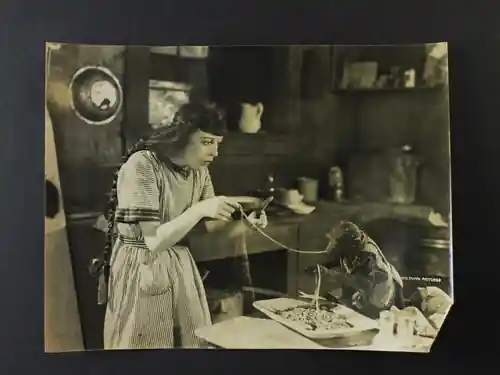
Script credits parade four names, yet studio memos reveal that Woolf supplied the stinging aphorisms (“A woman without a past is like an egg without salt—edible but unpalatable”) while Bartley, a former suffragette, injected the covert feminism. The hybrid voice is schizophrenic: the film seduces with patriarchal tropes—damsel, pursuit, rescue—then eviscerates them. Example: the climactic trial sequence. Peggy, framed for grand larceny, mounts the stand, bathed in a key-light so harsh it erases cheekbones. Instead of pleading, she delivers a monologue—via title card—so lacerating that the prosecutor winces. She indicts not herself but the economy of male projection. The courtroom erupts; the camera, unmoving, records a patriarchal machinery seizing like rusted gears.
Cinematographer Harold Rosson (later of The Wizard of Oz fame) lenses the picture in high-contrast orthochromatic stock. Whites flare; blacks swallow lapels whole. Amid this chiaroscuro, three tinctures repeat: the ochre of cheap champagne, the canary of taxi-cab headlights, the cerulean of dawn over the Hudson. Together they form a subconscious traffic light—proceed, caution, abandon.
Viewers fresh off The Recruit’s kinetic paranoia may find Head Over Heels glacial. Yet both dissect institutional grooming: the CIA factory vs. the patriarchal marketplace. Likewise, the spectral femininity of Das Geheimnis von Chateau Richmond finds its jazz-age twin here, though Bern’s ghost is flesh that bites back.
For decades only a 9.5 mm abridgement circulated among collectors. In 2018 the Cinémathèque française unearthed a 35 mm nitrate positive at the estate of composer Alexandre Tansman. The 4K restoration, completed by the George Eastman Museum, retains raindrop scratches—battle scars of a century’s neglect. Kino Lorber’s Blu-ray couples the film with a new score by Sexmob, whose trumpeter Steven Bernstein bends 1920s hot-jazz into minor-key noir, amplifying the moral vertigo. Stream via Criterion Channel or rent on Amazon.
Head Over Heels is not a love story; it is an autopsy of love’s industrial complex. It offers no catharsis, only the chill of self-recognition. When the projector’s flicker dies, the viewer confronts a sobering equation: we are not merely watching three men lose their grasp on a woman—we are watching cinema itself confess its complicity in the myth of ownership. That the confession arrives noiselessly, wrapped in silk and sarcasm, makes the wound both exquisite and terminal.
Reviewed by: Cinephelia Obscura | Runtime: 82 min | Rating: ★★★★½ (out of 5)
IMDb 5.6
1933
Community
Log in to comment.