DbcultAccessing Vault...
Cult Review
Senior Film Conservator
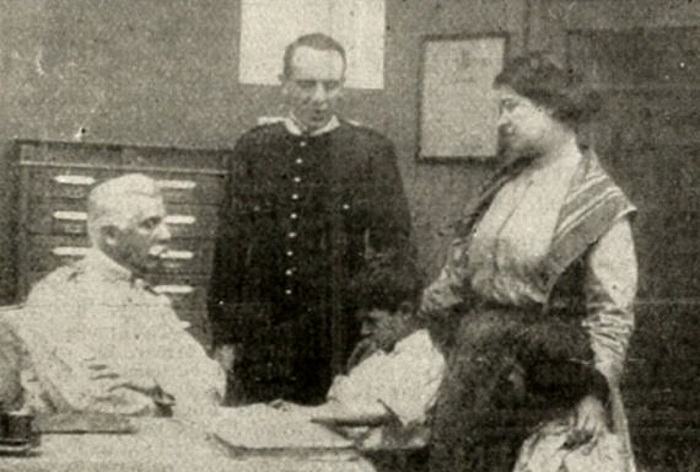
Imagine a world where the crackle of a single rifle shot echoes louder than any spoken dialogue, where the flicker of an intertitle carries the weight of a Dickens chapter, and where the creak of a uniform collar can break your heart more decisively than any orchestral swell. That world is The Heart of a Police Officer, a 1911 Italian one-reeler that somehow crams the moral heft of Les Misérables into twelve soot-black minutes.
Director-writer Enrico Gemelli, usually dispatched to chronicle processions and pageants, here trains his static camera on the human face as if it were a topographical map of conscience. The resulting topography is jagged: furrows of desperation across Alberto Capozzi’s brow, the tremulous hope in the eyes of two consumptive children, the metallic glint of duty in Officer Moretti’s gaze. Shot on the fog-veiled shores of Lake Como—stand-in for an unnamed Po-valley outpost—the film’s ambience is a character in itself: reeds bowing like penitents, half-frozen water the color of tarnished pewter, snowflakes that descend like unpaid debts.
Plot, on paper, is rudimentary: need vs. prohibition, trespass vs. penalty. Yet Gemelli’s staging agitates the clichés until they bleed. Note the first interior of the Canti hovel: a single oil lamp carves chiaroscuro so severe it turns the family table into an altarpiece. When the doctor slaps down a vial of quinine—price three francs—the sound is merely implied, yet the thud lands in the viewer’s stomach. Poverty here is not costume-shop rags but a palpable pressure, like altitude sickness.
Capozzi, a matinée idol more accustomed to swashbucklers, strips his persona to the sinew. His Frank Canti is a man who has measured the world in cartridges and now finds the ledger catastrophically short. Watch the micro-movement when he fondles the advance coins: thumb rubbing the embossed laurel of the Republic as though trying to erase it. The gesture is wordless exposition of a soul bargaining with itself.
The Count’s preserve—rendered through a matte painting that would look naïve were it not drenched in moonwash—functions as a liminal space between Eden and Empire. When Canti steps over the boundary, Gemelli cuts to a goose’s-eye panorama: the hunter a black hyphen against silver reeds, the cosmos indifferent. The moment of the shot is elided; we jump directly to the echo, a cloud of mallards scattering like ash. This ellipsis is masterful: it prevents the viewer from savoring illicit thrill, thrusting us instead into the aftermath where conscience begins its acid work.
Enter the gamekeeper, a stock villain elsewhere, here granted a subplot of thwarted desire: he stalks Canti’s wife through over-the-shoulder glances, his testimony in court tinged with erotic vengeance. The film never condones him, yet his bitterness tastes of lived experience, not moustache-twirling villainy.
At midpoint the film shifts vantage, alighting on Officer Moretti—played with magnificent restraint by Giuseppe de Witten. Introduced counting his hoarded sous, he becomes a metronome of duty ticking toward compassion. The envelope—flimsy paper talisman—assumes totemic power. Observe how Gemelli films its transfer: a close-up of Moretti’s hand clutching the stipend, then a cut to the lieutenant’s counter, then a reverse shot withholding facial reaction. The montage is Eisenstein before Eisenstein, implying that money, not character, is the true protagonist of modernity.
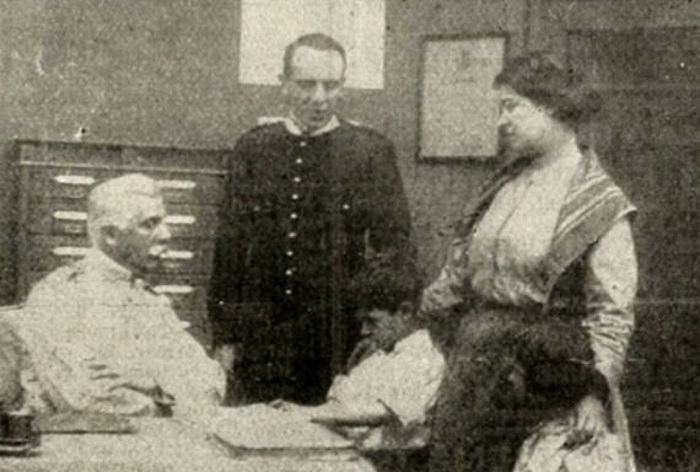
But the film’s coup de grâce arrives via the children. When Moretti appears at the Canti threshold, toddlers clutch his knees with the instinctive clamber of koalas. One expects pathos; what we get is a seismic jolt. The officer’s helmet, symbol of state force, becomes plaything; the baton metamorphoses into rocking horse. In this anarchic tenderness, the entire legal edifice totters.
Recent restoration by Bologna’s Cinémathèque reveals original hand-painted tints: amber hearth-light, livid cobalt for night exteriors, and—most startling—rose blush suffusing the final reel. The chromatic arc literalizes moral thaw, moving from frigid blues to incandescent oranges, culminating in that blush of communal absolution. It’s a visual grammar that renders intertitles almost redundant.
Compare this chromatic strategy to the stark monochrome of From the Manger to the Cross or the pageant excess of Cleopatra (1912). Gemelli’s nuanced palette anticipates the emotional colorism of later European art cinema, presaging hues in The Redemption of White Hawk without that film’s didactic overlay.
Contemporary viewers, jaded by CGI hyperbole, may smirk at the film’s single duck prop—clearly wooden, its wings articulated by visible wires. Yet that artifice amplifies reality: the hunt is revealed as transaction, not sport. The duck is pure exchange value, a 300-franc cipher. In an age of algorithmic finance, the metaphor lands with renewed sting.
Gender politics, admittedly, are period-standard: wives function as passive icons of virtue. Yet the moment when Mrs. Canti confronts Moretti in the street—bonnet askew, breath fogging—carries proto-feminist charge. She navigates public space with urgent purpose, her gaze daring the constable to translate statute into human terms.
Economics undergirds every frame. The film’s true tension is not between legality and criminality but between two accounting systems: the state’s ledger of fines and the heart’s ledger of grace. Moretti’s sacrifice zeroes both columns, revealing them as spectral. When the lieutenant reimburses the constable, he signs the closing entry with ink distilled from empathy.
Historians of early cinema often pigeonhole Italian output of the 1910s as declamatory spectacle—peplum epics like The Last Days of Pompeii or nationalist tracts such as The Independence of Romania. The Heart of a Police Officer slips between those classifications: too intimate for bombast, too socially incisive for pastoral idyll. It is, in essence, a piccolo Les Mis, minus the barricades.
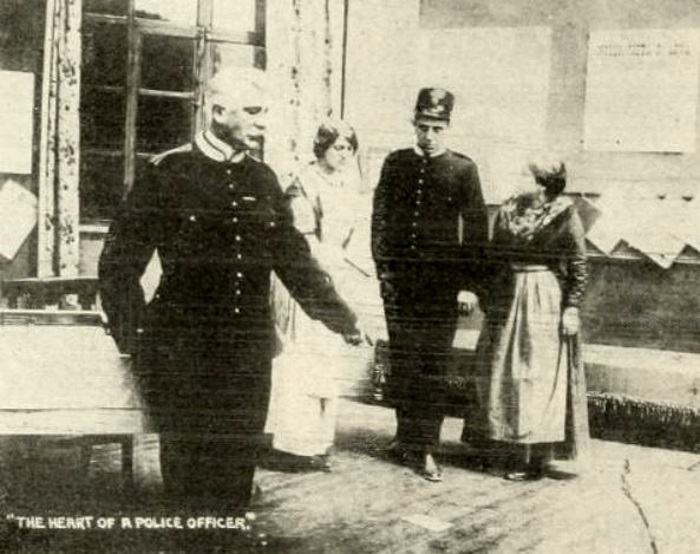
Capozzi’s later career leaned toward florid gesturing in historical pageants; here he practices performative minimalism. Note the slump of shoulders when the verdict is read: not operatic collapse but the slow leak of vitality, as if someone pulled a hidden stopper. Conversely, de Witten’s Moretti ages a decade in the seconds required to open the returned envelope; his blink rate slows, pupils dilate—a masterclass in micro-acting that rivals Renée Falconetti’s later travails.
Children’s performances resist the cloying, thanks to Gemelli’s tactic of filming their spontaneity first, then building the scene around the footage. Result: giggles that feel stolen from documentary time, inserting vérité into melodrama.
What lingers, long after the restoration’s end-flare, is the film’s proposition that institutions are only as rigid as the individuals who animate them. The police uniform—synonymous with repression in modern protest footage—here becomes canvas for moral improvisation. Moretti’s act of fiscal transubstantiation (wedding money → fine money) sanctifies both state and citizen, fusing them into a single breathing polis.
Viewers allergic to piety need not fear; the film eschews sermons. Its closing shot—families clustered around a modest table, wine jug passed hand to hand—evokes Caravaggio’s Supper at Emmaus re-staged by social realists. No miracle occurs except the miracle of mutual recognition.
If you curate a silent-film evening, pair this gem with the snowy tableaux of Glacier National Park for a thematic diptych on wilderness ethics. Or juxtapose it with Traffic in Souls to chart divergent treatments of institutional corruption. Whatever the context, allow the tints to breathe—project at reduced speed (18 fps rather than standardized 24) so the amber glow hovers like candlelight on retinas.
Ultimately, The Heart of a Police Officer is a brief, blazing proof that cinema’s infancy could already cradle complexity, that a nickelodeon audience hungry for sensation could be stealth-fed a graduate seminar on ethics. The film survives only because a Ligurian priest rescued a vinegar-soused print from a parish basement; its scars—scratches, water stains—testify to journeys as perilous as any undertaken by its fictional characters. Embrace those blemishes: they are the patina of time endorsing art’s wager on humanity.
Verdict: A pocket-sized masterwork that earns its tears without bullying, a 1911 relic that feels embarrassingly relevant to every modern conundrum where wallet and conscience tug in opposite directions.

IMDb —
1936
Community
Log in to comment.