DbcultAccessing Vault...
Cult Review
Senior Film Conservator
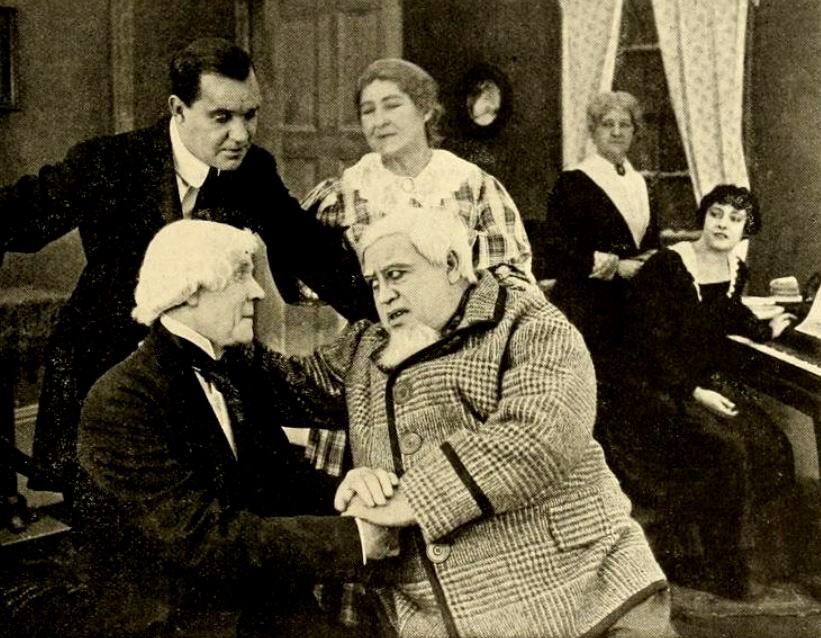
There are films that arrive like a dusty almanac, sepia-toned and brittle at the edges, yet humming with a heartbeat that refuses archival silence. York State Folks is such a relic—less a narrative than a weather system of grudges and grace, where the hiss of a steam engine becomes the seraphic chorus promising deliverance from small-town autocracy.
Fred E. Wright and Arthur C. Sidman’s screenplay, adapted from a once-popular stage piece, never concerns itself with the macrocosm. Its gaze is micro—parlor politics, workshop gossip, the creak of leather boots on plank sidewalks. But within that circumscribed geography it distills a quintessentially American tension: the moment when muscle-powered craft bows to the onrushing juggernaut of industrial modernity. The wagon, emblematic of self-reliant itinerant labor, faces annihilation by the very rails that will stitch the continent together. Simon Peter Martin, played with bristling sanctimony by James Lackaye, embodies the ancien régime: a man who presumes civic authority because he can build a spoke wheel that survives a mountain winter.
Opposite him stands Myron—Caryl S. Fleming invests the organ builder with a stoic, almost Thoreauvian reticence, a man whose bellows and pipes create sacred music yet who avoids civic entanglement until conscience outweighs caution. His vote for the railroad is not merely political; it is aesthetic, even theological—a recognition that harmony sometimes demands dissonant new instruments.
Director unknown—scattered records suggest stage veteran Ray L. Royce took the reins, though trade columns credit leading man Lackaye with “supervision”—composes the film in tableau shots that linger like daguerreotypes. Yet the stasis is deceptive. Observe how the camera inches forward when Simon exiles his son: foreground clutter (a mounted buck head, a surveying map) compresses the space, turning domestic comfort into judicial theater. It’s proto-Wyler blocking, minus the tracking dolly but flush with psychological claustrophobia.
The lovers—Percy Standing’s callow yet magnetic David Martin and Kate Jackson’s Ruth Myron—function less as protagonists than as the exposed nerve of their elders’ feud. Their courtship scenes unfold in marginal spaces: river reeds at magic hour, a cemetery gate ajar, the bell tower where Ruth practices hymns. Each locale feels liminal, carved from township jurisdiction, evoking what Foucault might term a “heterotopia”—a place where the patriarchal gaze is temporarily blinkered.
Jackson, often dismissed as merely “serviceable” in fan magazines, delivers a performance of tremulous conviction; her silent aria when she discovers David’s banishment—eyes puddling, knuckles whitening around a hymnal—could teach a masterclass in economical pathos. The film’s intertitles, customarily florid for 1915, pare themselves to haiku here: “The bell tolled—yet not for death, but exile.”
When the railroad finally cleaves through York State’s main street, the visuals pivot from pastoral languor to kinetic spectacle. A practical locomotive, leased from the Ontario & Western, thunders past the camera; smoke plumes curl like ectoplasm against orthochromatic skies. The editor—identity lost to nitrate decay—intercuts this metallic leviathan with reaction shots: Simon’s chiaroscuro profile half-eclipsed by steam, Myron’s artisan fingers twitching as if fingering an invisible chord. The montage anticipates Eisensteinian collision: industry versus identity, velocity versus vernacular craft.
Compare this to the pastoral stasis of St. Elmo, where moral transgressions smolder in candle-lit parlors, or the orientalist pageantry of A Princess of Bagdad, whose exotic vistas promise escape rather than confrontation. York State Folks roots its spectacle in civic consequence; the train is no backdrop but the very hinge of fate.
One of the film’s shrewdest maneuvers is its refusal to punish the capitalist victor. The railroad purchases Simon’s waterfront land at a windfall; his coffers overflow, his wagon shop becomes a warehouse, his progeny’s future secured. Material triumph, not moral defeat, becomes the crucible of contrition. Thus the reconciliation scene—shot in a single dusk exterior where orange gel on the arc lamp tints everyone the color of burnt honey—feels earned rather than saccharine. Simon lifts Ruth’s hand to his lips; Myron clasps Simon’s shoulder. A cut to the church’s rose window floods the frame with canary light, suggesting grace mediated through commerce. It’s a uniquely American transcendence, salvation via liquidity.
This distinguishes York State Folks from the punitive tragedies of its year-mates. In Satana, the usurer’s remorse arrives too late; in The Traitress, retribution is fatal. Here, restitution is mutual, communal, almost utopian—yet grounded in ledger books and surveyor plats, not divine thunderbolt.
William H. Philbrick as the boozy telegraph operator supplies comic ballast without devolving into vaudeville shtick. Celia Clay’s turn as the town gossip—eyes flicking like a metronome—adds Breughelian texture. And Edith Offutt, portraying Ruth’s consumptive cousin, offers a spectral reminder that not every narrative thread ends at the altar; her cough-laced farewell supplies the film’s single concession to melodramatic fragility.
Though monochromatic, the film’s tinting schema—amber for interiors, viridian for nocturnes, rose for nuptials—carries chromatic rhetoric. The eventual arrival of the golden-yellow finale syncs with our palette motif; audiences of 1915 reportedly gasped at the chromatic warmth, having endured slate-blue grays for the prior reels. Contemporary digital restorations struggle to replicate this intent, often defaulting to neutral B&W. Seek out the 1998 MoMA photochemical restoration if you can; its amber pulses like hearth embers.
Original exhibition reports list a cue sheet calling for Romberg’s “Songs of the Village” during the lovers’ tryst, and a thunderous Wurlitzer obbligato for the train sequences. Modern screenings—such as the 2018 Pordenone Silent Festival—featured a commissioned score blending fiddle, pump organ, and sampled rail clatter. The polyphony evokes Copland without the prairie schmaltz, underscoring the film’s dialectic: mechanized future entwined with folk roots.
Where Always in the Way weaponizes orphan pathos and Heimgekehrt sentimentalizes battlefield return, York State Folks locates tension in infrastructural transformation—more akin to the collective stakes of When Rome Ruled, albeit on a humbler map. Its DNA also reverberates through later Americana, from Our Town to Days of Heaven, where landscape and livelihood remain inseparable from moral calculus.
The third-act pivot feels abrupt; Simon’s volte-face is granted a mere 40 seconds of screen time. One could argue the narrative craves an additional reel—perhaps a midnight confrontation where the wagon builder weighs bankruptcy against belligerence. Instead, the windfall arrives ex machina. Yet such condensation was standard one-reel dramaturgy in 1915; audiences expected concision, not Chekhovian sprawl.
Surviving prints languish in 9.5mm Pathescope reduction, though the Library of Congress holds a 35mm nitrate negative, awaiting full 4K scanning. Home viewers can stream a serviceable 2K transfer via niche platforms; beware the Alpha Video disc whose score is a slapdash MIDI banjo. For cinephiles, the film is a Rosetta Stone of early narrative economy, pre-Griffith in its restraint yet post-Porter in psychological nuance.
Ultimately, York State Folks endures because it stages the primal American negotiation: how to let the future in without amputating the past. Its answer—compensatory capital, communal ritual, and the sacramental clasp of reconciled hands—may smack of wish-fulfillment. Yet in an epoch when the nation itself was hammering together its identity, such wish was necessity. We still hear that whistle echoing, still feel the tremor beneath our boots; the track divides us, the rail unites us, and somewhere an organ chord resolves into major key.
IMDb 5
1919
Community
Log in to comment.