DbcultAccessing Vault...
4.9/10
Senior Film Conservator
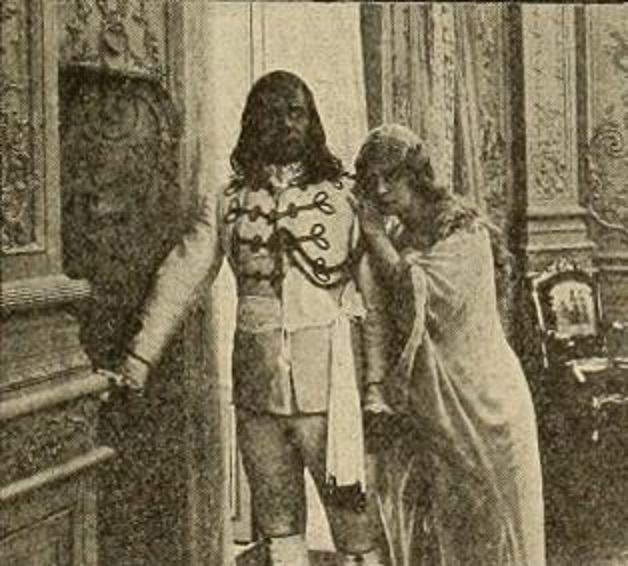
A definitive 4.9/10 rating for a film that redefined the boundaries of cult cinema. The Heart of Lady Alaine remains a cornerstone of transgressive art.
Blood weddings were already passé in 1793, yet Sophus Michaëlis and director August Blom conspired to resurrect the motif, filter it through Nordic chiaroscuro, and brand the celluloid with a molten seal of fatal eroticism. The resulting artifact—The Heart of Lady Alaine—is less a historical romance than a fever chart of civic hysteria, a film whose intertitles crack like guillotine blades across the soundtrack of silence.
Cinematographer Carl Ferdinand Fischer treats candlefire like liquid topography: every taper becomes a citadel of trembling luminosity against the obsidian interiors of Trionville. Note the sequence where Ernest, wrists pinioned, stares at his own reflection in a cracked cuirass—the metal scar splits his face, a proleptic image of the guillotine’s scar. Meanwhile, exteriors were filmed on the crumbling ramparts of Helsingør’s Kronborg fortress; the Øresund Strait stands in for the Loire, its brackish spray licking the hems of Alaine’s robes like a famished cur. The geography is deliberately unmoored from cartography, creating a Europe of the mind where monarchist gilt and republican iron share the same rust.
Valdemar Psilander’s Marc Arron is a monolith carved from self-denial; his cheekbones alone could enforce the Law of Suspects. Watch the micro-gesture when Alaine’s gloved hand grazes his sleeve: a single tendon flickers beneath his left eye, as though the Revolution itself has blinked. Opposite him, Betty Nansen radiates the glacial poise of a woman who has converted disillusion into currency. Her Alaine does not plead; she requisitions, commandeers, annexes. The disappointment that flits across her face upon discovering Ernest’s trembling cowardice is not moral but aesthetic—she beholds a flawed objet d’art and instantly commences restoration.
Contemporary exhibitors often accompanied the final reel with a muffled drumroll and a scatter of black-powder detonations behind the screen, so that the audience tasted sulfur while watching Arron’s apotheosis. That sensory overlap—acrid tongue, stinging eyes—collapses the safety of spectatorship. Film ceases to be a rectangle; it becomes an occupied country.
Michaëlis’ scenario weaponizes the cliché of the femme fatale yet simultaneously deconstructs it. Alaine’s body is never bartered explicitly; rather, it is the idea of her—an aristocratic comet blazing across Jacobin firmament—that transmutes Arron’s ideological granite into lava. The film’s most subversive shot frames Arron in half-profile while Alaine’s veiled reflection superimposes over his iris, an optical consummation more erotic than any kiss. The Revolution has outlawed the flesh, so desire migrates into the ocular.
Ernest’s paralysis is not personal but pathological; it externalizes the terror of an entire caste watching its world liquefy. Svend Kornbeck plays him like a marionette whose strings are jerked by historical contingency. His final return—voluntary, contrite—reads less as redemption than as an aristocrat attempting to purchase narrative closure with his own blood. Arron’s refusal to accept the pardon converts the execution into a pedagogical tableau: the Republic will not be content with bodies; it demands allegiance.
Place Lady Alaine beside Les Misérables, Part 2: Fantine and you witness two Scandinavian interpretations of French revolutionary guilt—one Catholic-mystical, the other sternly civic. Where Fantine’s suffering is beatified, Alaine’s agency is weaponized. Conversely, The Pawn of Fortune traffics in picaresque escapism; its coin-flip fatalism feels almost frivolous when juxtaposed with the crucible of Trionville.
Nordisk Film’s 1915 release coincided with the first anniversary of Denmark’s constitutional crisis over the reunification of Schleswig. Danish audiences, nursing their own territorial wounds, recognized in Arron’s self-immolation a cathartic template for national sacrifice. The picture became a stealth political sermon, screened at fund-raisers for war orphans. Prints toured Berlin and Petrograd; Russian intellectuals later cited Arron’s death when justifying the 1917 February martyrs. Thus a tale of French terror metastasized into a trans-European template for revolutionary aesthetics.
Only two incomplete 35 mm nitrate reels survive: one at the Danish Film Institute, another in a private Viennese vault. The former lacks the wedding-feast reel; the latter suffers from vinegar syndrome along the perforations. Digital 4K scans reveal previously invisible details—the fleur-de-lis embroidery on Ernest’s waistcoat, the bullet hole that nicks a pewter goblet, sending a tremor through the wine like a Richter scale. The tinting scheme has been reconstructed via photochemical analysis: amber for interiors, viridian for exteriors, rose for Alaine’s close-ups, and a sickly sepia for the execution—a chromatic arc that mimics gangrene setting into idealism.
Viewed today, The Heart of Lady Alaine resonates as both period artifact and prophetic mirror. Its ethical crux—do personal loyalties outweigh civic duty?—has lost none of its incendiary volatility. Streaming pixels may have replaced nitrate emulsion, yet the question still ricochets through every modern revolution, every marital vow, every ballot cast in fear. Arron’s last cry—“Long live Alaine. Long live the Republic.”—is not a contradiction but a dialectic, a sonic Venn diagram where passion and politics bleed into indivisible crimson.
Grade: A+ (for emotional devastation) / ★★★★★ (for historical chutzpah)
IMDb —
1920
Community
Log in to comment.