DbcultAccessing Vault...
Cult Review
Senior Film Conservator
A mansion stuffed with Fabergé trifles and moth-eaten morals
Wallace Irwin’s screenplay for Help Yourself arrives like a gin rickey spilled on a damask tablecloth—effervescent, irreverent, impossible to pretend it never happened. Director William C. deMille (yes, the less-celebrated but arguably slyer brother) lets every frame simmer in the tension between gilt cages and the animal desire to chew the bars. The film’s first miracle is that it makes a department-store counter feel claustrophobic before we ever see the marble staircase of Aunt Carmen’s empire; Emily’s cramped lunch break is shot in chiaroscuro, the shadows of mannequins looming like unclaimed souls.
The second miracle is how it anticipates every subsequent jazz-age takedown—from The Love Auction’s matrimonial cattle calls to Strictly Confidential’s poison-pen etiquette—yet still feels scaldingly personal.
E.J. Ratcliffe’s Aunt Carmen is a symphony of raised brows and fiduciary contempt; watch how she stubs her cigarette on a Sèvres saucer as though extinguishing Oliver’s future. Ratcliffe never overplays—she simply lets the camera catch the micro-twitch when Emily utters “love” instead of “prospect.” Beside her, Madge Kennedy’s Emily vibrates like a tuning fork struck by two hammers: gratitude and lust. One moment she’s a schoolgirl ogling silk stockings; the next she’s a conspirator in her own heartbreak, eyes pooling with the knowledge that every gift from her aunt is a lien on her pulse.
When the film pivots to Rosamonde’s soirée, DeMille swaps chiaroscuro for incandescent clutter. The camera pirouettes through a labyrinth of beaded dresses, cigarette holders, and a string quartet sawing out a mangled tango. Enter Professor Syle—Roy Applegate plays him with the carnivorous charm of a man who has read Marx between cabarets and decided both make fine lubricants for seduction. His lecture is a burlesque of dialectics: “Property is theft, my dear—but until the revolution, do try the caviar.” The guests titter as though he’s performing card tricks, yet the butler’s tray rattles like distant artillery.
DeMille’s visual punchline: a slow dissolve from Syle’s clenched fist to the servant’s white-gloved hand offering foie gras—revolution and servitude served on the same silver salver.
The expedition to Greenwich Village is staged like a pagan procession—top hats bobbing among burlap skirts, torchlights flickering across cobblestones. Cinematographer L. Guy Wilky shoots the Village loft in low-angle shadows so the rafters resemble a cathedral desecrated by excommunicants. Here Emily glimpses free love sketched in chalk on cracked walls, hears ukuleles strumming Shostakovich before it’s fashionable, and realizes that freedom can be another gilded cage, just with worse plumbing.
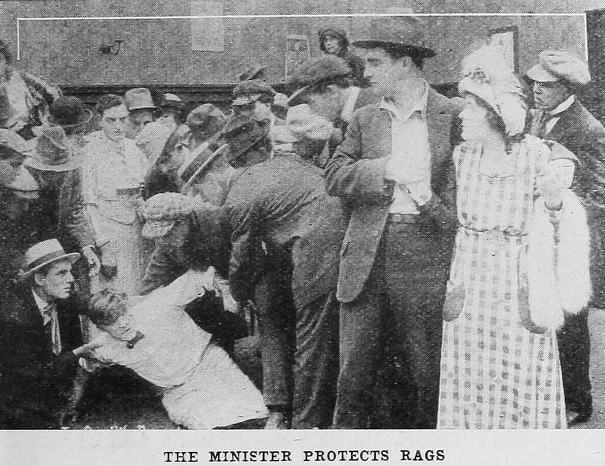
Back in Aunt Carmen’s ballroom, the third act detonates. The Bohemians arrive like exotic parasites, shedding boas and inhibitions. Vodka flows from tea spouts; someone mistakes a Ming vase for a chamber pot. A woman in a chemise recites Akhmatova while standing on the grand piano; the pedals are pressed by a man wearing only spats. The chaos is filmed in overlapping double exposures—faces melting into wallpaper, chandeliers morphing into handcuffs—suggesting that excess and repression are conjoined twins.
Oliver’s entrance is a masterclass in minimalist heroism. Joseph Striker doesn’t swagger; he simply walks through the rabble as though threading a needle, politely disarming a poet who brandishes a candelabrum like a cossack saber. With the servants—whose alliance he’s quietly cultivated by learning their names and their children’s birthdays—he orchestrates a counter-revolution of civility: windows flung open, cold dawn pouring in, guests herded into overcoats. The camera lingers on Emily’s face: half mortification, half revelation that love can be a janitor as well as a poet.
The dénouement weds satire to soap bubble. Emily and Oliver’s modest ceremony is shot in a garden at golden hour—DeMille lets the lens flare until the frame seems baptized in honey. Meanwhile, Vera Ballymore’s marriage to Professor Syle is a cathedral affair, flashbulbs popping like muskets. Cross-cut editing juxtaposes Emily’s hand-me-down dress with Vera’s train of imported lace, implying both women have bartered something—only the currency differs. In the final shot, Syle stands at a gilded podium, lecturing a ballroom of tuxedos about the dictatorship of the proletariat while his wife tallies ticket sales. Fade-out on Emily and Oliver boarding a streetcar, destination unspoken, but the conductor’s grin says the fare is paid in full.
Performances to engrave on celluloid memory:
DeMille repeatedly frames characters in doorways: thresholds as liminal spaces where identities can be doffed like overcoats. When Emily first crosses into her aunt’s mansion, the doorway eclipses her silhouette, swallowing her in stained-glass gloom—an omen that philanthropy can be a form of abduction. Later, Oliver stands in the same doorway, but the camera now shoots from inside; the outside world glows, reversing the polarity of captivity.
Notice too the color symbolism in intertitles (restored prints tint them): Bolshevik speeches washed in sulfurous yellow, declarations of love in bruised sea-blue, Aunt Carmen’s edicts in imperial orange. The palette sneaks ideology into your retina before your brain can file a protest.
Though the film predates synchronous dialogue, its anxiety about performative wokeness feels Twitter-zeitgeist. Syle’s commodified radicalism anticipates every influencer who monetizes resistance with merch drops. The film’s genius lies in refusing to crown either side—bohemia and ballroom are twin engines of self-delusion. Only Emily and Oliver’s modest, almost off-screen partnership hints at an exit: choose the person over the pose.
Streaming: currently cycling through boutique services specializing in 4K restorations—search under “Kino Jazz-Age Vault” or your platform’s “Silent Satire” bundle. For thematic double-features, pair with The Cinderella Man to see how class mobility was massaged into farce just two years later, or Sadie Goes to Heaven for another working-girl daydream that ends in disillusioned matrimony.
Physical media: Flicker Alley’s 2022 Blu-ray offers a 2K scan from the sole surviving nitrate print, plus a commentary by cultural historian Dr. Mara Epstein that unpacks the vodka-fueled third act as an allegory for America’s cyclical Red Scares.
Help Yourself is less a relic than a ricochet: it zings through gilded drawing rooms, ricochets off cobblestone basements, and lands somewhere in your contemporary feed where revolution is hashtagged and honeymoon registries crowdsource down-payments. Watch it for the slapstick bacchanalia, rewatch it for the chill recognition that every era believes it has just discovered authenticity—then invoices the next generation for the privilege. DeMille, Irwin, and company hand us a cracked mirror: laugh, wince, but don’t dare call it antique.
Verdict: 9.2/10 – a silent that refuses to shut up.

IMDb 5.2
1919
Community
Log in to comment.