DbcultAccessing Vault...
Cult Review
Senior Film Conservator
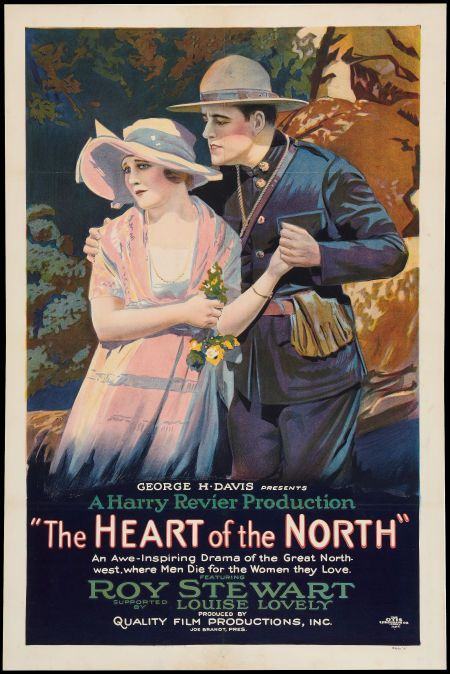
The silent era often grappled with the primitive struggle between civilization and the untamed wild, but few films encapsulate this dichotomy with the sheer visceral intensity found in The Heart of the North. Released in 1921, this production is more than a mere 'Northern'; it is a sprawling moral inquiry into the nature of nurture versus heredity, played out across a canvas of frost and flame.
At the center of this boreal tapestry is Roy Stewart, an actor whose physical presence commanded the screen with a rugged, almost granite-hewn stoicism. In this film, Stewart is tasked with a double role that demands a nuanced separation of spirit. As John, the lieutenant of the Northwest Mounted Police, he embodies the rigid, almost monastic devotion to the law that defined the Canadian colonial mythos. Conversely, as 'Bad' Maupome, he must tap into a more atavistic, predatory energy. This split-screen performance, while technically constrained by the era's optical limitations, succeeds through Stewart's ability to alter his posture and the very cadence of his gaze.
Unlike the lighthearted masquerades found in Twin Bed Rooms, the duality here is treated with a grave, almost Shakespearean weight. We see the 'bad' brother not merely as a villain of convenience, but as a tragic distortion of the potential seen in the 'good' brother. It is a cinematic reflection on how the same blood can boil with either justice or malice depending on the soil in which it is planted.
The technical achievements of The Heart of the North are particularly striking when one considers the logistical nightmares of filming in 1921. The forest fire sequence, where John rescues Patricia Graham (played with a luminous fragility by Louise Lovely), remains a staggering piece of practical filmmaking. The orange-tinted frames of the original nitrate prints would have made the screen seem to physically radiate heat. The smoke and the collapsing timber provide a chaotic backdrop that mirrors the internal turmoil of the characters.
Contrast this with the opening snowstorm—a sequence that establishes the harsh, indifferent power of nature. This isn't the sanitized, studio-bound winter of lesser films like The Barnstormers; this is a landscape that feels actively hostile. The cinematography uses the white-out conditions to isolate the characters, emphasizing their vulnerability before the providence of Father Ormounde. It is this environmental storytelling that elevates the film above the standard melodrama of its time.
In many ways, the film functions as a religious allegory. Father Ormounde is the silent observer, the hand of fate that rescues the twins but cannot control their ultimate trajectory. His role is reminiscent of the spiritual themes explored in Faith, where the divine is often found in the most desolate of places. When Ormounde eventually discloses the bandit's identity in the cabin, it isn't just a plot point; it's a moment of spiritual reckoning. The revelation of brotherhood serves as a catalyst for the final act's descent into tragedy and eventual redemption.
The film doesn't shy away from the darker aspects of frontier life. The looting of the Indian village and the mistreatment of Rosa at De Brac’s trading post provide a grim realism that was often missing from contemporary romances like The Charming Deceiver. Here, the North is a place where civilization's thin veneer is easily stripped away, revealing the raw, often ugly mechanisms of power and desire.
The second act of the film hinges on a classic trope: the stolen identity. When 'Bad' Maupome dons the police uniform to rob Patricia’s father, the film enters the territory of the psychological thriller. The visual metaphor of a criminal wearing the skin of the law is potent. It forces the audience to confront the fragility of authority. John’s subsequent arrest and escape transform the film into a proto-noir chase sequence through the wilderness. The pacing here is relentless, eschewing the slower, more theatrical development of The Daughters of Men in favor of kinetic action.
The pursuit through the storm is where the film’s editing truly shines. The cross-cutting between the fleeing John and the predatory 'Bad' Maupome creates a sense of inevitable collision. We are not just watching two men; we are watching two halves of a whole rushing toward a final, violent synthesis.
The resolution of The Heart of the North is famously providential. While some modern viewers might find the 'falling tree' ending a bit too convenient, within the context of 1920s storytelling, it is a profound statement on natural justice. Nature, which has been a silent witness to the brothers' diverging paths, finally takes an active role. The tree that crushes 'Bad' Maupome is a manifestation of the 'Heart of the North' itself—an ancient, unyielding force that corrects the imbalance caused by Maupome’s crimes.
This ending provides a catharsis that is far more satisfying than the social maneuvering found in The Woman Game. It is a primal conclusion for a primal story. John is cleared not just by Patricia’s testimony, but by the physical erasure of his dark mirror. The happiness they find together in the end feels earned, forged in the literal and metaphorical fires of the Canadian frontier.
When placed alongside other films of the era, such as the mystery-laden The House of Intrigue or the character-driven The Busher, The Heart of the North stands out for its atmospheric commitment. It doesn't rely on urban sophistication or comedic relief. Instead, it leans into the 'Mountie' mythos with a sincerity that is both refreshing and historically significant. The film helped solidify the image of the Northwest Mounted Police in the global imagination—a symbol of order in an entropic world.
The casting of Louise Lovely, an Australian actress who became a major star in Hollywood, adds another layer of interest. Her performance here is more substantial than the typical 'damsel' role. She is the witness, the survivor of the fire, and the ultimate arbiter of John’s innocence. Her chemistry with Stewart provides the emotional core that prevents the film from becoming a purely cold, procedural exercise.
In the final analysis, The Heart of the North is a triumph of early silent cinema. It manages to balance high-stakes action with a surprisingly deep exploration of human nature. While it shares some DNA with the sensationalism of The Whip, it possesses a rugged dignity that is all its own. The film’s ability to use the landscape as a character—a judge, a jury, and a setting—presages the great Westerns of the later decades.
For those interested in the evolution of the action genre or the history of Canadian-set cinema, this film is an essential artifact. It reminds us that even in the silent era, the screen could speak volumes about the complexity of the human soul and the enduring power of the wilderness. It is a film of fire and ice, of blood and duty, and ultimately, of the light that survives the storm.
IMDb —
1935
Community
Log in to comment.