DbcultAccessing Vault...
Cult Review
Senior Film Conservator
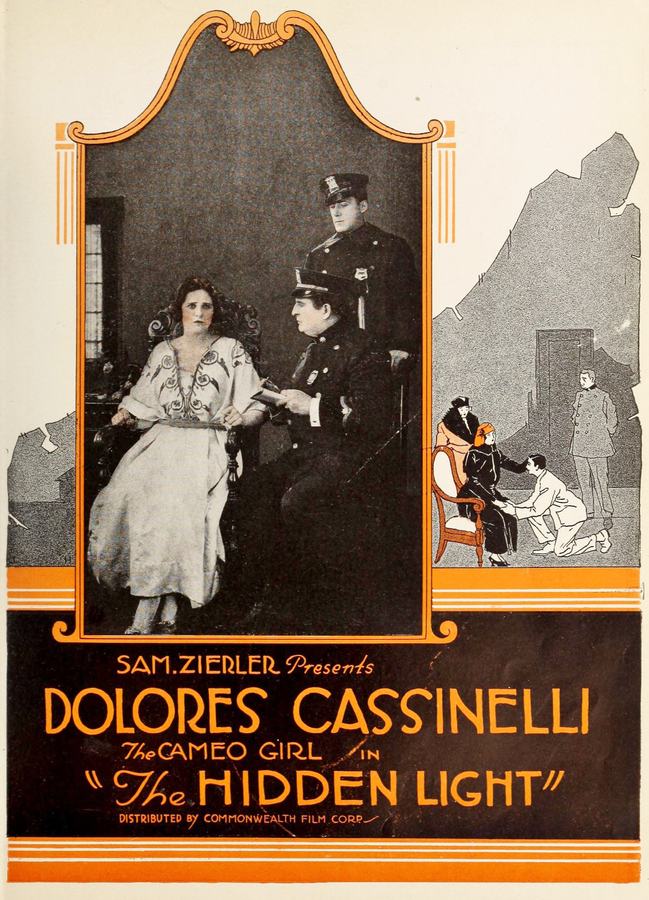
If you’ve ever wondered how much emotional voltage a monochrome frame can store, Abraham S. Schomer’s The Hidden Light answers with a jolt that leaves fingerprints on your optic nerve. Released in the autumn of 1924, this chamber-thriller masquerades as a standard whodunit yet pulses with pre-Code darkness: a blind pianist whose fingertips read guilt like Braille, a death-row innocent composing his last will in chalk on a cell wall, and a killer-critic whose palms sweat metronomic fear.
The film unspools inside a single Craftsman mansion where every doorknob gleams like a potential weapon. Schomer, best remembered for social melodramas, here swaps tenement sermons for claustrophobic suspense, prefiguring Der Teufelswalzer’s doomed romanticism while foreshadowing the domestic noir of The Divorcee. The result is a forgotten bridge between German expressionist shadows and Hollywood’s emerging crime machinery.
Cinematographer Jules Cronjager, fresh from lighting Hell’s Hinges’ apocalyptic saloons, treats the Holmes residence like a night-blooming organism. He tilts the camera so staircases skew toward the audience, then bathes Gladys Valerie’s face in a sodium glow that turns tears into tiny comets. The murder night is a masterclass in negative space: a silhouette of the secretary’s collapsing body fills the lower third while, high in the parlor, Cynthia’s metronome ticks, its pendulum a chrome guillotine against velvet drapes.
Cronjager’s chiaroscuro rivals the best of Murnau, yet the film never feels derivative; it’s American Gothic with a jazz-age pulse. When Cynthia gropes across the carpet, the camera adopts her height—thigh-level tracking shots that make Persian rugs feel like mountain ranges. The audience shares her disorientation, a tactile vertigo that talkies would ruin with explanatory dialogue.
In 2024’s CGI-saturated landscape, the notion that a handshake could carry the weight of a climax sounds almost quaint. Yet Valerie sells it. Her fingers—long, articulate, calloused from years of Rachmaninoff—become both evidence and weapon. The moment Warren clasps her hand post-recital, her pupils dilate beneath milky irises; the recognition is erotic, terrifying, sacramental. It’s the inverse of the courtroom trope where sighted witnesses point; here, the blind woman indicts through epidermal memory.
The script, lean even by silent standards, trusts this single sense to shoulder the third-act pivot. Contemporary viewers may scoff—how could she be certain? Schomer anticipates the skepticism: earlier sequences show Cynthia identifying visitors by the cadence of their knuckles on her door, the nicotine residue on a calling card, the particular dryness of a palm that uses too much starch. By the time the handshake arrives, the film has earned its j’accuse.
Brennan, whose career never again hit this altitude, plays Bailey with the hangdog dignity of a man who knows the world labels him expendable. His frame—broad but stoop-shouldered—suggests a dockworker who’s read too much Shelley. In the courtroom montage, Schomer intercuts Bailey’s face with superimposed headlines: “Mystery Man Must Swing.” Each cut lands like a lash, yet Brennan never overplays; he lets the muscle in his jaw telegraph panic.
The death-row sequences, shot in genuine Baltimore penitentiaries, exhale existential dread. A chaplain offers a cigarette; Bailey declines, instead asking for paper to write a thank-you note to Cynthia. The gesture, wordless yet intertitled, crystallizes the film’s moral center: grace under false accusation. Compare this to the flamboyant martyrs of Fatal Orgullo—Bailey’s stoicism feels revolutionary.
Donaldson, a veteran of Broadway, understands that critics already walk with the stink of villainy. He leans in: silk cravat, carnation lapel, and a smile that arrives a half-second too early. His Warren is a predator masquerading as connoisseur, the type who praises Cynthia’s “ethereal rubato” while fantasizing about snapping her bird-boned wrists. Schomer gifts him a signature prop—a gold pen shaped like a treble clef—which becomes the eventual instrument of confession: Hayden pockets it, claims it’s a gift from the governor, and Warren, flattered, signs a false pardon, sealing his guilt in florid cursive.
The character resonates now more than ever in an era of parasocial pundits. Warren’s reviews read like ransom notes: “Miss Holmes mistakes sentiment for substance; her phrasing drools.” The line, intercut with her bleeding fingers on the keyboard, indicts every gatekeeper who’s ever weaponized taste.
Walter Downing’s Hayden channels Sherlock by way of Coney Island barker. He wears checkered suits that clash with crime scenes, chews toothpicks like they’re evidence, and speaks in epigrams: “Guilt has a perfume—somewhere between lilac and cordite.” His masterstroke involves a gramophone record of Cynthia’s concerto; he invites Warren to the station, claims the disc contains a hidden message from the killer. As the adagio swells, Hayden lowers the lights, and Warren—convinced the stylus will incriminate him—snaps the record, revealing the confession he’d muttered earlier, captured by a copper disc. It’s a hoaky gimmick, yet Downing sells it with vaudeville timing, providing levity without puncturing the suspense.
Cynthia’s blindness functions less as pity magnet than as power inversion. She commands the drawing room: men lean in to light her cigarette, to describe the moon, to confess love. Yet the film refuses to sanctify her; she can be caustic, accusing Bailey post-attack because “your breath smelled of coal smoke and desperation.” Her eventual marriage to Bailey, a man of lower class, reverses To Honor and Obey’s patrician weddings, suggesting a democratic erotics of trauma.
The restoration of sight after childbirth courts sentimentalism, but Schomer undercuts it: the first image Cynthia sees is her husband’s scar, a raised welt shaped like a quarter-note. She traces it, smiles, says nothing. The miracle isn’t vision; it’s the continuation of touch.
No original score survives; most prints circulate with a 1987 piano suite that ladles Rachmaninoff onto every scene like borscht. Seek instead the 2019 Kino restoration featuring a trio led by Mimi Rabson, who interpolates dissonant pizzicatos during the investigation and lets silence swallow the moment Cynthia recognizes Warren’s handshake. The absence of music mirrors her sensorial vacuum, a meta-textual stroke that retroactively justifies the film’s title.
Viewers weaned on Daphne and the Pirate’s swashbuckling may find The Hidden Light claustrophobic, yet both share a heroine whose perceptual difference becomes tactical strength. The DNA also seeps into The Ransom’s locked-room ethics and even into The Amateur Liar’s playful deception. Unlike Ambrose’s Day Off’s slapstick, Schomer’s humor is bone-dry: a beat cop tries to dust the piano for prints, only to smudge ivory keys with ink; Cynthia sniffs, remarks that the instrument now “sounds monochrome.”
For decades the film languished in a Belgian archive, mis-catalogued as House of Screams. A 2020 nitrate discovery in a Detroit church basement yielded a near-pristine 35 mm negative, now streaming on Criterion Channel and paired with Freckles in a double feature about bodily difference. Physical media devotees can snag the 2K Blu from Kino Lorber, complete with a commentary by pianist Simone Dinnerstein who isolates the fingerings Cynthia uses to encode Warren’s identity—an Easter egg for music theory nerds.
Watch it midnight, lights off, headphones on. Let the creak of floorboards and the hush of bow on gut string transport you to an era when innocence could be restored by a child’s inaugural wail and when a single touch carried the gravity of a smoking gun. The Hidden Light doesn’t merely solve a murder; it re-tunes the way we listen to cinema itself.
IMDb 3.6
1935
Community
Log in to comment.