DbcultAccessing Vault...
Cult Review
Senior Film Conservator
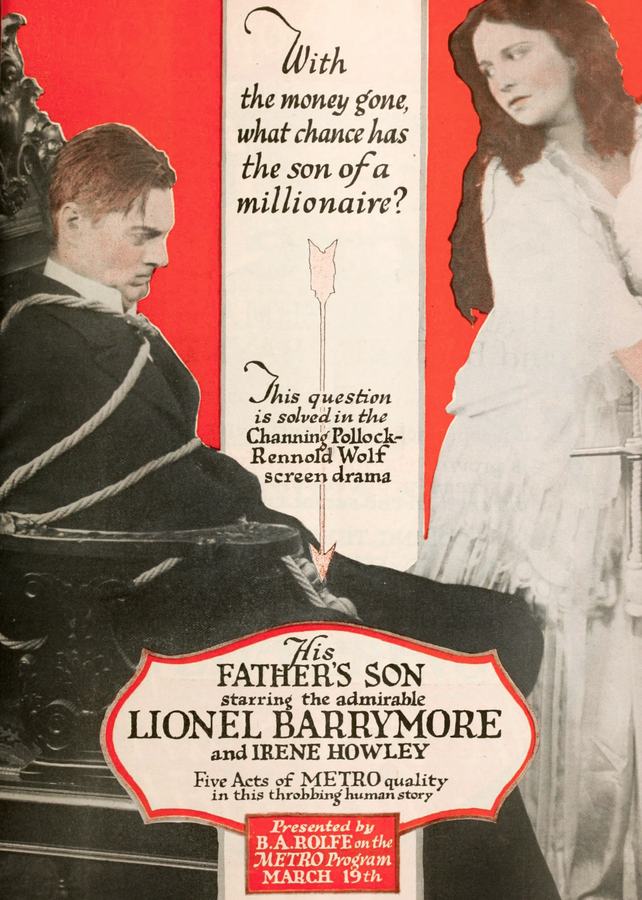
In the annals of silent cinema, where narrative ingenuity often compensated for the absence of spoken dialogue, a particular gem emerges from 1921: His Father's Son. This compelling feature, crafted by the astute minds of June Mathis, Rennold Wolf, and Channing Pollock, transcends mere comedic escapism, offering a delightful foray into the perennial themes of identity, filial expectation, and the transformative power of self-reliance. It's a film that, even a century later, retains a vibrant, almost effervescent quality, largely owing to its intricate plot and the magnetic performance of its leading man, Lionel Barrymore. Far from a simplistic moral fable, it's a wonderfully convoluted journey of a young man forced to navigate the labyrinthine corridors of societal expectations and personal growth, all while juggling mistaken identities and a rather audacious jewel heist.
The narrative pivots on J. Dabney Barron, portrayed with a captivating blend of youthful naivete and burgeoning wit by Lionel Barrymore. Dabney is, to put it mildly, a collegiate disappointment. His academic failures are not merely a plot device but a critical catalyst, igniting the central conflict. His father, a man clearly weary of his son's languid existence, delivers an ultimatum that echoes through the generations: prove your worth, or forfeit your privilege. This isn't just a financial cut-off; it's a challenge, a gauntlet thrown down in the form of a $6,000 wager, daring Dabney to hold a modest $60-a-month position for a specified period. This premise, a wealthy scion forced into the crucible of common labor, is a classic trope, yet His Father's Son injects it with an invigorating freshness through its specific comedic flourishes and the sheer audacity of Dabney's subsequent adventures. It's a testament to the writers' skill that this familiar setup blossoms into something so uniquely intricate, setting the stage for a delightful exploration of character.
Dabney's initial foray into the working world is, predictably, a comedic masterclass in futility. Accompanied by his ever-faithful valet, Perkins (a character who subtly underscores Dabney's privileged past while serving as a comedic foil), his attempts to secure employment are a series of delightful missteps. The scene where Dabney stands in an interminable line for a bookkeeper's position, only for his valet to inadvertently secure the job, is a stroke of genius. It highlights the absurdity of Dabney's predicament – a man of inherent capability, yet utterly unversed in the practicalities of earning a living. This sequence, while humorous, also subtly critiques societal structures and the often arbitrary nature of opportunity. It's a far cry from the more earnest struggles depicted in films like The Squatter's Son, where survival is the primary driver, here, it's about proving a point, a psychological wager as much as a financial one.
The chance encounter with Betty Arden (Florence Natol), whose broken-down automobile provides Dabney an opportunity for chivalrous intervention, adds another layer of intrigue. This serendipitous meeting in the park is more than just a romantic spark; it's a foreshadowing of the intricate web of deception and affection that will soon entangle them both. Betty's hurried departure, leaving Dabney intrigued and slightly bewildered, sets up a classic cinematic "meet-cute" with a twist, as their next meeting will be under vastly different, and decidedly more complicated, circumstances.
Dabney's fortunes finally turn when his friend, Jim Foley of a detective agency, offers him a peculiar assignment: to pose as a butler in the opulent home of millionaire gem collector John Arden. The mission: to safeguard "The Lady of the Sea," a priceless emerald, from a suspected thief. This revelation propels the narrative into a thrilling blend of drawing-room comedy and crime caper. The suspected culprit, Lord Lawrence (Phil Sanford), is not merely an aristocratic guest but "London Larry," a notorious gem thief with a reputation known to the English police. This dual identity adds a delicious layer of suspense, making every interaction a potential cat-and-mouse game.
The immediate discovery that Betty Arden, his employer's daughter, is the very woman he aided in the park, transforms Dabney's mission from a professional duty into a personal crusade to maintain dignity and, perhaps, win her affection. His spontaneous fabrication of an elaborate, utterly preposterous backstory – involving a vast inheritance, a villainous secretary named Slime, an uncle who exploded upon falling after consuming nitroglycerin, and a ceaseless search for his abducted sister – is a comedic tour de force. This moment perfectly encapsulates the film's playful spirit, showcasing Dabney's quick wit and desperate charm. It's a lie so outlandish it verges on the poetic, a testament to the human capacity for invention when faced with social awkwardness. Betty's feigned belief, her eyes twinkling with amusement and perhaps a nascent affection, adds a layer of knowing irony that elevates the romantic subplot beyond mere sentimentality. This is not a simple Romeo and Juliet tale; it's a sophisticated dance of wits and veiled affections.
At the heart of His Father's Son lies the extraordinary performance of Lionel Barrymore. Even in the nascent years of feature filmmaking, Barrymore's command of the silent medium is palpable. He imbues J. Dabney Barron with a nuanced blend of youthful exuberance, comedic timing, and genuine pathos. His facial expressions, gestures, and physical comedy convey a depth of character that transcends the limitations of the era. One can practically hear the internal monologue of Dabney through Barrymore's expressive eyes and the subtle shifts in his posture. He navigates the absurdity of his character's situation—a wealthy man pretending to be a butler, lying about an exploding uncle—with an earnestness that makes the audience root for him, despite the outrageousness of his deceptions.
Barrymore's portrayal of Dabney's evolution, from a spoiled dilettante to a resourceful and determined individual, is particularly compelling. He doesn't merely play a character; he embodies a journey. His interactions with Florence Natol's Betty Arden are charged with a delightful chemistry, a silent repartee that speaks volumes. The scene where he fabricates his ludicrous backstory is a testament to his comedic genius, managing to be both wildly funny and surprisingly endearing. It's a performance that holds its own against his later, more dramatic roles, demonstrating the versatility and range that would define his illustrious career. His ability to convey complex emotions without a single spoken word is a powerful reminder of the artistry inherent in silent film acting.
While Barrymore undeniably anchors the film, the supporting cast contributes significantly to its overall charm. Florence Natol as Betty Arden is a formidable presence, her intelligence and wit shining through her character's knowing glances and subtle reactions. She's not merely a damsel in distress or a romantic interest; she's an active participant in the comedic deception, often one step ahead of Dabney, which adds a layer of delightful complexity to their relationship. Phil Sanford's "London Larry" (Lord Lawrence) is a suitably conniving villain, embodying the aristocratic thief archetype with a sinister elegance that provides a credible threat to the priceless emerald. The interplay between these characters, even without dialogue, is remarkably dynamic, a testament to the direction and the clarity of the screenplay.
The writing team of June Mathis, Rennold Wolf, and Channing Pollock deserves immense credit for crafting such a tightly woven and engaging narrative. The plot, with its multiple layers of deception, mistaken identity, and escalating stakes, could easily become convoluted, yet it remains remarkably clear and consistently entertaining. They manage to balance the comedic elements with genuine suspense, ensuring that the audience is invested not just in Dabney's romantic pursuit, but also in the security of "The Lady of the Sea." Their ability to construct such a rich tapestry of events, culminating in a satisfying resolution, speaks volumes about their understanding of cinematic storytelling in an era still defining its grammar. It’s a far more intricate narrative than, say, the straightforward moralizing of Ignorance, showcasing a sophisticated approach to plot development.
Beyond the laughs and the thrills, His Father's Son delves into profound themes relevant even today. The central conflict of Dabney proving himself to his father is a timeless narrative of parental expectation and youthful striving. It explores the idea that true worth is not inherited but earned through effort and ingenuity. Dabney's masquerade as a butler, a man of service, forces him to confront his own privileged upbringing and develop a newfound respect for labor and responsibility. This journey of self-discovery, prompted by external pressure, is a powerful redemptive arc.
The film also subtly touches upon themes of class and perception. Dabney's initial inability to secure a "normal" job highlights the disconnect between the upper echelons of society and the realities of the working class. His elaborate lie to Betty, designed to maintain his perceived social standing even while in a subservient role, speaks to the anxieties surrounding class distinctions. Yet, ultimately, it is his inherent character, his bravery, and his genuine affection that win Betty over, suggesting that true love and respect transcend artificial social barriers. This nuanced approach to class dynamics is more sophisticated than the stark portrayals seen in some contemporary films, offering a hopeful vision of meritocracy.
The film's climax is a masterclass in escalating tension and satisfying resolution. Dabney, having won his bet and declared his love, finds himself unceremoniously dismissed by John Arden. Yet, his departure is interrupted by the discovery of "London Larry" attempting to steal the emerald. The ensuing confrontation, a silent ballet of struggle and cunning, is exhilarating. Dabney's quick thinking in overpowering Larry and locking him in the safe provides a moment of heroic triumph. However, the momentary victory is short-lived as Arden, misinformed by Larry, turns on Dabney, leading to a perilous situation where our hero is wrongly accused and bound. This dramatic reversal of fortune adds a final, thrilling twist, reminiscent of the intricate plotting in a play like Fedora, where identities and loyalties are constantly questioned.
The timely arrival of Jim Foley, the detective who initially placed Dabney in the Arden household, serves as the ultimate deus ex machina. Foley's identification of Dabney and the subsequent arrest of "London Larry" provide a cathartic release for both the characters and the audience. Dabney is not only vindicated but emerges as a true hero, having proven his courage, resourcefulness, and integrity. The film concludes with a joyous resolution: Betty's promise of marriage and Dabney's triumphant return home to claim his $6,000 wager, having unequivocally demonstrated that he is, indeed, His Father's Son in the most meaningful sense. It's a conclusion that satisfies both the romantic and the adventurous impulses of the narrative.
His Father's Son stands as a vibrant testament to the enduring appeal and sophisticated artistry of early 20th-century cinema. It’s a film that, despite its age, feels remarkably fresh and engaging, thanks to its clever plot, sparkling performances, and thematic depth. The visual storytelling, characteristic of the silent era, is expertly handled, with every gesture, expression, and camera angle contributing to the narrative's clarity and emotional impact. It showcases how much could be conveyed without a single spoken word, relying instead on the universal language of human emotion and action.
For those accustomed to the rapid-fire dialogue and special effects of modern cinema, returning to a film like this is a rewarding experience. It demands a different kind of engagement, inviting the viewer to actively interpret and connect with the visual cues, much like reading a richly illustrated novel. This active participation fosters a deeper appreciation for the craft involved. It's not merely a historical artifact; it's a living, breathing piece of entertainment that continues to captivate and charm. It reminds us that fundamental human stories—of love, ambition, deception, and redemption—are timeless, transcending technological advancements in filmmaking.
In conclusion, His Father's Son is more than just a silent comedy; it's a meticulously crafted narrative that blends romance, mystery, and character development into a cohesive and thoroughly enjoyable package. Lionel Barrymore's central performance is a masterclass, elevating the material and solidifying his status as a cinematic icon. The film serves as a delightful reminder of the ingenuity and charm of the silent era, proving that a well-told story, delivered with conviction and flair, can resonate across generations. It's a film that truly earns its place as a cherished classic, inviting repeated viewings and continued admiration for its timeless narrative and the brilliant minds behind its creation. If you haven't experienced this particular cinematic journey, I heartily recommend seeking it out. It's a narrative that proves that the path to self-discovery is often paved with the most unexpected, and indeed, most hilarious, of deceptions.
IMDb —
1923
Community
Log in to comment.