DbcultAccessing Vault...
Cult Review
Senior Film Conservator
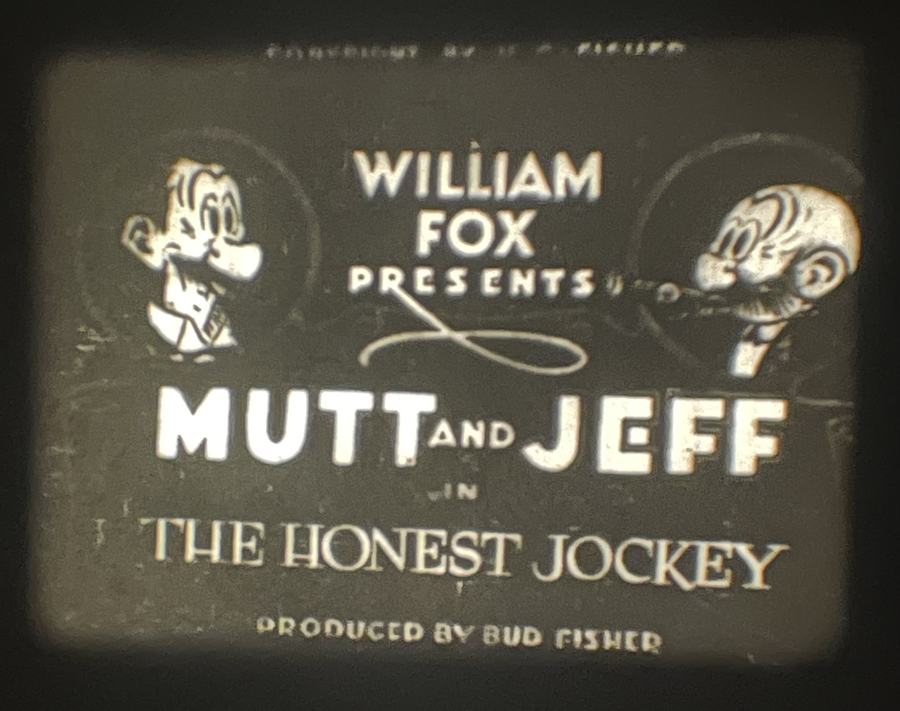
The celluloid arrives moth-eaten yet incandescent, like a love-letter scorched in a chimney. Bud Fisher, newspaper gag-man turned cinema prankster, distills the entire spectrum of silent-era optimism into The Honest Jockey—a two-reel sleight-of-hand that pretends to be about horse-racing but is actually a manifesto on liquidity: of luck, of bodies, of time itself.
From the first iris-in we occupy a world whose geography is ink. The city’s skyline is cross-hatched, its sky a smudge. Mutt and Jeff locomote across this paper-flat cosmos with the elastic gait of figures who know they’re drawings that learned how to breathe. Their discovery of the elixir—stoppered in a bottle whose label is conveniently off-camera—plays like a back-alley communion. Fisher refuses to moralise; the potion is neither sin nor salvation, merely a social solvent. When it trickles down the horse’s gullet, the cut is so abrupt the screen seems to hiccup. One moment we watch a glue-factory refugee, the next a rippling bronze engine of flesh. It is cinema’s first, best steroid joke, delivered decades before Ben Johnson or Lance Armstrong.
Jeff’s transmogrification into jockey is a master-class in scale gags. His boots are Dutch clogs on the stirrups; his cap swallows his head like a punctuation mark gone rogue. Yet Fisher animates him with the stoicism of Buster Keaton and the kinetic sass of a barfly. The race itself—rendered in a swirl of long shots and insert close-ups—feels less like sport than a locomotive dream. Hooves drum a jazz syncopation against the rail. The camera, bolted to a traveling car, keeps pace, so the world smears into charcoal streaks. Dust becomes nebula; the finish ribbon, a comet tail.
What thrills is not victory but the moment preceding it: a suspended chord where every bettor’s breath is held in collective escrow. Fisher inserts a single, unmotivated flash-cut of a female spectator’s eyes—two perfect discs of terror/exultation—then slams back to the thunder of hooves. It lasts maybe eight frames, yet it atomises the crowd into one synaptic jolt, a precursor to Eisenstein’s montage of attractions but laced with vaudeville arsenic.
Sound is absent, yet the film vibrates with sonic ghosts: the metallic clop of plates, the wheeze of a starting bell, the communal gasp that always precedes payoff. Intertitles, sparse and hand-scrawled, read like mutterings from a racetrack oracle: "He done it!"—three words that earn their exclamation mark through sheer typographic chutzpah.
Compare this to the rodeo actuality The Pendleton, Oregon, Round-Up, where authenticity is fetishised and drama accidental. Fisher’s universe is the antithesis: every spasm of reality is pre-cooked in cartoon brine. Even the horse, post-resurrection, sports a coat that gleams like it’s been shellacked by a cel-painter. Yet the stakes feel paradoxically higher precisely because they’re perched on artifice. When Jeff whips ahead, the triumph ricochets not through muscle but through metaphysics: the underdog as ontological event.
Narrative thrift here is surgical. Once the nag wins, the film ends within thirty seconds—no ribbon ceremony, no ticker tape. Mutt and Jeff pocket wads that look like inflating balloons, then trade a glance that says, "Now what?" Fade-out. The abruptness is a gag on the audience’s hunger for moral bookkeeping. In refusing catharsis Fisher anticipates the existential shrug of Samuel Beckett. Victory, like the elixir, is a consumable with alarming shelf life.
Let us, then, praise the film’s chromatic absence. Black-and-white is not limitation but distillation; it turns sweat into silver, dusk into mercury. The monochrome horse becomes a kinetic sculpture, every sinew rendered in gradients of charcoal. When Jeff digs heels, the contrast ratio spikes so violently you swear you see heat lightning ripple across the creature’s flank. Color would only Disney-fy this savage elegance.
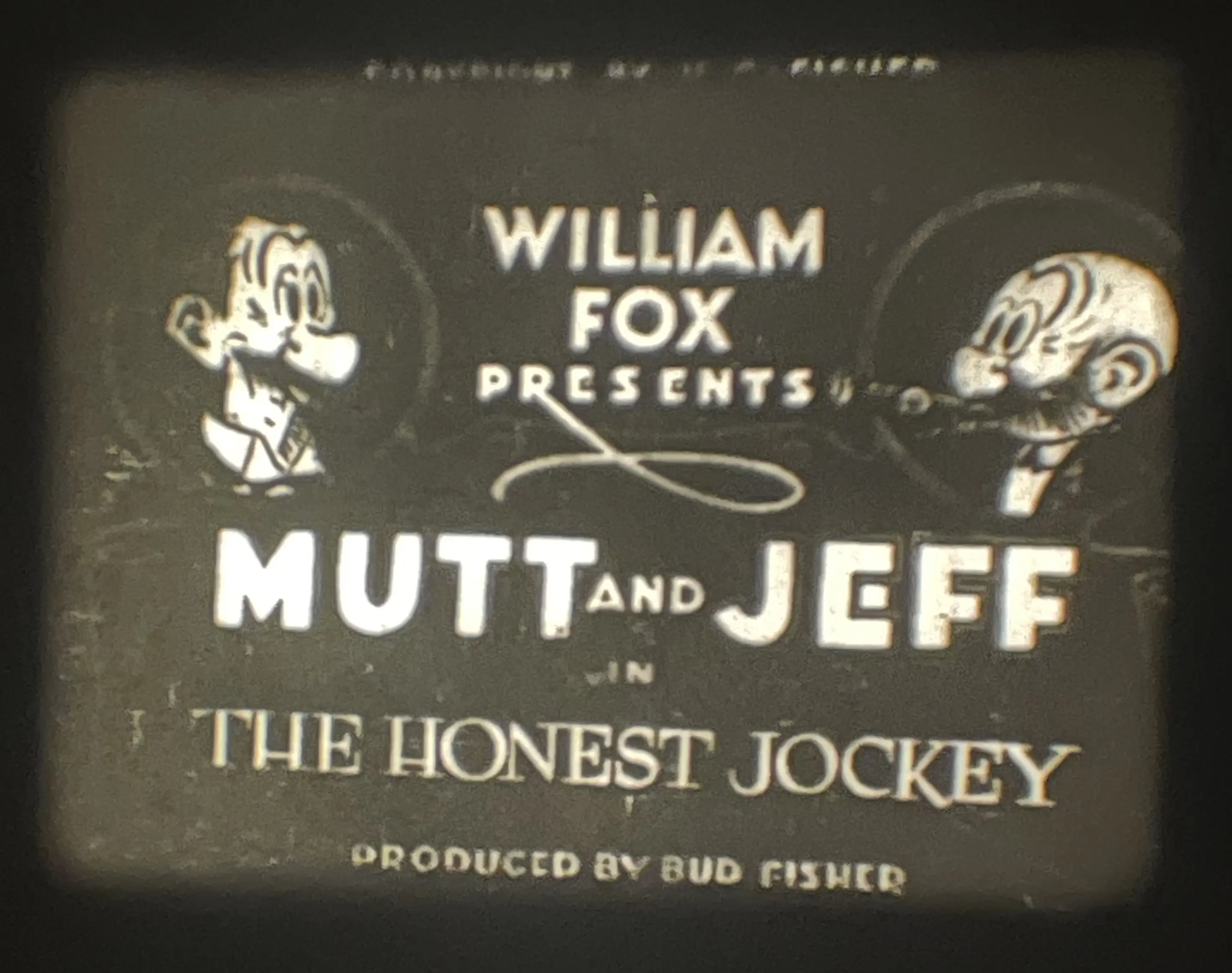
Fisher’s true coup lies in tempo. The opening reels dawdle like a raconteur tipsy on digression—Mutt and Jeff scrounge, bicker, flaneur. But once the elixir enters bloodstream, montage contracts; shots average three seconds, an amphetamine blitz that predates Battleship Potemkin by almost a decade. It’s as if the film itself has ingested its own miracle tonic and now must sprint before the high subsides.
Contemporary viewers may scoff at the rudimentary matte lines where Jeff’s miniature double trots across the track. Yet these seams are portals: they remind us every frame is a negotiation between lie and belief, a tension that CGI-saturated blockbusters have anaesthetised. When the rear-projection wobbles, imagination plugs the gap—an alchemical contract modern spectacles have broken.
Gender, curiously, is peripheral. Women exist as single-shot archetypes: parasol-wrapped socialites, gum-chewing touts, the aforementioned ocular flash. The film’s testosterone haze is mitigated only by the horse itself—an equine androgyne whose power transcends jockey genitalia. In that sense the animal is the true protagonist, its body the contested terrain where human ambition is both inscribed and ridiculed.
Financial subtext seeps through every sprocket. Note the purse: a pittance that nonetheless detonates Mutt and Jeff’s class standing. Fisher, himself a newspaperman who struck syndication gold, understood lucre as liquid luck—here today, pissed away tomorrow. Their post-race cigarette is less celebration than communion with evanescence, smoke curling like spent dividends.
Historians slot the film into the golden age of slapstick, yet its DNA coils forward to Nugget Nell’s prospector surrealism and even to The Mummy and the Humming Bird’s morbid whimsy. The elixir functions like McGuffin-predecessor to Hitchcock’s glowing suitcases, a catalyst whose essence matters less than the frenzy it triggers.
Restorationists have salvaged a 35 mm print marbled with nitrate burn. Damage blooms like chrysanthemums around the edges, occasionally swallowing whole frames. Rather than mourn these scars, savour them: they are time’s own graffiti, reminding us the film itself is mortal, courting the very decay its narrative outruns.
Reception in 1916 trade sheets was effusive yet bemused. "Fisher’s flivver of farce," one critic quipped, "gallops where Sennett merely trots." Audiences, war-taxed and Spanish-flu-wary, embraced its velocity as provisional amnesia. Today it plays like a tonic against franchise bloat, its 14-minute runtime a middle-finger to three-hour mythologies.
Could a remake work? Only if some iconoclast shot it as a single Snapchat story, vertical frame, captions scribbled in neon graffiti. Even then, the absence of tactile film grain would sand off the primal thrill. The honest jockey, after all, is celluloid itself—doomed, beautiful, galloping headlong into chemical oblivion while we, modern viewers, wager our attention spans on the outcome.
So place your bet. The nag wins, every time, because Fisher rigged the game at the dawn of cinema. We walk out dazed, clutching a ticket stub that reads: miracle, 100-to-1, paid in full. The payoff? A flicker in the dark, a horse that learned to outrun its own ghost, and two cartoon tramps who discovered immortality, then sold it for the price of a smoke.
IMDb 5.6
1925
Community
Log in to comment.