DbcultAccessing Vault...
Cult Review
Senior Film Conservator
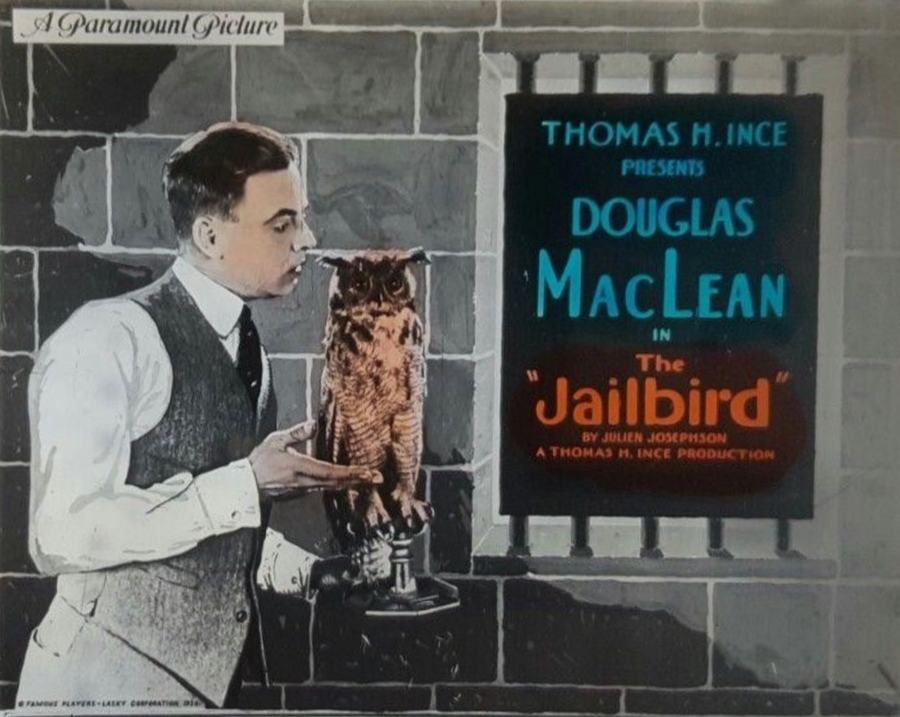
There is a moment, roughly two reels before the end, when the camera in The Jailbird lingers on Douglas MacLean’s profile as dawn breaks over Dodson. The light is the color of weak coffee, and you can almost smell the dust and printer’s ink commingling. In that sliver of silence, MacLean’s Shakespeare Clancy—con man, charmer, accidental prophet—looks as if he has just realized the joke is on him. It is the single most honest frame in a film otherwise devoted to elaborate fibs, and it lands like a bruise.
Director William C. deMille (yes, the less cannonized but arguably wilier brother) understood something that many silents only gesture toward: the American West was already a back-lot myth by 1920, its empty spaces ready-made for anyone who could sell a story faster than a horse could bolt. Into that vacuum he flings Julien Josephson’s screenplay—a fable of paper promises and sudden gushers—letting the plot ricochet between poker-faced satire and slapstick penance.
The film’s first act is a master-class in negative space. We never see Clancy’s breakout; we simply witness him evaporate into a throng of visitors, a trick that prefigures the fade-out he will perform in reverse at the finale. The prison itself is shot from low angles so the walls loom like blackened type columns, each bar a monolithic serif. When Skeeter Burns (William Courtright, all elbows and ink-smudged spectacles) is discharged, the warden hands him a cheap suit and a warning; Skeeter’s grin suggests he has already rewritten both.
Their arrival in Dodson is staged like a traveling circus folding itself into a postcard. The town’s main street is a diorama of false fronts: the bank that never opens, the saloon that never closes, and the newspaper office—The Dodson Clarion—whose presses wheeze like asthmatic prophets. Josephson’s script delights in the lexicon of boom-and-bust: shares are "units of possibility," the barren acreage is "a cathedral of undiscovered liquidity," and every handshake feels numbered.
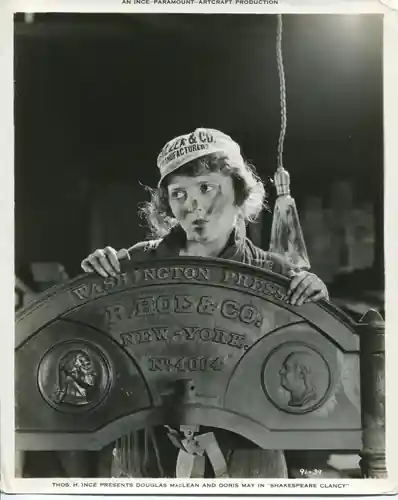
MacLean, better known for boy-next-door roles, here weaponizes that affability. His Clancy never tells a mark what to think; he asks them what they want to believe and then repeats it back with a comma and a percentage sign. The performance is calibrated between the wink and the wound: watch how his shoulders relax when Alice (Doris May) first enters the newsroom, as though some internal ledger has just been balanced in red.
Silent cinema is littered with virginal schoolmarms who exist to blush on cue. Alice Whitney is not among them. May plays her with the brisk competence of a woman who can set type one-handed while quoting circulation figures. Her first close-up—eyes narrowing at Clancy’s too-slick introduction—lasts perhaps three seconds, yet it rewrites the film’s temperature. From that point on, every fraudulent share certificate carries her unseen signature.
The courtship unfolds in margins: a shared proof-sheet at midnight, a ink-smudged coffee cup passed like contraband. DeMille frames them against rolls of newsprint that resemble prison bars, a visual rhyme with the opening sequence. When Alice finally invests her savings, the act is shot from above, the bills fluttering into a strongbox like white doves volunteering for a cage. The film dares you to laugh, but the lump in your throat won’t obey.
Most comedies of the era would have let the well stay dry, the con men flee, and the townsfolk learn a sermon. Josephson instead detonates the premise: the earth yields a slick, shimmering rebuke to every lie. The derrick—erected from spare lumber and sheer chutzpah—becomes a Pentecostal spire, drenching the populace in literal black gold. Cinematographer L. Guy Wilky switches to a faster stock so the oil sparkles like molten obsidian, turning the final reel into a perverse baptism.

This discovery should be the triumph beat; instead it hollows Clancy out. MacLean’s face—usually a semaphore of eyebrows and teeth—goes ominously still. In a medium that prized broad pantomime, he gives us micro-movements: a swallow, a blink, the almost imperceptible straightening of the spine. The con man confronts the rarest predator of all—consequence—and decides the only escape is backward into the cage he already shed.
The final gag is so quietly audacious it feels modern. Clancy ditches his suit, slips among tourists, and re-emerges in stripes as if checking a coat. The warden, distracted by headlines of overnight millionaires, barely glances up. The last shot freezes on Clancy at the press, cranking out a story he can no longer profit from. The implication: identity is just another set of clothes, and America will always applaud the hustle as long as it punctuates with a punchline.
Compare this with the snow-slogged fatalism of Escaped from Siberia or the urban Gothic redemption in The Regeneration, and you see how deMille’s film refuses either despair or easy grace. The jail is not a place; it is a revolving door greased by ambition.
Courtright’s Skeeter Burns is a marvel of comic specificity: the way he adjusts his spectacles with an inky thumbprint, the pigeon-toed sprint when the well erupts. He embodies the era’s blind faith in print—words as spells, shares as incantations. Edith Yorke, as Alice’s spinster aunt, delivers a miniature master-class in fluttering desperation; her handshake feels like a bird negotiating terms with a cat.
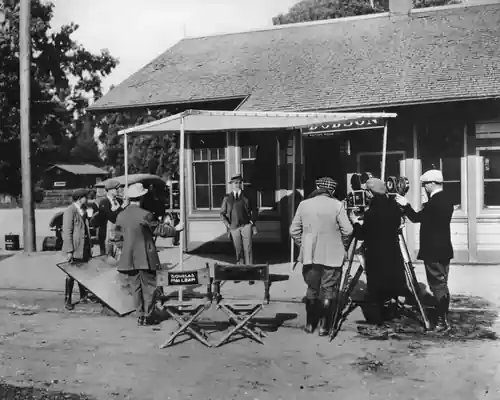
Among the townsfolk, Otto Hoffman’s bank president deserves mention. He pivots from skeptic to evangelist the instant his cuffs are spattered with crude, a conversion both hilarious and unsettling. Watch how deMille crowds the frame in these moments: faces stacked like type cases, each one a different font of greed.
Though marketed as a romp, the film borrows the chiaroscuro grammar of later crime pictures. Interiors are pools of shadow broken by single source lamps; exteriors bleach under high-noon sun that turns every plank into a potential weapon. When Clancy and Alice share their first kiss, deMille backlights them so their silhouettes merge—an eclipse of virtue and larceny.
The montage of share-selling is a kinetic collage of hands, pens, and ink stamps, cut to the rhythm of a jaunty piano cue that sounds like Scott Joplin on amphetamines. Each insert—an eye twitching, a thumb sealing an envelope—functions like a micro-epitaph for the death of skepticism.
Surviving prints carry handwritten cue sheets calling for "The Prisoner’s Song" during the escape, shifting to "Till We Meet Again" over the lovers’ parting. Contemporary exhibitors often replaced these with local ragtime bands, creating regional variants that could turn the same scene into either farce or tragedy. The film thus mutates nightly, a flicker-prophet foreshadowing the remix culture of a century later.
Viewed today, The Jailbird plays like a pop-culture premonition of the coming crash. The bogus well is every over-leveraged holding company; the jubilant townsfolk, the margin-call crowd nine years early. Even the black spray that anoints them feels eerily akin to the ink that would later spill across breadlines of bankruptcy notices.
Yet the film never moralizes. Its genius lies in letting the audience gorge on the joke until the aftertaste arrives. By the time Clancy volunteers for his cell, we have laughed ourselves complicit, implicated in every swindle from Teapot Dome to cryptocurrency.
Notice how the women—Alice and her aunt—are the only investors who demand no interest rate, only belief. Their savings represent years of sewing circles and budgeted grocery pennies, the quiet accumulation of female invisibility. When the well pays off, the film declines to show their celebration; they vanish from the narrative like footnotes history forgot. The omission is deliberate, a void where a feminist critique can roost.
Stack The Jailbird beside Madame Jealousy and you see two temperaments of 1920: urban melodrama steeped in perfume versus frontier burlesque reeking of sweat. Where Bull Arizona mythologizes land as birthright, deMille treats it as blank paper awaiting the next forgery.
And yet, tonally, the film shares DNA with The Dippy Dentist: both understand that the quickest route to an audience’s laugh is through its unease. Each pratfall is a memento mori wearing clown shoes.
Only two incomplete 35 mm negatives are known to survive—one at MoMA, one at the BFI—each missing the reel depicting the actual gusher. Contemporary reports describe oil spraying over the lens, a proto-cinematic breaking of the fourth wall. Until a print surfaces, we are left with stills that show townsfolk slicked head-to-toe, their eyes white crescents of euphoria. The gap haunts film historians like the lost cocaine sequence from The Mystery of the Leaping Fish.
Because every era reinvents its scams—tulips, dot-coms, NFTs—yet needs the same bedtime story: that somewhere, somehow, the bum strike turns to gold. DeMille’s film withholds that comfort. Clancy’s return to prison is not redemption but resignation: the only way to pay for the dream is to wake up inside your old nightmare.
The movie ends where it began, the press clanking like a metronome for a song whose lyrics no one remembers. Outside, oil still seeps into the soil, and Alice—presumably—types society notes that will never mention her name. The audience, newly wise to the hustle, shuffles into the neon street, pockets full of paper that might already be worthless. Somewhere a gusher waits, or maybe just a hole. And the jailbird keeps singing, because the song is all that’s left.
IMDb 6.8
1926
Community
Log in to comment.