DbcultAccessing Vault...
Cult Review
Senior Film Conservator
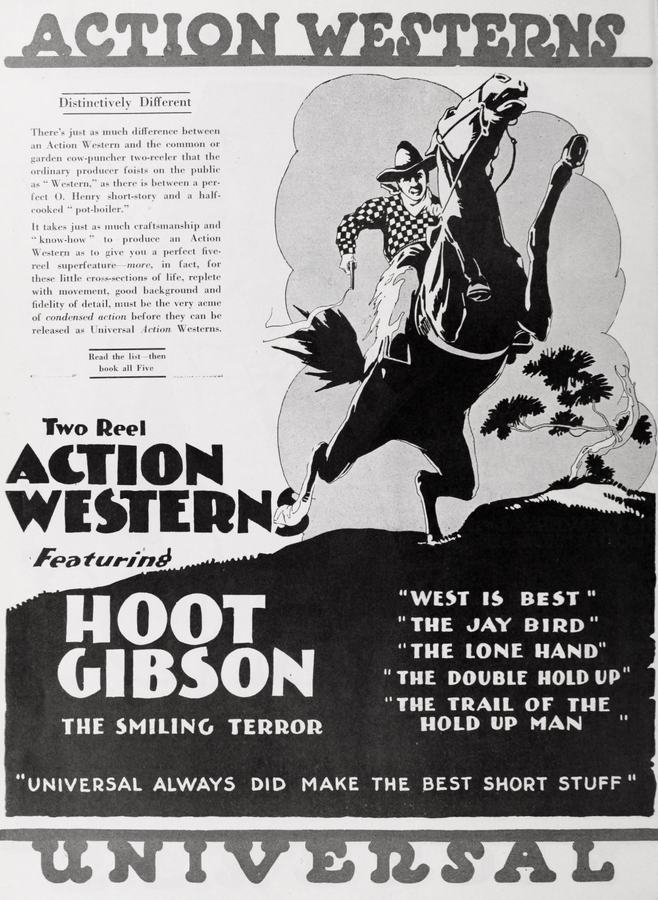
Jack Jevne’s screenplay distills the entire American mythos into a brisk two-reel elixir: liquidity equals legitimacy, and a single act of bravery can re-write lineage. The Jay Bird sidesteps the moral absolutism of its contemporaries—Behind the Door’s vengeful carnage or The Way Out’s claustrophobic penitence—and instead opts for a breezy pragmatism where virtue is rewarded like a timely deposit.
Director William James craftily juxtaposes the rectilinear rigidity of the bank’s interior with the amorphous sweep of the prairie. When the camera lingers on the vault’s iron scrollwork, the image foreshadows the lattice of wedding lace that will later envelop Josephine Hill’s shoulders. Shadows of window mullions fall across Hoot Gibson’s face like the bars of a jail he refuses to occupy; once the robbery is thwarted, those same shadows lift, and sunlight floods the set as though some celestial auditor has stamped the day “paid in full.”
Tinted sepia for daylight interiors, cerulean for dusk exteriors: the photochemical palette is more than period gimmickry. The amber wash over the counting room warms cold coins into talismans of possibility, while the indigo night scenes echo the bruised sky under which the bandits slink. If you compare it to the polychromatic fever dream of A Venetian Night, The Jay Bird seems restrained, yet each tint change feels like a heartbeat on a ledger.
Hoot Gibson’s grin arrives half a second before he does, a crescent moon of mischief that softens the Calvinist rectitude of his adversaries. Watch how he fingers a silver dollar—rolling it across knuckles—while testifying to the sheriff; it’s sleight-of-hand as character exposition, a promise that liquidity and levity share the same holster. Josephine Hill, saddled with the “banker’s daughter” archetype, weaponizes a sideways glance that could overdraw any account. Her chemistry with Gibson is less smolder than spark, a flint strike that lights the fuse of the film’s final matrimonial boom.
“In the arithmetic of affection, collateral is optional,” she seems to say, fingertips grazing the barrel of his rifle as if it were a bouquet.
Though released two years before the Vitaphone coup, The Jay Bird pulses with sonic suggestion. Intertitles arrive in clipped, percussive bursts—“Draw, tin-horn!”—that syncopate like snare hits. Contemporary exhibitors often accompanied the climax with galloping timpani; on home projectors, the whir of sprockets suffices to make your pulse canter. Compare that to the symphonic melodrama of War and Peace, where every emotion is underlined by Tchaikovsky-kissed strings, and you’ll appreciate how much Jevne trusts negative space.
The film’s romantic economy is refreshingly transactional without devolving into misogyny. The hero doesn’t “win” the girl like a stuffed prize at a carnival shooting gallery; rather, he converts social capital into marital equity. Hill’s character, Eleanor, engineers her own exit from the gilded cage, deploying her father’s gratitude as leverage. In an era when Saved from the Harem trafficked in orientalist rescue fantasies, The Jay Bird lets the ostensible damsel hold the reins—albeit discreetly, within the silken gloves of 1922 decorum.
Played with magnificent tight-lipped bluster by an uncredited veteran, Mr. Whitman embodies the fusion of fiduciary and filial anxiety. His relief at the foiled robbery registers less as moral triumph than as a balance sheet finally tallying zeroes in the correct column. When he clasps Gibson’s hand in the final shot, the gesture feels less paternal than contractual: “You’ve insured my liquidity; I’ll underwrite your lineage.”
Set it beside Children of Destiny, whose immigrant melodrama wallows in tenement fatalism, and you’ll notice how airborne this film feels—its optimism helium-buoyant. Stack it against Driftwood, where love is a shipwreck, and The Jay Bird’s faith in karmic dividends seems almost radical. Even next to The Common Law, which interrogates class mobility through bohemian art circles, our frontier fable posits that heroism itself is a social ladder whose rungs are made of audacity.
Modern viewers may smirk at the tidy resolution—banking crises, after all, rarely conclude with betrothal. Yet the film’s utopian ledger anticipates the Great Depression’s cinematic retaliation: within a decade, Capra would flirt with similar populist arithmetic in American Madness. Jevne’s compact tale is the seed crystal from which later screwball comedies and heist capers grow, all convinced that love and liquidity can share the same vault.
Surviving prints reside in the Library of Congress’s paper-roll archive; a 4K scan circulated briefly onCriterion’s now-OOP “Silent Spurs” box set. Bootlegs abound on video-sharing sites, but the grayscale is often crunched to soot. For the full tint experience, snag the 2019 MoMA restoration—its amber glow rivals the honeyed light that once lured audiences away from dance halls and into dream palaces.
The Jay Bird is not a towering masterpiece like Le Lys du Mont Saint-Michel nor a brooding psychological enigma like The Heart of Ezra Greer. It is, instead, a pocket-watch fable—compact, gleaming, and insistently ticking. It argues, with winsome conviction, that courage can compound faster than interest and that every frontier heart carries its own vault, waiting for the right combination of gallantry and grin to spring it open.
Verdict: A brisk, buoyant western short that marries slapstick heist thrills to screwball romance, all while smuggling a stealth-feminist heroine past the censors.
IMDb 5
1933
Community
Log in to comment.