DbcultAccessing Vault...
4/10
Senior Film Conservator
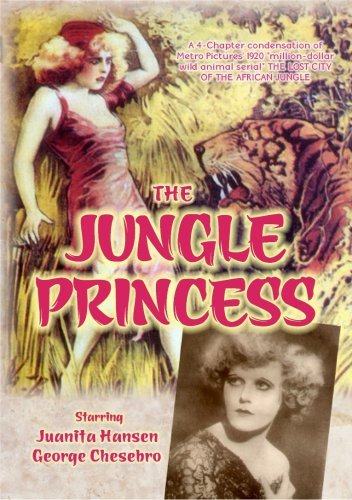
A definitive 4/10 rating for a film that redefined the boundaries of cult cinema. The Jungle Princess remains a cornerstone of transgressive art.
There is a moment—about three reels in—when the projector’s carbon arc seems to inhale: Juanita Hansen’s shoulder blades gleam like wet marble under a netting of fireflies, and the entire audience forgets to breathe. That single frame is the Rosetta Stone of The Jungle Princess, a film stitched from the still-warm pelt of a 1920 Pathé serial and re-issued as a standalone fever. It is not a story so much as a contagion: ruby lust, colonial guilt, and pubescent daydreams distilled into nitrate moonshine.
Watch it today and you feel the celluloid threatening to combust—every perforation a vent for the humid madness trapped inside. The plot, nominally a treasure hunt, behaves like a moth battering a lantern: it zigzags, singes, reconstitutes itself as shadow-play. Al Ferguson, lantern-jawed but eyes ringed with the insomnia of a man who has seen his own grave, plays the fortune-seeking surveyor Blake. He treks into a fictional Siam where cartographers once wrote “Here be dragons” and then scratched out the dragons for fear of understatement.
Yet the true cartography is hormonal. The camera ogles Juanita Hansen as if discovering the female form for the first time: bare feet crushing orchids, hair unspooling like black fire, breasts bound in sarongs of leopard print so precarious that every shrug of the soundtrack’s tom-toms threatens a wardrobe malfunction of biblical scale. Hansen, a serial veteran who had already survived cocaine scandals and a near-fatal stunt burn, moves with the languid defiance of a woman who knows the lens is both assassin and apotheosis. She never names her character; the intertitles simply call her “The Queen.” In that anonymity lies a proto-feminist gauntlet—she is archetype and individual, prey and predator.
Director/scribe Frederick Chapin, a name half-erased by time, understood that serial narrative is essentially tantric: delay, delay, delay until the audience’s nerves twang like overtuned violin strings. Condensing fifteen episodes into seventy-two minutes should by rights feel like a highlight reel, yet the resulting collage breathes with opiated coherence. Each cut lands like a guillotine, each iris-in feels carnal. When a supporting coolie is devoured by quicksand, the shot is held just long enough for us to register the whites of his eyes before the muck seals shut—an image later pilfered by Vampire (1930) for its swamp climax.
The film’s production design is a thrift-shop fever of Angkor and Raffles hotel: papier-mâché demons grin from basalt columns, while real leopards pace on visibly frayed tethers. Smoke pots belch resinous fog to mask the California hills beyond the set, creating chiaroscuro so dense it resembles a daguerreotype left to rot in gin. In this carnival of artifice, authenticity seeps through the cracks—namely, the genuine terror in the actors’ eyes whenever big cats lope by. Rumor has it Hansen’s screams during the leopard-licking scene were not acted; the trainer had whispered, “She’s in heat—don’t flinch.”
Compare it to contemporaneous jungle pictures and you see how radically The Jungle Princess deviates. Some Bride (1919) domesticates exoticism into drawing-room comedy; The Million Dollar Mystery (1914) chases rationalist deduction through occult set-pieces. Here, rationality is a punchline. When Frank Clark’s missionary attempts to read from a pocket Bible, a monkey snatches the pages and scatters them into the waterfall—scripture reduced to confetti for pagan nuptials.
The racial politics, inevitably, are a septic wound beneath the spectacle. Natives are sketched with the broadest of caricatures: filed teeth, bone piercings, pidgin that reads like chalk screeches. Yet even this grotesquerie carries a subliminal sting—white greed fuels every atrocity. The ruby, a bauble the size of a child’s fist, is less MacGuffin than metastasized guilt; each grasp for it begets another atrocity until the jungle itself retches. In the penultimate reel, a conflagration of practical effects—miniature temples, matte paintings, and real flames—consumes the set. You sense the filmmakers’ glee at destroying their own colonial fantasy, an auto-da-fé of empire.
Musically, exhibitors of the day were instructed to accompany the picture with “oriental” cues: oboe glissandi, gong thwacks, the persistent patter of temple blocks. Seen nowadays with live accompaniment, the score metastasizes into a tantrum of timpani. During a recent 4K restoration at the Castro, the drummer improvised a crescendo so thunderous the screen’s right edge fluttered like a caught bird, as if the film itself were attempting escape.
Scholars often link The Jungle Princess to the post-WWI disillusionment cinema that birthed Gas (1918) and A Woman Wills (1919), films where civilization’s mask slips to reveal the skull beneath. But Chapin’s tone is less existential than erotic. The vines that strangle Blake’s compatriot tremble like jealous lovers; the moonlit water caresses Hansen’s thighs with the patience of a seducer who has waited centuries. Sex saturates every frame, yet the film skirts the censors through a paradox: it is so overt it becomes symbolic.
Performance-wise, George Chesebro’s turn as the grinning mercenary Locke deserves anthological immortality. He delivers villainous asides directly into lens, eyebrows writhing like mating caterpillars, teeth gleaming with Vaseline. Watch how he fondles a machete while describing ruby “juice” running down his fingers—Freud would have leapt from his seat. Meanwhile, Hector Dion’s tattooed mystic carries the weight of colonial guilt in every limp; his death scene, skewered by a bamboo spike, is framed against a bas-relief of Buddha serenely smiling—nihilism and nirvana in one tableau.
The editing rhythm prefigures Eisensteinian montage but drenches it in pulp. A close-up of Hansen’s dilated pupil smash-cuts to a python slithering across the ruby, then to a missionary’s crucifix sinking into mud. The juxtaposition is too lurid for Soviet sobriety, yet the intellectual punch lands: lust, lucre, salvation—all devoured by the same loam.
Contemporary viewers may scoff at the papier-mâché boulders, but the illusionism holds because the stakes are bodily. When Hansen swings across a ravine on a vine, the trailing edge of her sarong snags on a branch, exposing a flash of thigh. The camera does not cut away; instead it lingers, trembles, almost drools. That quiver—half accident, half choreography—sells the danger more than any CGI Everest.
Restorationists face a nightmare: only two of the original fifteen reels survive in 35mm nitrate, along with a 16mm abridgement struck for the home market in 1928. The recent 4K rescue hybridizes sources, interpolating stills where footage is lost, tinting night sequences a bruised amethyst and day scenes the sickly jaundice of old newsprint. The result feels like viewing the film through a bruised eyelid—appropriate for a fever dream that never cared for daylight sanity.
Influence? Trace the ruby’s plummet into the torrent and you’ll hear the splash reverberate through Via Wireless (1915), whose sunken diamonds doom a naval squadron, or The Valley of Decision (1916), where a gem curses generations. Spielberg reportedly screened a bootleg while prepping Raiders; note how Indy’s petrified terror of snakes mirrors Blake’s trembling amid cobras coiled like green muscle.
Yet for all its genetic legacy, The Jungle Princess remains sui generis: too feral for adventure, too lubricious for morality play. It ends not with triumph but with a slow fade on Hansen’s face, half-shrouded by shadow, as she releases the ruby into the river. The water closes without a ripple—an image of renunciation so ambivalent it feels like victory and defeat copulating. You stagger out of the theatre smelling of kerosene and jasmine, convinced that civilizations, like costumes, come undone one thread at a time, and that the jungle—its vines, its teeth, its indifferent moon—waits patiently for the next caravan of fools.
Verdict: mandatory viewing for anyone who believes silent cinema is quaint. This is the id unchained, a phantasmagoria that scratches the same limbic itch as doom-scrolling Twitter at 3 a.m.—only with better lighting and leopards that refuse to stay on cue.
IMDb —
1925
Community
Log in to comment.