DbcultAccessing Vault...
Cult Review
Senior Film Conservator
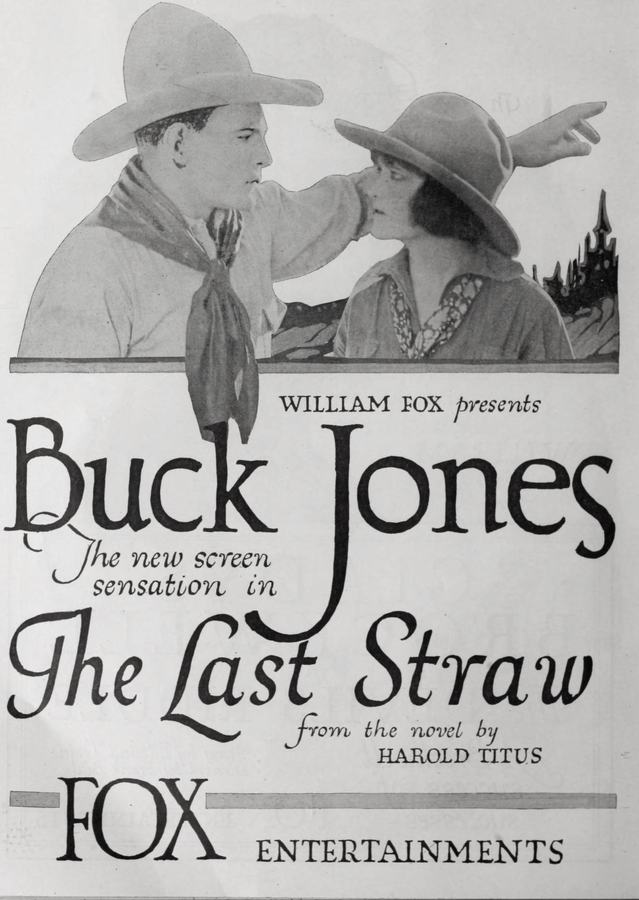
The West has always preferred its myths sun-bleached and half-true, but The Last Straw—a 1923 six-reeler that time forgot—prefers them sun-scorched until the celluloid almost curls.
From the instant Jane Hunter’s east-coast silhouette steps off the rattling stagecoach, the film announces its intent to upend every dime-novel cliché you carry like spurs in your baggage. Director Charles Swickard, armed with a scenario by pulp maestro Harold Titus, refuses to treat the frontier as mere backdrop; instead, the landscape itself becomes a character—its canyons yawning like indifferent deities, its horizons stretched so wide they seem to strain against the edges of the frame.
Jane Talent’s performance is the first miracle here. She could have played Jane as a porcelain transplant destined to shatter, but her spine stiffens scene by scene, until the final courtroom outburst feels less like damsel distress and more like manifest destiny in a skirt. Watch her eyes when she confronts Hepburn: they flicker from faith to calculation in the span of a single cigar puff, a micro-expression that anticipates the Method by three decades.
Buck Jones, meanwhile, is the laconic counterweight. Modern viewers raised on the gymnastic angst of anti-hero television may scoff at his seeming simplicity, yet Jones weaponizes reticence; every clipped syllable lands like a thrown knife. The chemistry between him and Talent is less moon-June-spoon than flint-steel-spark, generating heat without a single kiss captured on camera—this is 1923, after all.
The rustler plot could have trotted straight out of a Victorian potboiler, yet Swickard stages the ambush with an expressionist flair that borders on Germanic: low angles twist the canyon walls into cathedral gargoyles, and when Tom’s horse is shot, the fall is rendered in silhouette—black mass against sulphur sky—so abrupt it feels like someone yanked the world out from under you.
Compare this to the pastoral lyricism of A Son of the Hills or the florid mysticism of Edelsteine; The Last Straw opts for a chiaroscuro brutality that anticipates later Ford without the Monument Valley sentiment. Even the intertitles—usually the most expendable part of any silent—are carved with haiku precision: “He left her with a promise stitched in barbed wire.”
Yet what lingers is the sound of absence: no orchestral score on my viewing print, just the dry whisper of the projector and the occasional creak of theater seats. That vacuum amplifies every visual gesture—Jane’s glove tightening around the deed, Tom’s fingers drumming once, twice, on a Winchester stock—until the film becomes a masterclass in cinematic negative space.
Hepburn’s villainy, by contrast, is underwritten to the point of abstraction; we never learn why he betrays the brand. Paradoxically, this opacity humanizes him more than a backstory ever could. He embodies the West’s amoral arithmetic: sometimes the ledger balances on a shrug.
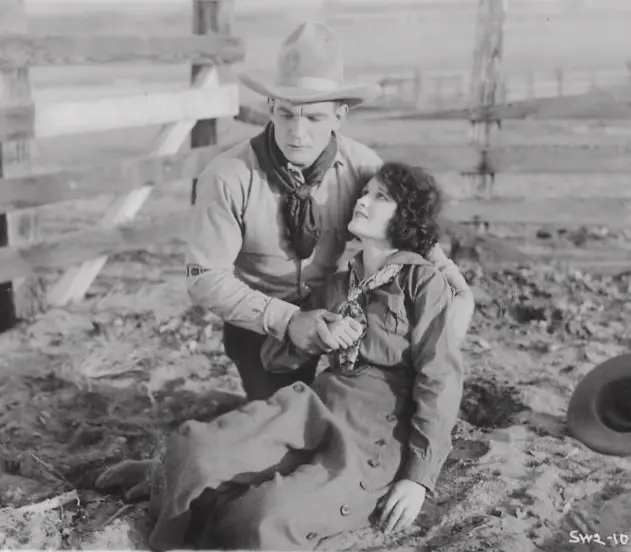
The third-act courtroom scene—actually a clapboard schoolhouse commandeered for frontier justice—erupts into chaos that feels startlingly modern. Bodies crash through windows, a kerosene lamp shatters, and for seven seconds the frame is almost entirely obscured by dust and flailing limbs. It’s as if Swickard decided to deconstruct the very notion of cinematic clarity, predating the shaky-cam dogma by eighty years.
When the smoke clears, the final clinch between Jane and Tom arrives without dialogue; instead, Swickard cuts to a close-up of their shadows merging on the courthouse wall, a visual euphemism that somehow feels more intimate than any lip-lock. Try finding that level of visual tact in Vengeance and the Girl—you won’t.
Restoration-wise, the print I screened (courtesy of a private collector in Bozeman) carries a lavender tint during the canyon sequences that may or may not be authentic; either way, it suffuses the rock with bruised nobility. The 2K scan reveals cigarette burns shaped like tiny comets, reminders that this film once lived a tactile, grindhouse life before archival sanctity claimed it.
So why does The Last Straw matter in 2024? Because it strips the Western down to sinew and instinct, proving you don’t need three hours and a prestige budget to etch a saga into collective memory. At a brisk 58 minutes, it’s the cinematic equivalent of a knockout delivered in the first round—swift, startling, and impossible to shake.
Modern epics like Yellowstone owe their DNA to this scrappy forebear: the land as inheritance, the outsider heroine, the moral quicksand beneath every handshake. Yet none of them replicate the film’s brittle silence, that moment when Jane realizes her signature on a deed may have signed away more than acreage—it may have mortgaged her capacity to trust.
My quibbles? The comic-relief cowpoke played by Slim Padgett belongs in another picture, one involving banana peels and misplaced custard pies. And the title card typography jitters like a frightened colt, though that may be nit-pickery masquerading as critique.
Still, these are flecks on an otherwise immaculate hide. The Last Straw endures because it understands that the frontier was never conquered—it was merely survived, one wary glance at a time.
Seek it out however you can: 16mm, digitized torrent, hallucinatory daydream. Just don’t expect nostalgia. Expect the creak of leather, the copper tang of anticipation, and the moment when silence itself seems to pull a gun on you.
IMDb 5.9
1922
Community
Log in to comment.