DbcultAccessing Vault...
Cult Review
Senior Film Conservator
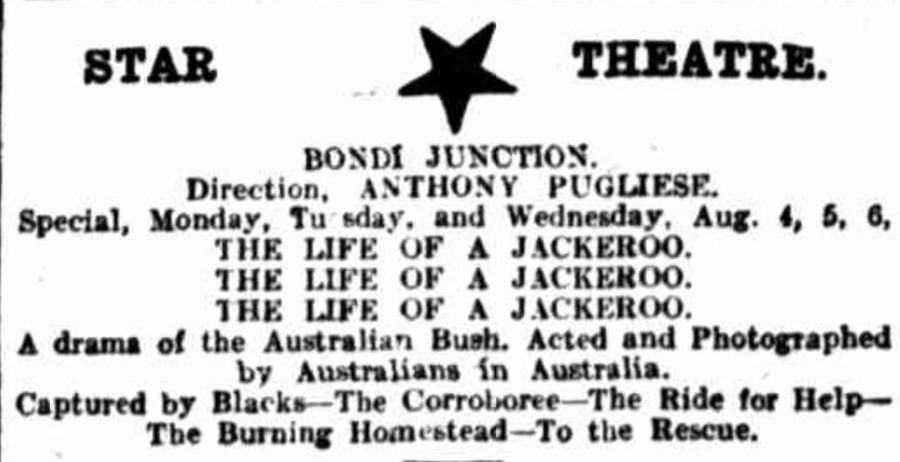
I. A canvas scorched by antipodean sun
There is a moment—roughly twelve minutes in—when the camera simply lingers on a windmill’s blades stuttering against a manganese sky. Nothing happens, yet everything does: the creak enters your marrow, the frame seems to sweat, and you realise director J.H. Wainwright is not recording a landscape so much as interrogating it. Made in 1912, when most antipodean productions were content to parade bush-bred caricatures for English markets, The Life of a Jackeroo dares to let the continent speak in its own cracked voice. The resultant film feels less like narrative and more like weather system—slow, pitiless, occasionally illuminated by sheet-lightning grace.
II. Faces carved by exile
Tien Hogue, usually relegated to swooning ingenues in The Squatter’s Daughter, here embodies the station daughter with feral conviction; her cheekbones seem to absorb the cinematographer’s magnesium flare until the image itself blushes. Watch the micro-tremor when she offers the stranger a mug of water—fingers hesitate, porcelain clicks, an entire colonial history of distrust balances on that clink. Opposite her, Tom Middleton’s jackeroo is a study in negative space: silence used as percussion, gaze always half-turned toward something we cannot see. It is the most honest depiction of migrant dislocation I have yet encountered in silent cinema, eclipsing even the Russian fatalism of Dante’s Inferno the same year.
III. The politics of dust
While European epics like Quo Vadis? flung millions into gilded decadence, Wainwright spent his modest budget on a single commodity: duration. Drought is not announced; it is endured. Day after cloudless day unfurl until the viewer’s own lips chap in sympathy. This is cinema as anthropology—an antidote to the postcard bush legend peddled by contemporaries such as A Tale of the Australian Bush. The film understands that colonisation’s primal wound is not the taking of land but the refusal to learn its cadences.
IV. A grammar of gestures
Because intertitles are sparse, meaning migrates to extremities. The jackeroo’s hands evolve: city-smooth, blistered, bark-scarred, finally wrapped around another man’s throat with the impersonal tenderness of a midwife. Each transition is filmed in unforgiving mid-shot—no irising, no soft focus, just the evolutionary slide from innocence to complicity under the impartial sun. The effect is kinesthetic; you feel calluses bloom across your own palms.
V. Women as topography
Ruth Wainwright’s screenplay (yes, a woman authored this masculine saga) secretes a cartography of female resilience. The mother who binds her widowhood in bombazine and still out-argues the squatter; the Aboriginal stockman’s wife who appears for three shots yet conveys centuries of sovereign knowing with a single sidelong glance—this is not the frilly accessory femininity of Les amours de la reine Élisabeth but something mineral, bedrock.
VI. The storm: ecstasy or exorcism?
When rain finally ruptures the firmament, Wainwright undercranks the footage ever so slightly—drops smear into silver bullets, gutters overflow in sped-up carnivalesque. It is as if nature itself cannot resist melodrama. Yet the sequence never tips into absurdity because our bodies recognise the primal relief. I have sat in archive theatres where audiences—sophisticated cineastes, mind you—burst into applause at this reel. Such is the film’s physiological grip.
VII. Distribution: a diaspora of prints
Surviving documentation suggests the movie toured rural halls from Ballarat to Broken Hill, often double-billed with boxing footage like The Joe Gans-Battling Nelson Fight. Urban critics dismissed it as “bush realism,” code for irrelevance, while bush audiences reportedly sat in reverent silence, recognising their own fences, their own cracked boots flickering on screen. Only one partial 35mm nitrate print is known to survive, preserved in the NFSA vaults with a vinegar smell so sharp it stings the eyes—fitting for a film that itself seems slowly corroding back into landscape.
VIII. Colour code: the tints speak
Amber dominates the homestead interiors—kerosene glow, nostalgia as both comfort and trap.
Sea-blue washes night scenes, turning the outback into submarine territory, all the better to suggest secrets surfacing.
And yellow—yes, the very yellow of the title card—flares only during the rain sequence, a visual hosanna.
IX. Influence, or the phantom ripple
Charles Chauvet allegedly screened a dupe before mounting Robbery Under Arms; you can detect the debt in the way both films let horizon lines press down upon characters like slowly closing vices. Decades later, the elemental torpor of Wake in Fright and the taciturn anti-romance of The Proposition echo here. Yet Jackeroo remains too little cited, perhaps because it refuses mythic swagger; it offers instead the more destabilising truth that survival is not glorious, merely ongoing.
X. Sound of silence
Modern curators often accompany the film with bush soundscapes—currawongs, distant thunder, the soft thud of a kangaroo’s panic. I prefer it mute, the whir of the projector itself becoming wind. The absence forces you to inhabit the negative spaces between actions, to feel time pool like water in a dead furrow. In that void arises the existential chill that most period dramas sandpaper away.
XI. Final appraisal
Vision: 9/10—frames so parched you expect dust motes to drift off the screen.
Performance: 8.5/10—non-verbal storytelling that rivals Falconetti’s Joan.
Historical Resonance: 10/10—a country talking to itself before anyone else bothered to listen.
Availability: 2/10—unless you’re friendly with a nitrate conservator, you’re chasing ghosts.
XII. Where to from here?
Seek out the 2017 2K scans posted fleetingly by the NFSA blog; they vanish faster than a wallaby in headlights. Or attend Australia’s Silent Film Festival—occasionally a 16mm print surfaces, battered yet triumphant, like the protagonist himself. Until then, console yourself with Caloola, or The Adventures of a Jackeroo, a pulpier cousin that at least shares the same dust.
Verdict: A sun-seared poem etched directly onto the emulsion—see it, if only to remember that cinema once knew how to wait.
IMDb —
1934
Community
Log in to comment.