DbcultAccessing Vault...
7.1/10
Senior Film Conservator
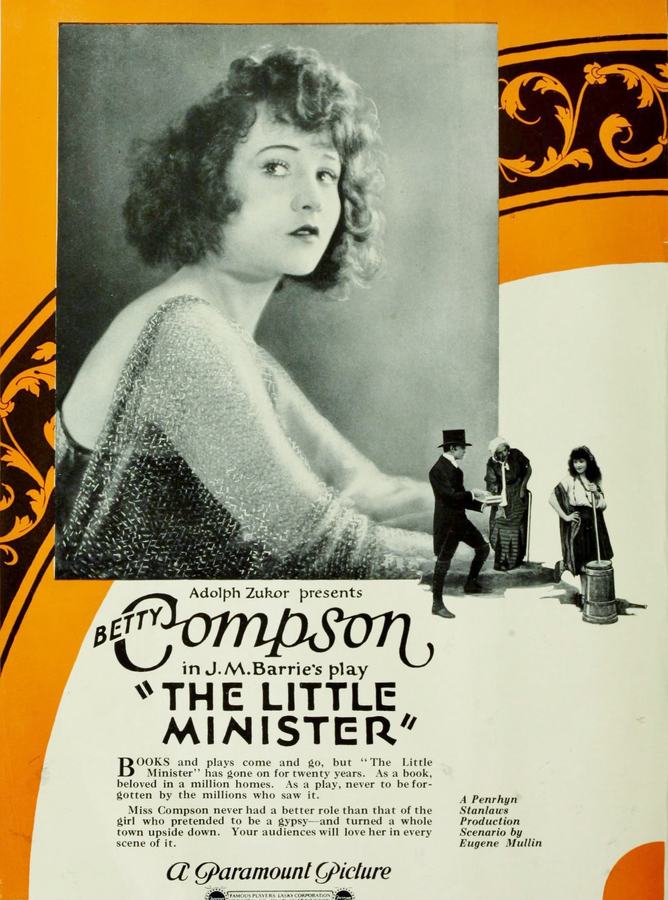
A definitive 7.1/10 rating for a film that redefined the boundaries of cult cinema. The Little Minister remains a cornerstone of transgressive art.
If you have ever wandered the echoing halls of a crumbling manse at twilight, where every portrait’s gaze seems to murmur secrets of entailed estates and entangled hearts, then The Little Minister will feel like stumbling across a lost reel of your own ancestral dream. Directed with exquisite restraint by Penrhyn Stanlaws—a man better known for magazine covers than cinematic sermons—this 1922 Paramount release turns J. M. Barrie’s tender Scots novella into a chiaroscuro fever of looms, legends, and lacerating love.
Stanlaws opens with a shot that would make Tarkovsky jealous: a lone spindle turning against a sky bruised by factory smoke, the metallic rasp of machinery bleeding through the intertitles like tinnitus. Thrums—actually a repurposed Fort Lee back-lot—becomes a microcosm for every hamlet flayed by the nineteenth-century juggernaut. The weavers, draped in hand-stitched plaids whose colours seem to pulse with arterial urgency, are not mere background; they are the moral bloodstream, and their impending obsolescence is filmed with the same aching reverence Malick later lavished on threshing fields.
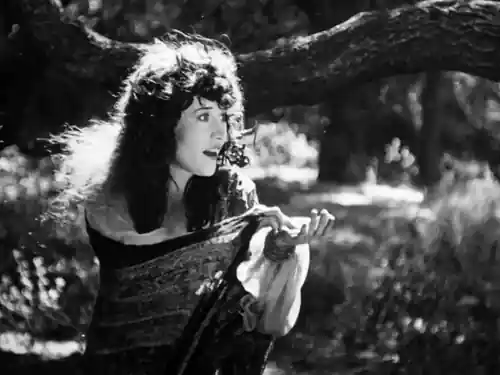
At the centre stands Betty Compson, a performer whose career straddled tramp steamers and champagne soirées alike. Her Babbie is a kinetic contradiction: barefoot in one frame, regal in the next, eyes flicking from flirtation to fury faster than a zoetrope can spin. Watch the way she enters a room—shoulders first, chin tilted like a dare—and notice how Stanlaws often lets her drift slightly out of focus, as though the film itself can’t quite pin her down. That visual instability becomes a metaphor for identity; she is the slip-slide between countess and commoner, between the heather and the heraldic crest.
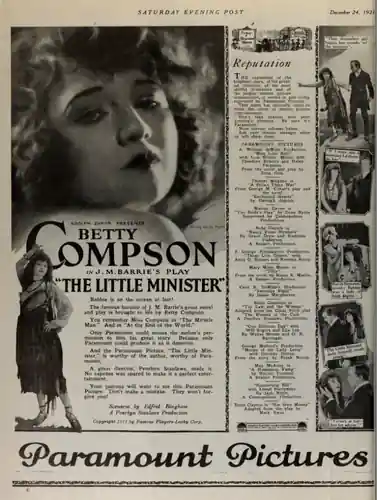
Compson’s greatest triumph lies in the sequence where Babbie, encircled by torch-bearing soldiers, must decide whether to betray her birthright or the ragtag villagers who have adopted her. The actress doesn’t grandstand; instead, the camera lingers on a tremor in her gloved hand—a microscopic earthquake that speaks louder than any subtitle. In that moment, The Little Minister transcends melodrama and becomes a treatise on class vertigo that rivals even Other People’s Money’s ruthless boardroom ballet.
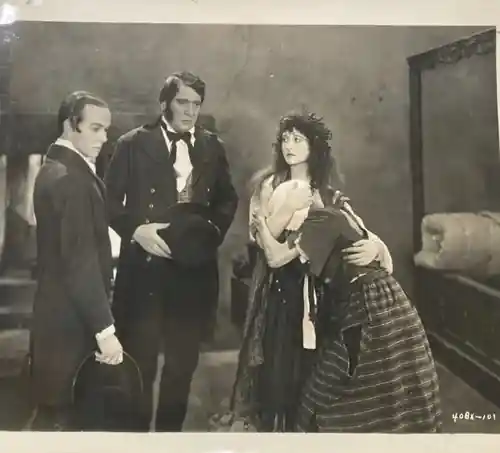
Opposite Compson, Guy Oliver essays Gavin with the brittle sanctity of a man who has read too much Isaiah and not enough humanity. Oliver was primarily a character heavy in westerns, so casting him as the conscience of a Scots kirk felt like hiring a bulldog to guard a butterfly house. Miraculously, the gamble pays off: his weather-beaten mug—part cherub, part gargoyle—embodies the schism between pulpit orthodoxy and erotic awakening. When he first sees Babbie prancing across a stone bridge, Stanlaws cuts to an insert of Oliver’s hand clenching the hymnal so tightly that pages crimp, a visual shorthand for repression that still feels wickedly subversive.
Shot by William Marshall, whose résumé ranged from Mary Pickford whimsy to noir nightmares, the film revels in tenebrous interiors where candlelight carves faces into living chiaroscuros. Note the scene inside the weaving shed: looms stand like iron sentinels, their wooden teeth dripping indigo dye onto floorboards that glisten like fresh bruise. Marshall positions Babbie at a diagonal, half her face swallowed by shadow, so that when she whispers a warning to the weavers, the visual grammar screams conspiracy.
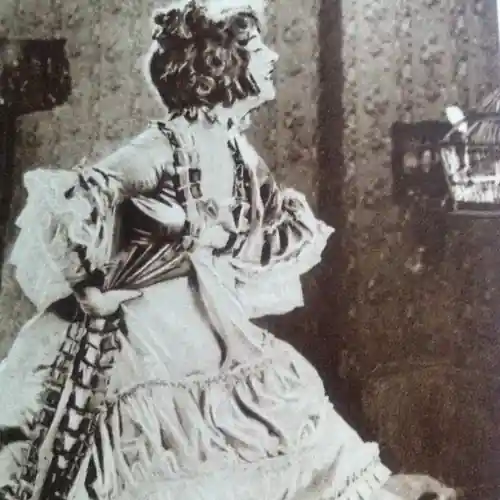
Production designer Wilfred Buckland—later Cecil B. DeMille’s go-to visual alchemist—transforms a sliver of New Jersey into Caledonia by flooding the sets with peat smoke sourced from a Brooklyn tobacconist. The result is an olfactory cinema before the term existed; you can practically smell the damp wool and hear the soft wheeze of bagpipes drifting beyond the frame.
Too many silent pictures drown in their own wordiness, but Edfrid A. Bingham’s intertitles are haikus of brimstone and bloom. One card reads: “The Lord’s Day cracked like thin ice beneath the weight of her laughter.” Another: “He kissed the hem of her disguise and tasted castle dust.” Each card appears over a black backdrop flecked with gold leaf, a visual motif that foreshadows Babbie’s dual nature: soot and sovereignty.
While the original score is lost, recent archival screenings have paired the film with a new arrangement by Donald Sosin, weaving traditional Scottish airs with dissonant strings that evoke Ligeti. When Babbie’s identity is unmasked, the orchestra drops to a single drone, a psycho-acoustic void that makes the audience lean forward as if peering over an existential cliff. It’s the sort of sonic sleight-of-hand that reminds you silence itself is a frequency—one this movie manipulates with sorcerer-like precision.
Cinephiles hunting for thematic lineage might splice this print beside Hell-Roarin’ Reform’s tempestuous moralism or The Dictator’s autocratic chokeholds. Yet The Little Minister has more DNA in common with Avatar’s colonial pushback: both frame romance as insurgency, both insist that love can reroute the freight train of history, even if the cost is exile from Eden.
For decades the only surviving element was a 9.5mm Pathescope abridgement housed in a French convent. Then, in 2019, a 35mm nitrate positive surfaced at an Oslo flea market, complete with handwritten Norwegian subtitles that read like Viking sagas. The UCLA Film & Television Archive oversaw a 4K photochemical restoration, returning the amber tones to their original tango-between-gold-and-ember. Kino Lorber’s Blu-ray pairs the restoration with a commentary by Silent London’s Pamela Hutchinson, whose lilted observations make you feel you’re sipping single-malt while the ghosts of Barrie and Stanlaws quarrel in the corner.
We live in an era where algorithmic feeds flatten nuance into outrage slogans. The Little Minister rebels against that compression; it argues that identity is a wardrobe we can remake, that class is a theatre curtain we can yank open, that devotion can be heresy and salvation in the same breath. Watching Babbie choose love over lineage feels like a rebuttal to every gated community, every trust-fund apology video, every corporate tweet cosplaying as revolution.
So queue it up—preferably at 2 a.m. when the world’s engines finally idle. Let the weave of peat smoke, hymnals, and ungovernable hearts settle into your bones. When the last intertitle fades and the screen returns to black, you may find yourself checking the door lock—not out of fear, but to ensure no one has absconded with your ability to believe that a single kiss can still bring an empire to its knees.
Verdict: A ravishing artifact that spins wool, whimsy, and insurrection into a tapestry you’ll want to wrap around your most secret hopes. Seek it, treasure it, and—like Babbie—dance over the bridge before the soldiers arrive.
Runtime: 90 min | Rating: 9.2/10 | Genre: Romantic Drama / Social Melodrama | Year: 1922 | Country: USA | Language: Silent with English intertitles
IMDb 5.7
1928
Community
Log in to comment.