DbcultAccessing Vault...
Cult Review
Senior Film Conservator
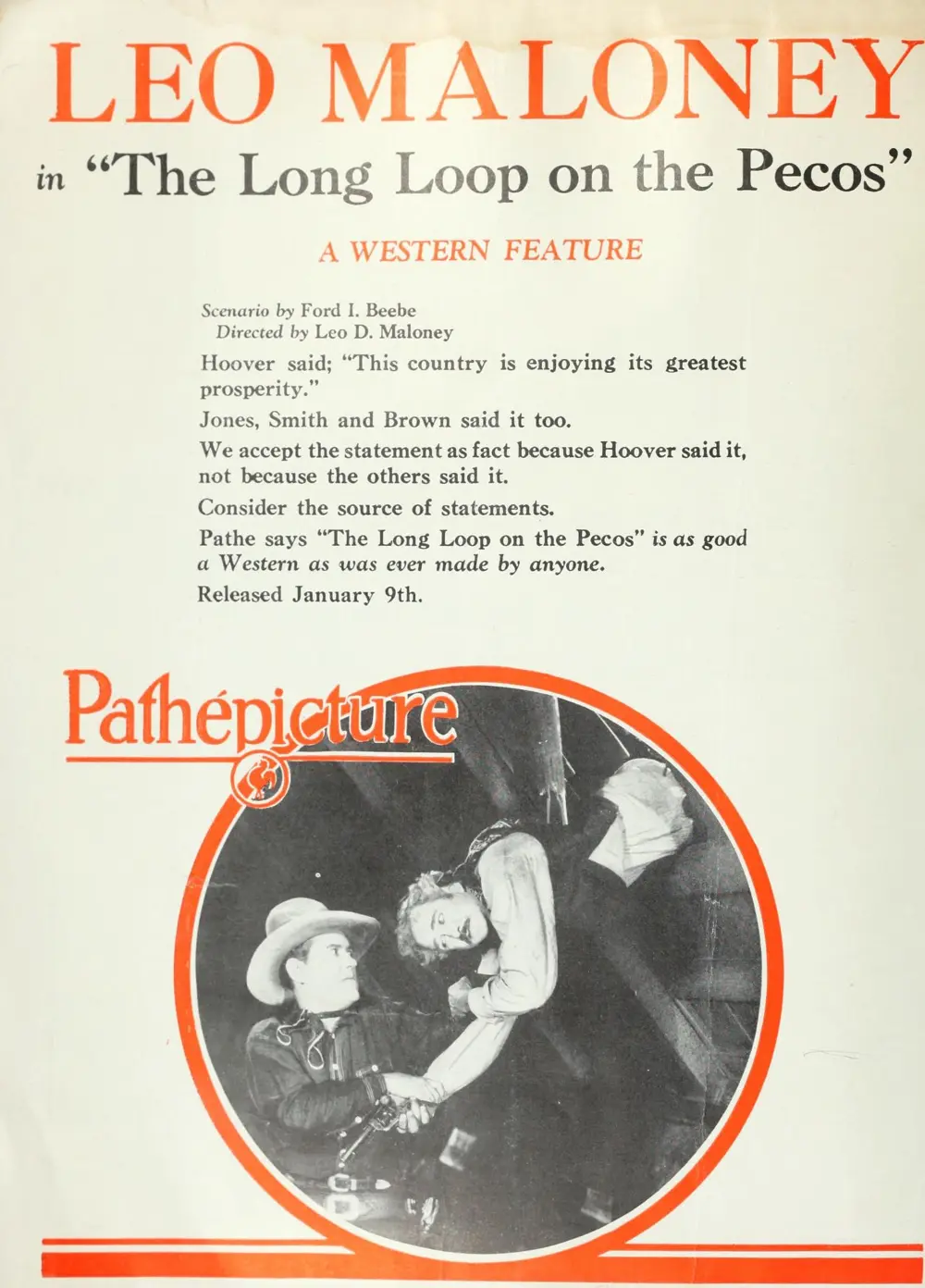
Does The Long Loop on the Pecos, a silent Western from 1927, hold up for modern audiences? Short answer: yes, surprisingly so, though with caveats that are inherent to its era. This film isn't merely a historical curiosity; it's a surprisingly robust piece of genre filmmaking that, despite its age, still manages to deliver a compelling narrative and a palpable sense of frontier justice.
This film is absolutely for devotees of early cinema, Western enthusiasts curious about the genre's roots, and anyone who appreciates the raw, unadorned storytelling of the silent era. However, if you're accustomed to fast-paced, dialogue-heavy modern blockbusters or expect sophisticated character arcs, this might test your patience. It demands a willingness to engage with its particular language, but the reward is a genuine connection to a foundational piece of cinematic history.
Before we delve deeper, let's lay out the essential truths about this often-overlooked feature.
This film works because of its unpretentious storytelling and the raw, physical performances that define silent-era Westerns. The conflict is clear, the stakes are tangible, and the landscape itself acts as a powerful, silent character. Director Ford Beebe understands the visual grammar of the West, using wide shots and close-ups effectively to convey both scale and intimacy.
You should watch it if you appreciate the foundational elements of the Western genre, are interested in the evolution of film, or simply enjoy a straightforward tale of good versus evil set against a rugged backdrop. It’s a window into a bygone era of moviemaking that, while imperfect, possesses a charm and authenticity often missing today.
The film introduces Jim Rutledge, a lone rider whose arrival in the Pecos country is less an entrance and more an immersion into an already troubled world. The Pecos, in this cinematic rendering, is not merely a setting; it’s a character—a vast, unforgiving expanse ruled by the whims of nature and, more menacingly, by the terror inflicted by the titular Long Loop gang.
Rutledge, portrayed with a stoic resolve characteristic of silent Western heroes, quickly encounters Clem Vining. Vining is not just a neighbor; he's a victim, his life a testament to the gang's pervasive cruelty. His plight immediately humanizes the abstract threat of the Long Loop, transforming them from a mere name into a tangible, oppressive force.
The narrative, penned by William Dawson Hoffman and Ford Beebe, deftly establishes this dynamic without excessive exposition. We understand the power imbalance, the fear, and the simmering resentment that permeates the community. Rutledge's decision to befriend Vining isn't just an act of kindness; it's a declaration, a silent challenge to the established order.
This setup is classic Western fare, yet it’s executed with an admirable economy of storytelling. The film doesn't waste time on elaborate backstories for its hero or villains. Instead, it plunges directly into the conflict, trusting the visual medium and the actors' expressions to convey the necessary emotional weight. The 'Long Loop' itself becomes less a gang and more a symbol of lawlessness, a pervasive evil that Jim Rutledge, the archetypal outsider, is destined to confront.
The plot, while straightforward, is not simplistic. It explores themes of community, the courage of the individual, and the slow, grinding process of bringing justice to a land that seems to have forgotten its meaning. Rutledge's journey isn't just about defeating a gang; it's about restoring balance to a fractured world.
In the silent era, acting was a physical art, a ballet of expression and gesture. Leo D. Maloney, as Jim Rutledge, embodies the quintessential Western hero with a quiet intensity. His performance is less about overt theatrics and more about a simmering resolve. When he fixes his gaze on a member of the Long Loop gang, his eyes alone convey a promise of retribution that needs no words. It’s a masterclass in understated power, a contrast to some of the more exaggerated styles of the period.
Maloney’s stoicism could, to a modern eye, sometimes border on wooden, yet it perfectly captures the idealized, unshakeable hero of early Westerns. He’s a man of action, not words, and his every movement, from mounting his horse to drawing his weapon, is imbued with a purpose that speaks volumes.
Opposite him, Dick La Reno, likely playing a key figure in the Long Loop gang, delivers a performance steeped in menace. Silent villains often relied on exaggerated expressions and menacing posturing, and La Reno certainly leans into this. His sneers are palpable, his gestures broad enough to convey cruelty even from a distance. One particular scene, where he silently intimidates Clem Vining, is particularly effective, showcasing the power dynamics through sheer presence.
The supporting cast, including Eugenia Gilbert, brings a necessary human element to the frontier drama. Her portrayal of a woman caught in the crossfire adds emotional stakes to the otherwise masculine-dominated conflict. Her expressions of fear and hope are crucial in grounding the larger-than-life battles in relatable human experience.
What's truly striking is how these actors communicate complex emotions without a single spoken word. A tightening of the jaw, a quick glance, a subtle shift in posture – these are the tools of their trade. While some might find the style dated, it's a testament to their skill that the story remains entirely comprehensible and emotionally resonant, even nearly a century later.
Ford Beebe's direction in The Long Loop on the Pecos is functional, yet often inspired. He understands the visual grammar of the Western, prioritizing clear action and expansive landscapes. There’s a directness to his approach that serves the genre well, focusing on the core elements without unnecessary flourishes.
The cinematography, while not groundbreaking for its era, effectively utilizes the natural beauty and harshness of the Pecos country. Wide shots of riders traversing vast plains immediately establish the scale of the frontier, making the characters feel small yet resilient against the backdrop of an indifferent world. This sense of isolation amplifies the threat posed by the Long Loop gang; there's no immediate help, only the raw courage of individuals.
One particular sequence involving a horseback chase demonstrates Beebe's competence. The camera, likely mounted on a moving vehicle, keeps pace with the galloping horses, immersing the viewer in the action. While it lacks the rapid cutting of modern action sequences, the sustained shots allow the audience to truly appreciate the speed and danger of the pursuit. It's a testament to practical effects and skillful stunt work.
Beebe also employs close-ups judiciously, reserving them for moments of heightened emotion or critical decision-making. A close-up of Maloney's determined face before a confrontation is far more impactful than a medium shot, drawing the audience into his mindset. These visual cues are vital in a silent film, replacing dialogue with direct emotional connection.
The film’s lighting, likely a mix of natural sunlight and some artificial fill, contributes to a rugged aesthetic. Shadows are used to dramatic effect, particularly in indoor scenes or during nighttime encounters, adding to the sense of mystery and danger. It’s a testament to the crew's ability to create atmosphere with limited resources. The visual storytelling is paramount, and Beebe, along with his cinematographer, ensures that every frame contributes to the narrative.
The pacing of The Long Loop on the Pecos is undeniably a product of its time. It begins with a deliberate, almost observational rhythm, allowing the audience to settle into the Pecos landscape and understand the initial conflict. The introduction of Jim Rutledge and his encounter with Clem Vining unfolds without haste, building the foundation for the coming struggle.
While modern audiences might find the initial setup a tad slow, this measured pace serves to heighten the impact of the action sequences when they do arrive. The film isn't a constant barrage of excitement; instead, it builds tension gradually, punctuated by bursts of thrilling gunfights, chases, and confrontations. This ebb and flow keeps the viewer engaged, even if the 'ebb' periods are longer than what's typical today.
The tone is classic Western: a blend of rugged realism, clear-cut heroism, and a pervasive sense of danger. There's an underlying grit to the film, reflecting the harsh realities of frontier life. The Long Loop gang isn't just a nuisance; they are a genuine threat, and their actions are depicted with a seriousness that underscores the stakes involved.
However, there are also moments of quiet determination and a subtle, almost melancholic beauty in the vastness of the Pecos. The film manages to balance the grimness of the conflict with the stoic resilience of its heroes. It lacks the overt comedic relief found in some contemporary silent films, opting instead for a consistent, earnest dramatic tone.
The film's tone is its strength. It doesn't attempt to be more than what it is: a straightforward, earnest Western. This commitment to its genre identity allows it to avoid pretension, delivering a story that resonates with the core values of frontier mythos. It’s a film that knows its purpose and executes it with conviction.
The screenplay, credited to William Dawson Hoffman and Ford Beebe, is a testament to effective, economical storytelling. In the silent era, writers had to distill complex ideas into visuals and concise intertitles, a skill that often resulted in remarkably lean narratives. The Long Loop on the Pecos exemplifies this approach.
The character motivations are clear: Jim Rutledge, the newcomer, represents justice and order; Clem Vining, the victim, symbolizes the community's suffering; and the Long Loop gang embodies pure, unadulterated villainy. There's little room for moral ambiguity, which, while perhaps simplistic by modern standards, is entirely fitting for the genre and the period.
The intertitles, while sometimes lengthy, convey essential plot points and character dialogue. They are not merely captions but an integral part of the narrative flow, guiding the audience through the story's beats. For instance, an intertitle establishing the Long Loop gang's reign of terror immediately sets the stage for Rutledge's heroic intervention.
The strength of the writing lies in its ability to establish a compelling conflict quickly. The persecution of Vining provides an immediate, personal stake for the audience, transforming the abstract concept of a criminal gang into a tangible threat against an individual. This foundational conflict is what drives the entire plot forward.
While the plot adheres to many Western tropes—the lone hero, the persecuted townsfolk, the ruthless gang—it does so with a sincerity that avoids feeling entirely derivative. It’s a sturdy framework upon which the visual storytelling is built, proving that a strong, clear narrative backbone is timeless, regardless of the medium's technological limitations. The film doesn't try to reinvent the wheel, but it rolls it forward with considerable force.
Yes, The Long Loop on the Pecos absolutely warrants a viewing today, especially for those with an appreciation for early cinema. It’s a solid, representative example of a silent Western.
The film offers a valuable glimpse into the foundational elements of the genre. It showcases the acting styles and directing techniques prevalent in the late 1920s. Its straightforward narrative of good versus evil remains engaging.
While it lacks the sophisticated narrative layers of modern films, its raw charm is undeniable. It's a piece of history that still entertains. Don't expect a modern blockbuster; expect a classic Western tale, told simply and effectively.
The Long Loop on the Pecos sits comfortably within the rich tradition of the silent Western, a genre that was immensely popular in the early decades of cinema. These films, often produced quickly and efficiently, established many of the tropes and archetypes that would define Westerns for generations to come.
What's fascinating about films like this is their ability to convey complex narratives and intense emotions without spoken dialogue. The actors, directors, and cinematographers had to work in concert to create a purely visual language. This often led to more physically expressive performances and a greater reliance on powerful imagery.
Compared to other silent films of the era, such as the whimsical animation of Feline Follies or the dramatic intensity of The Midnight Guest, The Long Loop on the Pecos finds its strength in its grounded realism and commitment to genre conventions. It's not trying to experiment with form; it's perfecting a proven formula.
The film's portrayal of the Pecos is also noteworthy. Many silent Westerns used the landscape as more than just a backdrop; it was often a character in itself, reflecting the struggles and triumphs of the pioneers. Here, the vastness and ruggedness of the terrain amplify the isolation and danger faced by characters like Jim Rutledge and Clem Vining.
Its legacy, though perhaps not as widely celebrated as some of its contemporaries, lies in its contribution to the enduring mythos of the American West. It’s a reminder that even in the earliest days of cinema, filmmakers understood the power of a hero on horseback, fighting for justice against overwhelming odds. It works. But it’s flawed. Yet, its historical significance and raw charm make it an essential watch for understanding where the genre began.
"The silent Western, at its best, strips away dialogue to reveal the primal core of conflict and heroism. 'The Long Loop on the Pecos' does precisely that, with a stoic grace."
Let’s break down what works and what doesn't in this silent Western.
The Long Loop on the Pecos is more than just a relic; it's a sturdy, engaging silent Western that delivers exactly what it promises: a compelling tale of justice in a lawless land. While its pacing and archetypal characters might not appeal to every modern sensibility, its strengths—particularly its authentic atmosphere, strong central performance by Leo D. Maloney, and clear narrative—make it a surprisingly rewarding watch.
It's a foundational piece of cinema that, with an open mind, still resonates. It’s not a masterpiece, nor does it try to be. Instead, it’s a confident, well-executed genre piece that deserves more than just a footnote in cinematic history. If you're willing to embrace its silent language, you'll find a genuine, gritty Western that stands the test of time, albeit with a few creaks and groans. Give it a chance; you might just discover a new appreciation for the origins of the genre.
IMDb —
1934
Community
Log in to comment.