DbcultAccessing Vault...
Cult Review
Senior Film Conservator
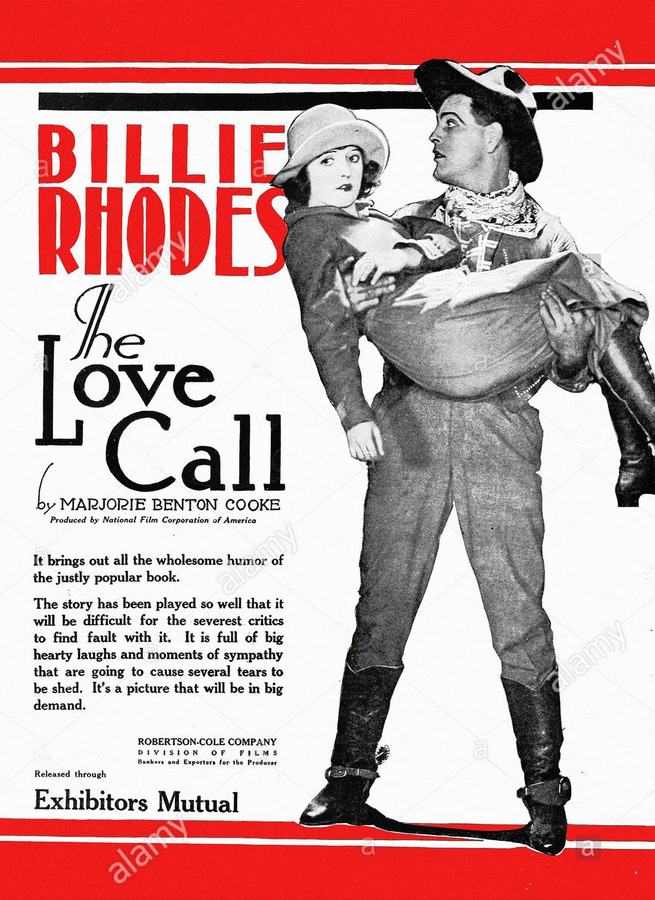
Stepping back into the cinematic landscape of the early 20th century, one encounters a fascinating tapestry of storytelling, where nascent film techniques converged with timeless human dramas. The Love Call, a 1920 silent Western, emerges as a compelling example of this era's vibrant narrative spirit, a film that, despite its age, resonates with themes still pertinent today: independence, the pursuit of knowledge, and the enduring power of love. Directed with a certain raw energy, it plunges us into a world where justice is often swift and personal, and where the untamed frontier shapes character with an unyielding hand. This isn't just a simple cowboy flick; it’s a nuanced exploration of a young woman's journey through profound loss, self-discovery, and ultimately, a choice between societal refinement and authentic passion.
At the heart of The Love Call lies Kid Allen, portrayed with a compelling blend of vulnerability and fierce resolve by Billie Rhodes. Her life is initially circumscribed by the dimly lit, smoke-filled confines of a saloon, a nightly vigil to escort her father, Mate Allen (William Dyer), a man whose former seafaring life has been replaced by the steady pull of the bottle. This initial setup immediately establishes a palpable sense of duty and the heavy burden of care that rests upon Kid’s young shoulders. The film doesn't shy away from depicting the harsh realities of this existence; Mate's drunken state isn't romanticized, but rather presented as a stark, limiting factor in Kid's life.
The catalyst for Kid’s transformative journey arrives with brutal suddenness. Saloon owner O'Keefe (Frank Whitson), a man clearly lacking in moral compass, makes an unwelcome advance toward Kid. Mate, despite his inebriation, rises to the occasion with a primal, protective fury, engaging O'Keefe in a violent confrontation. The scene, while brief, effectively conveys the volatile nature of frontier life and the deep, if flawed, love between father and daughter. But O'Keefe’s retaliation is swift and final, ending Mate’s life in a shocking act of violence. This moment is not merely a plot device; it’s the crucible in which Kid’s character is forged anew. Her immediate, unhesitating act of vengeance – shooting O'Keefe – defines her as a product of her environment, a woman who understands and dispenses justice on her own terms. It’s a raw, visceral response that sets the tone for her subsequent odyssey, a stark contrast to the more conventional legal systems prevalent in settled societies.
With her father gone and vengeance exacted, Kid finds herself at a crossroads. Her father's dying wish, though perhaps uttered through a drunken haze, echoes with profound significance: "an education." This desire, for a better life for his daughter than he could provide, becomes Kid's guiding star. She mounts her pony and rides off, a solitary figure against the vast, indifferent landscape, embarking on a quest not just for schooling, but for self-improvement and a future unknown. This pivotal moment underscores a theme often explored in silent Westerns: the individual's struggle against fate and circumstance, and the yearning for something beyond the immediate horizon. It's a journey reminiscent of other strong female characters seeking agency in early cinema, perhaps even drawing parallels to the moral dilemmas faced by figures in films like The Soul of a Magdalen, though Kid's path is one of active pursuit rather than redemption from past transgressions.
Her journey, however, is not without its trials. A fall from her pony leaves her with a sprained ankle, a physical vulnerability that forces her to pause. It is here that Joe Emory, a sheep herder portrayed by Lloyd Whitlock, enters her life. Joe is the quintessential gentle frontiersman, a man of quiet strength and genuine kindness, offering a stark contrast to the rough-and-tumble world Kid has just left. Their interactions, rendered through the expressive silent film acting of the era, depict a blossoming romance born of necessity and mutual respect. Joe nurses her back to health, and in the intimacy of shared solitude, they fall deeply in love. This segment of the film beautifully illustrates how human connection can flourish even in the most desolate of settings, a testament to the universal language of affection.
Yet, the call of her father's dying wish remains potent. Despite her profound connection with Joe, Kid's resolve to seek an education propels her onward. This decision highlights her unwavering commitment to her goal, even at the cost of immediate happiness. It’s a powerful statement about ambition and the internal conflict between personal desire and a sense of duty, a dilemma that echoes in countless narratives across cinematic history. Her departure from Joe, though heartbreaking, is not a rejection of love, but a temporary deferral, a testament to her nascent independence and determination. It also sets up the dramatic tension for the film's later acts, leaving the audience to wonder if these two souls, so perfectly suited, will ever truly reunite.
Kid's arrival in a university town marks a dramatic shift in environment and tone. The wild, open spaces of the frontier are replaced by the structured, often rigid, world of academia. Here, she encounters Nick Horton (Jack Hoxie), a cow puncher whose boisterous, unrefined demeanor provides a humorous, if somewhat chaotic, counterpoint to the intellectual atmosphere. Nick, in his well-meaning but utterly misguided attempt to advocate for Kid's immediate entry into the university, creates a memorable spectacle. His confrontation with the university president and students, born of a misunderstanding of academic protocols and a frontier sensibility, is a highlight of the film, showcasing the comedic potential of cultural clashes. It's a scene that could easily devolve into caricature, but instead, it effectively underscores Kid's "unpreparedness" for the polite society she aims to join, while also highlighting the inherent biases of the established order.
The university president, a figure of authority and perhaps surprising understanding, intervenes, preventing Nick and Kid from being arrested. This act of clemency suggests a deeper wisdom, a recognition of Kid's innate potential despite her rough edges. He places her in a boarding school, offering her a structured path to the education she seeks. For a moment, it seems Kid's quest is on track. However, the revelation that her schooling will last seven long years comes as a crushing blow. The prospect of such an extended period of confinement, divorced from the freedom she has always known, and more importantly, from the love she found with Joe, proves unbearable. It's a powerful statement on the limitations of formal education when it clashes with one's fundamental nature and deeply held desires. The film subtly questions whether true education lies solely within institutional walls or if life experiences and genuine connection offer a more profound form of learning. This narrative choice offers a fascinating counterpoint to films that champion education unequivocally, such as perhaps implicitly in Mesék az írógépröl, where knowledge and skill acquisition are presented as pathways to advancement, but here, the personal cost is too high.
Ultimately, Kid makes a choice that resonates with the core values of the human heart. She abandons the seven-year sentence of academic rigor for the immediate, tangible warmth of Joe's love. Her return to him is not a failure of her educational quest, but a redefinition of what "education" truly means for her. It's an education of the soul, a recognition that true fulfillment lies not in societal credentials, but in authentic connection and personal happiness. The film culminates in their tender reunion, a kiss that transcends the narrative, fading into a symbolic statue of Cupid embracing Psyche. This artistic flourish elevates their personal story to a mythical plane, suggesting that their love is as timeless and enduring as the classical figures of passion and the soul. It’s a remarkably poetic ending for a silent Western, moving beyond mere narrative resolution to a deeper, allegorical statement about love's triumph.
The power of this ending lies in its universal appeal. It's a narrative that privileges genuine human connection over the pursuit of conventional success, a theme that remains compelling regardless of the era. The decision to conclude with such an iconic image underscores the film's romantic heart, cementing Kid and Joe's love as something almost divine, an ideal to aspire to. It’s a bold artistic statement, moving beyond the simple "happily ever after" to something more transcendent, making the film's final moments particularly memorable.
Billie Rhodes, as Kid Allen, delivers a performance that is both nuanced and powerful. Her expressive face and body language convey a wide range of emotions, from the quiet stoicism of her early life to the fierce determination of her revenge, and the tender vulnerability of her romance with Joe. She embodies the "Kid" moniker perfectly, a young woman forced to grow up too fast but retaining an innate purity of spirit. Her portrayal is central to the film's success, grounding the more melodramatic elements in believable human experience. One can easily draw comparisons to other strong female leads of the era, such as those navigating complex social terrains in films like A Militant Suffragette, where female agency is similarly foregrounded, albeit in a different social context.
Lloyd Whitlock's Joe Emory is the ideal foil for Kid. His quiet strength and gentle demeanor provide a calming presence, making his character instantly endearing. The chemistry between Rhodes and Whitlock is palpable, a crucial element for the central romance to land effectively. Jack Hoxie, as Nick Horton, injects a much-needed dose of comic relief and frontier swagger. His performance, while perhaps over-the-top by modern standards, perfectly suits the era's acting conventions and provides a memorable, if brief, interlude. The supporting cast, including William Dyer as Mate Allen, Frank Whitson as O'Keefe, Harry De Vere, and John Pettie, contribute effectively to the film's rich tapestry, each bringing their characters to life with the broad, expressive strokes typical of silent cinema. The collective effort ensures that even minor characters leave an impression, contributing to the overall immersion in this world.
The writing, credited to Marjorie Benton Cooke and E. Magnus Ingleton, deserves particular commendation. They crafted a narrative that, while adhering to many Western tropes, manages to introduce layers of emotional complexity and thematic depth. The decision to frame Kid's journey around her father's dying wish for education, and then to have her ultimately choose love over institutional learning, is a sophisticated narrative twist that elevates the film beyond a simple adventure story. It speaks to a thoughtful approach to character development and plot construction, ensuring that the motivations feel earned and the stakes remain high. The pacing is generally brisk, maintaining audience engagement through a series of dramatic events and emotional beats, a hallmark of effective silent film storytelling that had to convey so much without dialogue.
Cinematically, The Love Call utilizes the visual language of silent film to great effect. The expansive frontier landscapes are captured with a sense of grandeur, contrasting sharply with the claustrophobic interiors of the saloon and later, the academic setting. The use of close-ups to convey emotion, particularly in Rhodes's performance, is skillful, drawing the audience into her internal world. While the film may not boast the groundbreaking technical innovations of some of its contemporaries, it demonstrates a solid grasp of visual storytelling, ensuring that the narrative unfolds clearly and compellingly. The visual progression from dusty, dangerous frontier to burgeoning romance, then to the staid halls of academia, and finally back to the open embrace of love, is artfully managed, creating a distinct sense of journey and transformation.
The Love Call stands as a compelling artifact from a pivotal period in cinematic history. It's more than just a historical curiosity; it's a testament to the enduring power of simple, yet profound, storytelling. The film's themes of justice, self-discovery, and the search for belonging resonate with audiences even today. It reminds us that the foundational elements of compelling drama – well-drawn characters, clear motivations, and meaningful conflicts – are timeless. While it shares genre elements with other Westerns of the era, such as Code of the Yukon, its particular focus on a young woman's personal evolution and the ultimate prioritization of emotional fulfillment sets it apart.
For silent film enthusiasts and newcomers alike, The Love Call offers a rewarding viewing experience. It provides a window into the narrative conventions, acting styles, and moral sensibilities of its time, while simultaneously delivering a story that feels remarkably fresh and emotionally resonant. The film’s final, almost mythical image of Cupid and Psyche serves as a powerful reminder that some stories, particularly those of love conquering all, are eternally relevant, transcending the specific technological limitations or stylistic quirks of their original presentation. It encourages us to look beyond the surface of silent film and appreciate the artistry and profound humanity that lies beneath. This film, with its potent blend of frontier drama, blossoming romance, and a unique take on the quest for self-improvement, remains a vibrant example of early cinematic storytelling at its most engaging.
In an era when cinema was rapidly evolving, The Love Call contributes to the rich tapestry of early Hollywood by demonstrating a sophisticated understanding of character arcs and thematic resonance. It’s a narrative that champions inner truth over external validation, a message that holds considerable weight. The choice Kid makes, to return to Joe and embrace a life of authentic love rather than a prescribed path of academic attainment, is presented not as a sacrifice, but as a victory of spirit. This nuanced portrayal of personal agency is particularly noteworthy for a film of its time, showcasing a forward-thinking approach to female characters that moved beyond mere damsels in distress or one-dimensional heroines. It's a film that quietly asserts the profound value of emotional intelligence and genuine connection, standing as a poignant reminder that the heart's wisdom often surpasses the intellect's dictates.
The film’s aesthetic, while simple by modern standards, effectively conveys the stark beauty and inherent dangers of the American West. The cinematography, though limited by the technology of the day, manages to capture the vastness of the landscapes and the intimacy of personal moments. The use of intertitles, an essential storytelling tool in silent cinema, is handled adeptly, providing necessary exposition and character dialogue without disrupting the visual flow. This delicate balance ensures that the audience remains immersed in Kid’s world, feeling her triumphs and tribulations firsthand. Ultimately, The Love Call is a compelling argument for the enduring power of silent film to tell deeply human stories, proving that the absence of spoken dialogue does not equate to a lack of voice or emotional depth. It remains a captivating journey through the heart of the frontier, and the heart of a young woman finding her true self.
IMDb —
1925
Community
Log in to comment.