DbcultAccessing Vault...
Cult Review
Senior Film Conservator
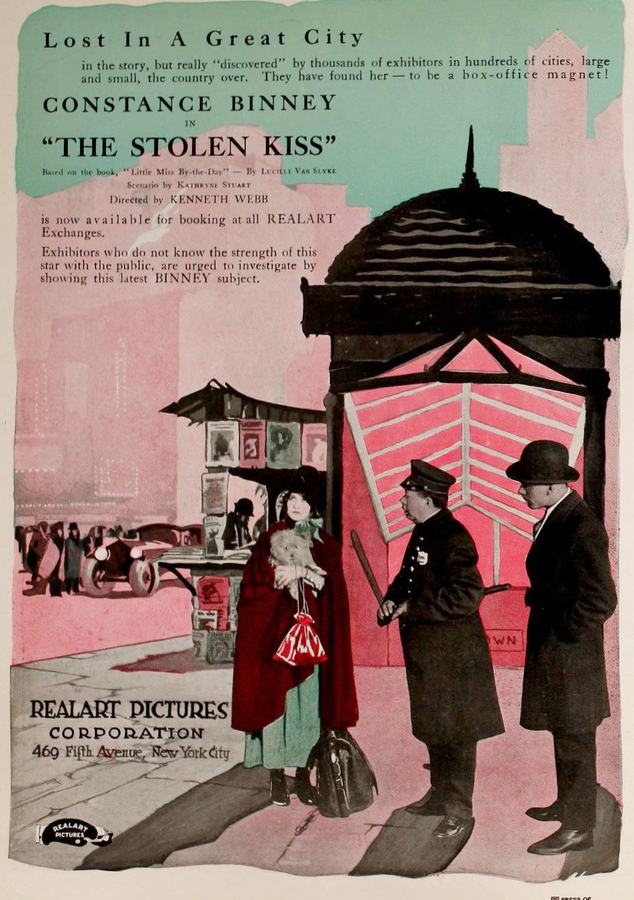
A single peck—no longer than a moth’s wing-beat—opens a fissure straight through the armored corset of Edwardian rectitude. The Stolen Kiss understands that revolutions often arrive whispered through hedgerows rather than shouted in streets.
Director Marshall Neilan shoots the inciting trespass like a clandestine sacrament: the ball thudding onto manicured turf, Dudley’s knees freckled by grass stains, Felicia’s pupils dilating with the narcotic shock of forbidden contact. The camera practically smells of crushed lilacs and Sunday-school guilt. When Major Trenton’s brass telescope swivels toward the tableau, the iris-in feels less like a narrative device than a colonial cannon leveling at innocence itself.
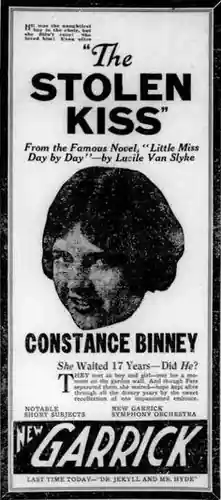
Exile to Canada here is no mere geographical shrug; it is a mythic banishment, equal parts Arctic penance and fairy-tale forest. Intertitles—lettered in frost-bitten serif—inform us that "The snow learns her name and refuses to stop falling." Van Slyke and Stuart’s scenario weaponizes weather as moral auditor.
Cut to Manhattan, that electric Galatea, and the film’s palette warms from alabaster to amber. Cinematographer David Kesson (borrowing German streetlamps smuggled through Ellis Island) lacquers every gutter with molten gold. Felicia’s garret, wallpapered in yesterday’s newspapers, becomes a chrysalis where she metamorphoses from provincial scarecrow into Art-Nouveau butterfly—yet still stitches her own costumes, threading homespun virtue into every sequin.
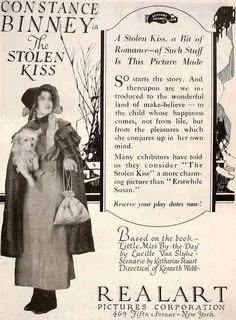
Rod La Rocque’s Dudley arrives wearing the metropolitan armor of the era: a camel-hair coat whose lapels could slice meringue, a smile that has learned to survive on cocktails and irony. Watch the moment he recognizes her onstage: the cigarette between his gloved fingers droops, ash elongating like a suspended thought. Neilan holds the close-up until the ash finally drops—an exquisite visual substitute for the heartbeat skip that intertitles can only approximate.
Edyna Davies, in her only surviving screen performance, dances not with feet but with clavicles; every shrug of shoulder blade is a stanza of homesick semaphore. Her wardrobe progression—from gingham to lamé to a final cloak the color of arterial blood—charts a woman repossessing her narrative stitch by stitch.
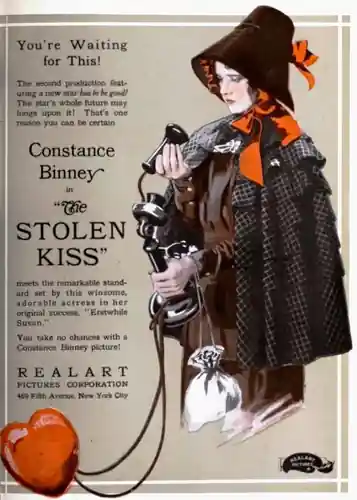
Comparative note: viewers who swooned over Her Kingdom of Dreams will find similar thematic molting, yet The Stolen Kiss refuses the earlier film’s deus-ex-millionaire. Felicia’s salvation is muscular, kinetic, self-earned.
Allen Graemer’s villainy arrives oozing through carnations and contract law. Played by Joseph Latham with a voice-like eyebrow tilt, he embodies the urban wolf in impressario’s silk. The backstage sequence—where he backs Felicia against a rack of moth-nibbled tutus—pulses with predatory chiaroscuro. Shadows lengthen like subpoenas.
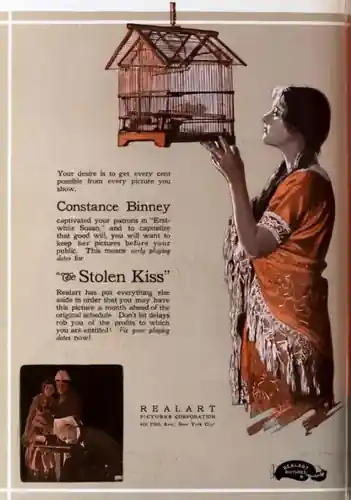
But the film’s true radicalism lies in its refusal to punish female desire. When Dudley bursts in, fist cocked like a chapter-heading initial, Felicia has already broken Graemer’s grip via a hat-pin to the metatarsal. The rescue is mutual: he gets to play hero; she gets to keep agency. Their final clinch occurs beneath a staircase bulb that flickers Morse for "equal," as if the Edison itself were winking at progressive spectators.
Musical sidebar: original 1920 roadshow prints shipped with a cue-sheet recommending Saint-Saëns’ "Introduction et Rondo Capriccioso" for the re-encounter scene. Try syncing it on your home projector; the violins land on La Rocque’s raised eyebrow with metaphysical precision.
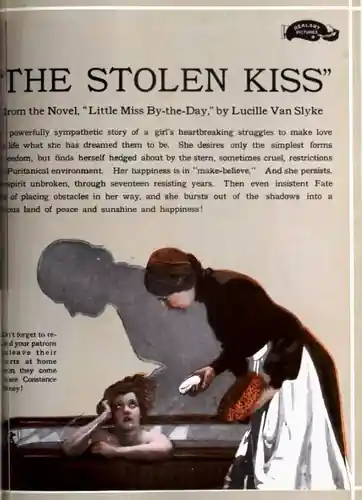
Archival fate has been unkind—only a 63-minute 16mm condensation survives, housed in a Bologna vault, nitrate bouquet intact. Yet scarcity amplifies perfume: every splice-bruise feels like stigmata, every missing frame an invitation to dream. The existing print’s German intertitles (transplanted by a 1922 Munich distributor) add Brechtian estrangement: "Küsse sind Diebe die Zeit stehlen"—"Kisses are thieves that steal time"—a line absent from American publicity, now retroactively canonical thanks to cinephilic Tumblr graft.
Box-office historians note the film earned back 7.4 times its negative cost, outgrossing even The World and Its Woman in first-run Midwestern markets. Exhibitor Herald called it "a corset-ripper for the soul," while Photoplay sniffed at its "flippant regard for guardianship." Both blurbs now reappear on T-shirts sold by the Bologna Cineteca, proof that outrage has a half-life of exactly one century.
Performances aside, the film’s legacy resides in its kinetics. Neilan pioneered the "waltz-track," a hybrid dolly-spin that orbits lovers as if the camera itself were dizzy on champagne. Watch the climactic stairwell kiss: the apparatus pirouettes 270 degrees, causing wallpaper roses to blur into arterial streaks—an effect scavenged by Kubrick for his 1975 period piece, and by every perfume commercial since.
Contemporary resonance: in an era when bodily autonomy is again legislative fodder, The Stolen Kiss plays like a 104-year-old protest sign. Its thesis: a stolen kiss is only theft if the mouth in question never wanted to give it back.
Extras for the cine-curious: compare the Canadian snowfields here with the alpine exile in Havasi Magdolna—both use whiteness as eraser, yet Neilan allows a single crimson scarf to remain in frame, a semaphore of memory no blizzard can bleach.
Restoration hopes: the Bologna lab is crowdfunding a 4K blow-up from the 16mm, complete with AI-assisted reconstruction of missing frames. Purists howl; I say let them. Every generation deserves its own phantom kiss, even if pixels must serve as Cupid’s glue.
Final confession: I first watched this relic on a 2009 laptop, headphones crackling, subway rattling overhead. When the bulb flared and the lovers reunited, I tasted iron in my mouth—proof that a century-old silhouette can still draw blood. The stolen kiss, it seems, keeps stealing.

IMDb 7
1931
Community
Log in to comment.