DbcultAccessing Vault...
Cult Review
Senior Film Conservator
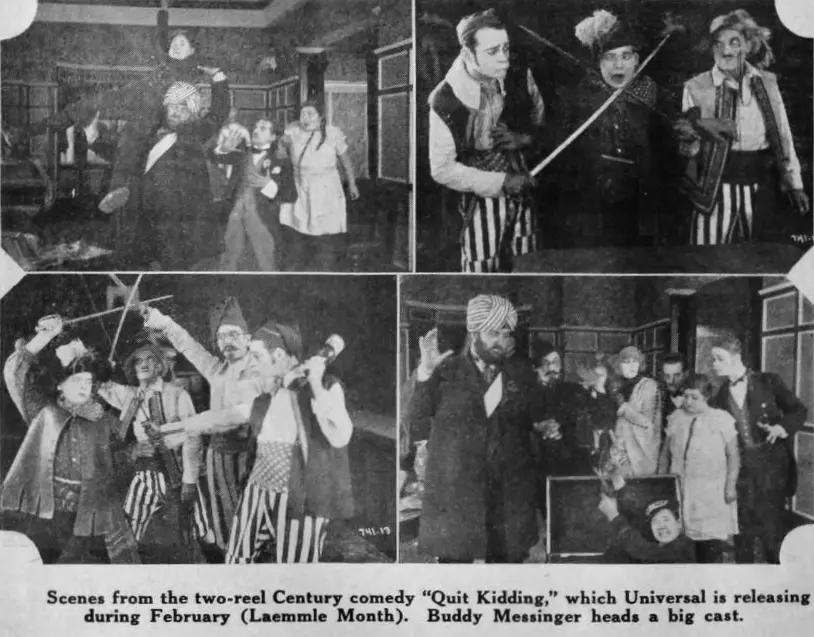
he year 1923 was a seminal epoch for the cinematic medium, a time when the language of visual storytelling was shedding its theatrical chrysalis to embrace a more kinetic, uniquely filmic identity. In the midst of this transformation, Quit Kidding stands as a testament to the versatility of the silent short, blending the frantic energy of the messenger-boy comedy with the burgeoning tropes of the 'Old Dark House' mystery. Directed by the prolific Albert Herman, the film serves as a showcase for the physical prowess of Buddy Messinger, a performer whose name might have faded into the sepia-toned background of history but whose timing remains as sharp as a razor’s edge.
The premise of Quit Kidding is deceptively pedestrian. We are introduced to Buddy, a courier whose uniform is his armor and whose bicycle is his steed. He is the quintessential everyman of the Roaring Twenties—underpaid, overworked, and perpetually in motion. However, the mundane nature of his errand is shattered when he is tasked with delivering a message to the grandson of a legendary pirate. This narrative pivot introduces a touch of the exotic into the gritty reality of the city, a thematic juxtaposition that Herman handles with surprising nuance.
The introduction of the 'men of mystery' elevates the film from a simple physical comedy to something more atmospheric. These antagonists do not merely oppose Buddy; they manipulate his reality. The scene in which they swap the message is a masterclass in silent tension. Unlike the overt melodrama found in Moral Suicide, the villainy here is subtle, almost playful, which ironically makes the threat of death—the 'warning that death will follow'—feel all the more jarring. It is this tonal dissonance that defines the film’s first act, setting the stage for the architectural madness that follows.
"The house in 'Quit Kidding' is not merely a setting; it is an antagonist in its own right, a wooden beast with trap doors for teeth and shadows for eyes."
Buddy Messinger’s performance is the centrifugal force that holds the film together. In an era where many actors relied on exaggerated gesticulation, Messinger possesses a groundedness that makes his eventual panic in the haunted house feel earned. His movements are fluid, almost rhythmic, particularly during the sequences where he must navigate the house’s various mechanical traps. There is a specific kind of athletic grace required for this brand of comedy—a requirement often seen in the works of contemporaries like those in A Champion Loser.
As the plot thickens and the 'spooky mediums' begin to manifest, Messinger’s reactions provide the necessary levity to prevent the film from descending into pure horror. His wide-eyed bewilderment serves as a surrogate for the audience, grounding the supernatural elements in a recognizable human response. The way he interacts with the vanishing papers—feverishly grasping at air—is a poignant metaphor for the ephemeral nature of wealth, a theme that resonates even a century later.
Albert Herman’s direction in Quit Kidding displays a sophisticated understanding of spatial geometry. The interior of the pirate’s grandson’s house is a labyrinth of shifting planes. Trap doors open with a suddenness that still surprises, and the use of 'secret papers' as a MacGuffin allows Herman to play with the audience’s expectations regarding continuity and presence. Much like the historical grandeur attempted in Fridericus Rex - 1. Teil: Sturm und Drang, there is an attention to detail here, though on a much more intimate, localized scale.
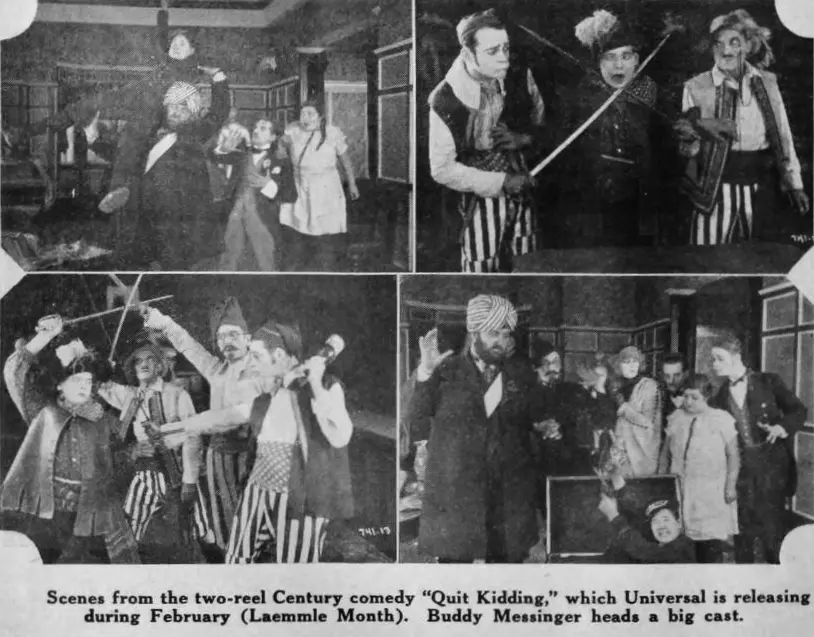
The cinematography, while constrained by the technology of the early 20s, makes excellent use of chiaroscuro. The shadows in the corners of the mansion feel heavy, pregnant with the history of the pirate ancestor. This atmospheric density is rarely seen in the pure comedies of the time, suggesting that Herman was looking toward the future of the thriller genre, perhaps even foreshadowing the psychological depth seen in The Man Who Saw Tomorrow.
The choice of a pirate’s grandson as the recipient of the message is a stroke of brilliance. It anchors the film in a tradition of adventure literature while allowing the 'old dark house' tropes to feel organic. The 'vast fortune' concealed within the house is the ultimate siren song, drawing both the protagonist and the antagonists into a clash of wills. This isn't just about a messenger boy doing his job; it's about the clash between the modern world (represented by the messenger service) and the spectral, lawless past (represented by the pirate’s legacy).
This thematic interplay is handled with more grace than the somewhat didactic approach found in At Piney Ridge. Here, the moral stakes are secondary to the visceral experience of the chase. The audience isn't asked to contemplate the ethics of the pirate’s theft; they are asked to marvel at the ingenuity of the house’s defenses and the bravery of the young man caught in the middle.
To analyze Quit Kidding without acknowledging its place in the broader silent canon would be a disservice. The film utilizes a vocabulary of movement that is often lost in modern cinema. Every tilt of the head, every frantic scramble across a rug, and every hushed conversation (rendered through expressive intertitles) contributes to a dense narrative tapestry. The supporting cast, including Sadie Campbell and Joe Bonner, provide a solid foundation for Messinger’s antics. Campbell, in particular, manages to convey a sense of urgency that complements the film’s brisk pacing.
When compared to the more somber tones of Nearing the End, Quit Kidding feels remarkably buoyant. It is a film that refuses to take its own morbidity too seriously, hence the title. The 'death will follow' warning is treated with a sort of gallows humor that keeps the energy high. Even when Buddy is trapped, there is a sense that his wit will be his ultimate salvation.
One of the most intriguing aspects of the film is the introduction of 'spooky mediums.' In the 1920s, spiritualism was a cultural obsession, and Albert Herman cleverly integrates this into the plot. The papers don't just disappear; they vanish through means that suggest a supernatural intervention, even if we know—as the audience—that it is likely the work of the 'mysterious strangers' and their hidden mechanisms. This ambiguity adds a layer of psychological depth to the film. Is the house actually haunted, or is it just a very sophisticated prank? Buddy’s eventual capture of the intruders provides the answer, but the journey to that revelation is paved with genuine unease.
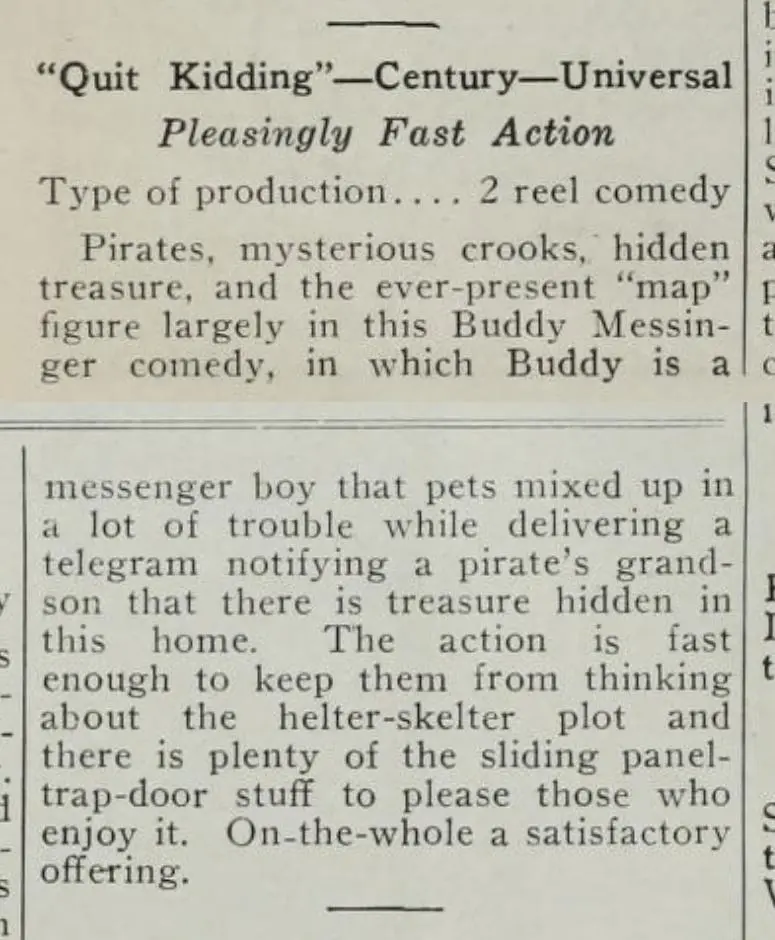
The pacing of these sequences is relentless. Unlike the slower, more methodical build-up in Ragged Robin, Quit Kidding opts for a barrage of stimuli. One moment a trap door is opening; the next, a secret panel is sliding shut. It is a proto-cinematic version of a funhouse ride, designed to keep the viewer off-balance and engaged.
In the context of 1923, Quit Kidding was part of a wave of films exploring the intersection of comedy and the macabre. While it may not have the epic scale of Famous Battles of Napoleon, it possesses a structural integrity that is often lacking in larger productions. The film is tightly wound, with no wasted frames. Every character, from Ella McKenzie to Fred Spencer, serves a specific purpose in the clockwork mechanism of the plot.
Interestingly, the film shares a certain DNA with Vanity's Price in its exploration of hidden motives and the masks people wear. In Quit Kidding, these masks are literal and figurative, as the intruders use the house’s secrets to hide their true intentions. Even the title itself—a colloquialism—suggests a dismissal of the very real danger Buddy faces, a bravado that defines the American spirit of the decade.
Ultimately, Quit Kidding is a triumphant example of how early cinema could blend genres to create a cohesive, entertaining whole. It avoids the melodramatic pitfalls of films like A Sister to Salome by staying true to its comedic roots while simultaneously delivering genuine thrills. Buddy Messinger’s journey from a simple messenger to a hero who secures a 'vast fortune' is a satisfying arc that mirrors the aspirational quality of the era.
The film’s resolution, where Buddy rescues the papers and captures the intruders, is a cathartic moment of triumph. It reaffirms the value of the 'little guy' in a world dominated by mysterious forces and ancient legacies. While it might not be as internationally recognized as Hei de Vencer or as emotionally heavy as Maddalena Ferat, Quit Kidding remains a vital piece of the silent era puzzle. It is a film that demands to be seen by any serious student of cinema, not just for its historical value, but for its sheer, unadulterated energy.
As we look back through the lens of a hundred years, the flickering images of Quit Kidding remind us of the power of visual invention. Albert Herman and his cast created a world that was at once familiar and fantastic, a world where a simple delivery could lead to a life-changing discovery. It is a film that, despite its age, refuses to be ignored. It is a reminder that in the world of cinema, as in the house of the pirate’s grandson, there is always something hidden just beneath the surface, waiting to be revealed.

IMDb 5.5
1935
Community
Log in to comment.