DbcultAccessing Vault...
Cult Review
Senior Film Conservator
Honestly, only if you are the type of person who digs through digital archives for fun. If you want a smooth story, skip it. If you want to see how people in the 1930s were sold ideas about the world, you’ll find this surprisingly tangled and strange.
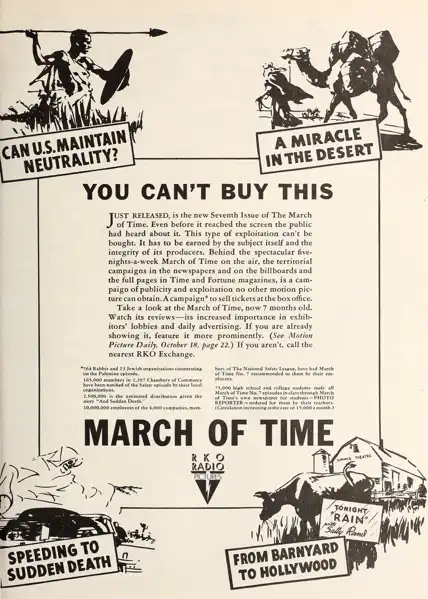
It opens with this intense, fast-talking narration that feels like it’s trying to win a race. The segment on Palestine is heavy on the "modernizing" rhetoric of the era, showing irrigation and construction like it’s a miracle of the age. It’s all very earnest, which is kind of the point.
Then, just like that, we’re watching a PSA about reckless driving. It’s jarring. One minute you’re looking at arid landscapes being turned into farms, and the next, a narrator is yelling at you about speed limits.
The segment on summer theaters feels like a total afterthought. It’s just a breezy way to close things out, I guess. It lacks the same weird, heavy-handed energy of the other parts.
It reminds me a bit of the frantic energy found in British Industries: The Oxford University Press, though this one has way more explosions—well, metaphorical ones at least. It doesn't have the grit of something like Peludópolis, but it’s definitely a piece of history that wasn't meant to be scrutinized this closely.
The whole thing feels like a magazine that got shoved into a blender. It’s not elegant. It’s just there, flickering on the screen, demanding you pay attention to three completely unrelated things at once. I think I’ll stick to modern documentaries next time, but it was a weird way to spend twenty minutes. 🎞️
1935
IMDb Rating
—

Editorial
Deciphering the legacy of transgressive cult cinema.
Community
Log in to comment.