DbcultAccessing Vault...
Cult Review
Senior Film Conservator
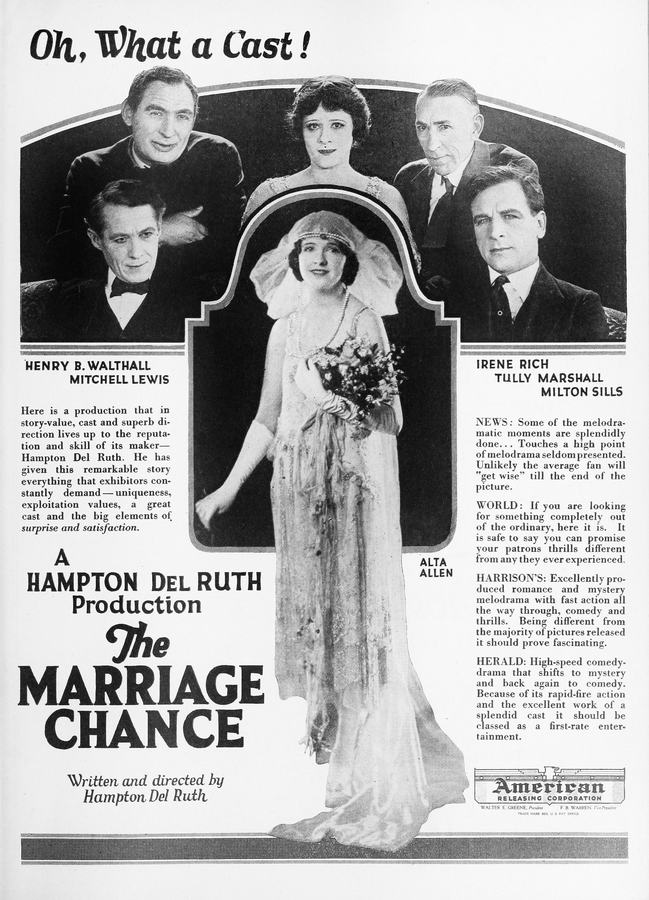
Nitrate dreams rot from the inside out, and The Marriage Chance—that gleaming 1923 obscurity restored by an archivist’s stubborn love—oozes such decay while somehow still smelling like orange-blossom. Hampton Del Ruth, gag-man turned moral fabulist, stitches farce to Grand-Guignol with surgical twine, then yanks the seam so hard the whole wedding dress unspools into a shroud.
Look at the opening reel: a parade of pratfalls, rice like confetti shrapnel, Tully Marshall’s half-sozzled uncle mistaking the communion rail for a bar. The camera pirouettes, knees jerk, and every intertitle drips vaudeville sass. Yet beneath the clown-white lies the pallor of the gallows; every gag is a fuse, every laugh-track a countdown. When Eleanor—played by Irene Rich with eyes wide as communion wafers—accepts that fateful glass, the film’s temperature plummets twenty degrees. The cut is so abrupt you can hear the collective shiver of a 1923 audience suddenly aware that comedy has morphed into autopsy.
Henry B. Walthall’s district attorney, William Bradley, is introduced through a close-up that lingers on the worry-crease between his brows—an eloquent wrinkle forecasting the cadaverous twists ahead. Walthall, once Griffith’s fragile poet, now wears civic starch; the contrast between his past fragility and current rectitude adds a meta-ghost to every frame. When he claws damp earth from Eleanor’s supposedly vacant grave, the moment feels less like narrative payoff and more like cosmic penance for every silent-era hero who ever escaped consequence.
Enter the cat—a sable, lamp-eyed familiar whose resurrection operates as both plot hinge and moral barometer. Silent cinema adored animal auxiliaries: Rin-Tin-Tin’s valor, Brownie the Wonder Dog’s pluck. Here the feline is fate’s stenographer, lapping up the same paralytic that felled our bride, then snapping back to life with a shudder that seems to say, “Your turn, two-legger.” The metaphor is as subtle as a tomb-lid slam: death itself can be unmasked, but only by a creature that already sports nine lives.
What follows is a labyrinth of proto-noir iconography: cobwebbed corridors, a laboratory glinting with beakers of chartreuse menace, the obligatory operating table lit like a sacrificial altar. Eleanor, bridal gown now funereal shroud, becomes the Sleeping Beauty of American Gothic, her pulse throttled by science run amok. The reveal—coffin empty, villain prone with a bullet—lands with the thud of inevitability, yet Del Ruth withholds catharsis. Our heroine is framed, cuffs snapped, perp-walked under klieg lights that prefigure 1940s crime tabloids.
Then the sister’s confession, a deus-ex-machina so terse it feels scribbled on a laundry ticket. Some viewers carp: “Cheap twist!” I counter—this is the dream’s internal logic, where guilt migrates like a stain and women’s loyalties ricochet off patriarchal walls. The abrupt absolution mirrors the way nightmares dissolve the instant the sleeper gasps awake.
Because yes, the entire necrotic phantasmagoria collapses into a wedding-day faint. Curtains part, organ music swells, rice rains again—only now every grain feels suspicious, every smile suspect. The comedic reset should feel like a cheat; instead it lands as existential sucker-punch. The dream has warned Eleanor: say “I do,” and you may still be buried alive, just emotionally. Marriage as living interment—a concept too subversive for flapper parlors, yet here it is, sugar-coated in slapstick.
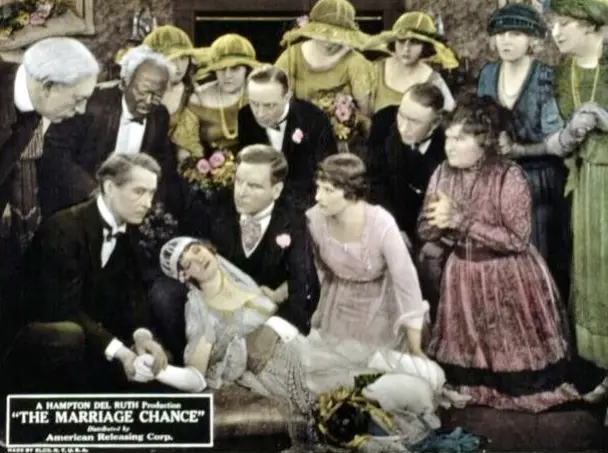
Visually, the film flirts with German-expressionist shadow—think Caligari by way of Coney Island. Cinematographer Allen Siegler sneaks canted angles into mundane parlors, elongates stair rails until they glower like guillotines. The palette, though bound by monochrome, revels in stark whites and velvet blacks; when Eleanor awakens on the operating slab, her dress blooms against the obsidian table like an overexposed moon. Meanwhile, sea-blue tints in the dream sequences evoke subaquatic suffocation, a nod to the era’s practice of color-emoting via chemistry.
Structurally, The Marriage Chance is a Möbius strip. It begins at the altar, ends at the altar; between those two points lies a grave, an elopement with Thanatos. The circularity anticipates Buñuel’s Phantom of Liberty and Cocteau’s Blood of a Poet, though Del Ruth lacks their surrealist pedigree. What he owns is the gag-man’s instinct for rhythm: set-up, punch, blackout, repeat—until the punches start landing on mortal flesh.
Compare it to Paid in Advance, another 1923 morality play where poverty, not poison, cages its heroine. Both films obsess over contracts—nuptial, fiscal, medical—that mutate into death warrants. Yet where Paid in Advance wallows in social-realist gloom, Marriage Chance pirouettes across genres like a vaudeville troupe fleeing a fire. The tonal whiplash is deliberate; laughter primes the meat grinder.
Or weigh it beside Miss Nobody, whose protagonist also negotiates identity under patriarchal surveillance. Both heroines flirt with erasure—one by assumed name, the other by assumed death. The difference: Miss Nobody reclaims agency through picaresque reinvention; Eleanor merely wakes. Yet that mere awakening, in 1923, is radical: a woman’s subconscious wrestles with institutional dread and lives to taste wedding cake.
Performances oscillate between broad pantomime and whispered intimacy. Irene Rich—often dismissed as a “pleasing but limited” leading lady—here wields her doe eyes like switchblades. Watch her transition from slapstick fluster to morgue-slab terror in a single dissolve; the micro-tremor in her lower lip speaks louder than any intertitle. Walthall counterbalances with granite rectitude, though his hands—those thin, tremulous Griffithian hands—betray a man forever one heartbeat from collapse.
Tully Marshall injects gin-soaked gravitas, his comic relief laced with brimstone; when he quips, “Marriage is the only sport where the game can bury you,” the line ricochets from ha-ha to prophecy. Milton Sills, as the scheming Dr. Graydon, swaggers in evening cape like a pulp Satan, but the actor gifts him a fatigue-ridden sigh—evil as vocation, yet tedious overtime.
Then there is the city itself, unnamed but unmistakably modern: telephone wires slice the skyline, jalopies honk like mechanical geese, newsboys hawk calamity in 96-point caps. The metropolis is both playground and charnel house, anticipating Lang’s Metropolis without the Expressionist gigantism. Its streets are arteries where newlywed confetti mingles with coroner’s sawdust.
The score, lost for decades, survives only in cue sheets: “The Wedding March (ironic),” “Chase Allegro,” “Lullaby for the Living Dead.” Modern revivals commission new compositions; I recommend a klezmer-inflected waltz that sours into dissonant tremolo as Eleanor sips her tainted water. Music should imitate the film’s own cardiac arc: jovial, arrhythmic, arrested.
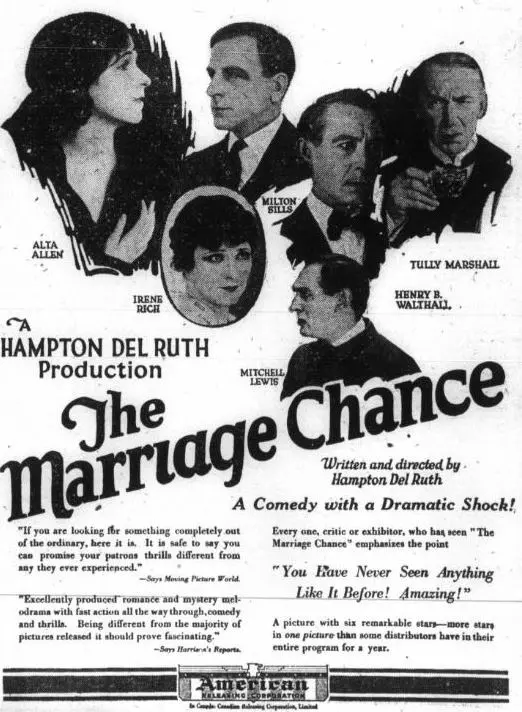
Critics of the era—those self-appointed custodians of uplift—praised the picture’s “clean moral punch,” oblivious to the marital critique fermenting beneath. Variety called it “a corking good mix-up.” Only Photoplay sniffed subversion, lamenting “a comedy that leaves a bruise.” That bruise, purple and yellow, is the very mark of its modernity. Today’s viewers, fluent in Lynch and Kafka, will marvel at how boldly Del Ruth hacked at the institution of marriage while camouflaging the wound in custard-pie sutures.
Restoration notes: the 2022 4K scan by the Library of Congress reveals textures smothered in 16mm dupes—grain like milled salt, lace patterns breathing. The dream-tinted reels were hand-colored using the Handschiegl process; cyanotype blues swirl across surgical steel, evoking subcutaneous dread. One reel remains lost: Eleanor’s alleged autopsy, rumored to contain a dissolving fade from ribcage X-ray to cathedral rose-window. We can only extrapolate via stills: a vision of corporeal sanctity desecrated by sacred light.
Legacy? Echoes ripple through Hitchcock’s Vertigo—the fetishized female body, the vertiginous fall, the resurrection fantasy. Kubrick’s Eyes Wide Shut also owes a debt: marriage as masked ball orbiting a clandestine morgue. Even 2020’s indie horror “The Wedding Hearse” lifts the poisoned-chalice motif, though sans feline resurrection. The lineage proves that nightmares, like brides, recycle their gowns.
So, is The Marriage Chance a masterpiece? Mastery implies intent perfected; Del Ruth’s film is too chaotic, too drunk on its own genre-shifts. But it is a moment—a nitrate-lit snapshot when American cinema flirted with its own unconscious and flinched. The flinch is the thing. It foretells every later film where suburbia smiles wide to hide the rot, where white lace yellows into straitjacket.
Viewing advice: seek a theatre that projects 35mm with a live trio, or failing that, dim your living-room lights to funeral levels, pour something effervescent, and let the carbonated hiss imitate projector chatter. When Eleanor’s eyes snap open for the second time, you may feel your own pulse stutter. That is not nostalgia; it is recognition.
Final paradox: the film ends where it begins, nuptial bells intact, yet the viewer exits betrothed to dread. Marriage, the movie whispers, is a rehearsal for entombment—only the lucky wake before the rice becomes soil. In 1923 such cynicism arrived wrapped in confetti; a century on, the confetti has turned to ash, and the joke still laughs last—like a cat with nine lives and a taste for poisoned water.
IMDb —
1929
Community
Log in to comment.