DbcultAccessing Vault...
Cult Review
Senior Film Conservator
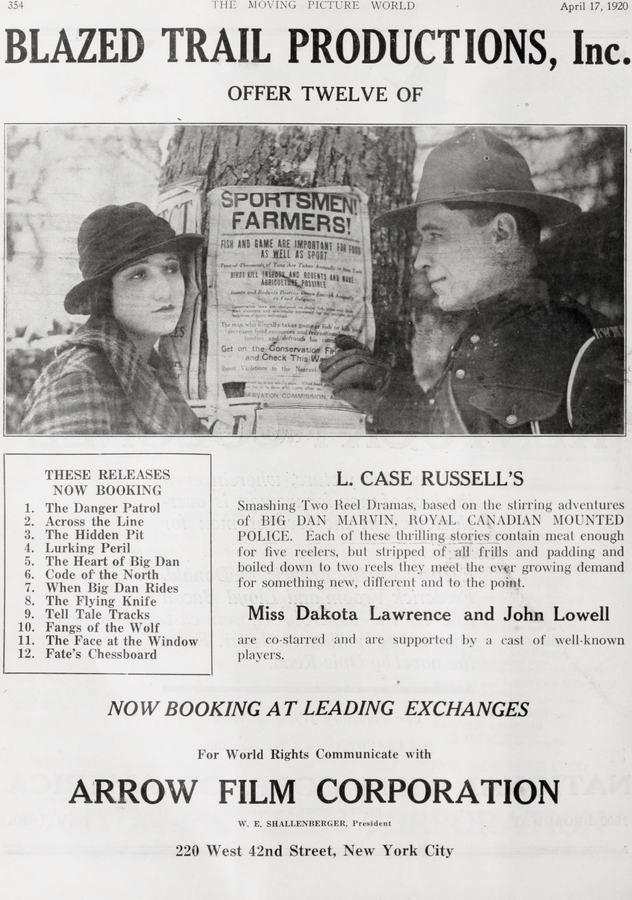
The year 1917 remains a watershed moment for the cinematic medium, a period where the primitive flickers of the early nickelodeon era began to transmute into the sophisticated visual language of narrative storytelling. Amidst this transition, When Big Dan Rides emerges not merely as a relic of a bygone genre, but as a robust testament to the craft of Lillian Case Russell and the raw magnetism of Dakota Lawrence. This is a film that breathes the dust of the trail and the sweat of the saddle, refusing to succumb to the sanitized nostalgia that would later characterize the Hollywood Western. Instead, it offers a gritty, unvarnished look at the mechanics of power in a land that had yet to be fully tamed by the gavel or the locomotive.
To understand the resonance of this film, one must first acknowledge the intellectual rigor of its screenwriter, Lillian Case Russell. In an industry that was already becoming a bastion of male perspectives, Russell’s ability to inject nuance into the hyper-masculine world of the Western was nothing short of revolutionary. Her script for When Big Dan Rides possesses a structural integrity often missing from contemporary serials like The Million Dollar Mystery. Where other writers relied on sheer spectacle or repetitive cliffhangers, Russell focused on the slow burn of tension and the inevitable collision of divergent moral codes. She understood that the 'ride' wasn't just a physical act, but a metaphor for the relentless forward momentum of destiny.
The narrative architecture here is surprisingly complex. We see echoes of the social consciousness found in The Cry of the Weak, yet filtered through the lens of a rugged individualism that defines the American ethos. Russell doesn't shy away from the darker impulses of her characters, allowing Big Dan to exist in a gray area that predates the anti-heroes of the 1950s. This isn't the binary world of white hats and black hats; it is a world of survival, where every gallop across the horizon carries the weight of life and death.
Dakota Lawrence delivers a performance that is remarkably understated for the silent era. Eschewing the grandiloquent gestures common in theatrical adaptations of the time, Lawrence uses his physical presence to convey a sense of gravitas. His 'Big Dan' is a man of few words—rendered literal by the medium—but his eyes speak of a weary wisdom. There is a specific scene, roughly midway through the film, where Dan pauses at the crest of a hill, looking down at the valley below. The composition of this shot, likely influenced by the burgeoning aesthetic seen in films like A Girl of the Timber Claims, frames Lawrence as a part of the landscape itself, as immutable as the granite peaks surrounding him.
His chemistry with Kitty Edwards provides the film’s emotional heartbeat. Edwards brings a luminosity to her role that serves as a necessary counterpoint to the film’s more abrasive elements. In their shared sequences, the pacing slows, allowing the audience to breathe and appreciate the burgeoning intimacy that threatens to derail Dan’s quest for justice. It is a delicate balance, one that reminds me of the romantic tensions in Heart's Desire, though here the stakes are amplified by the constant threat of violence.
The cinematography in When Big Dan Rides utilizes the natural light of the California sun to create a high-contrast world that feels both immediate and eternal. The wide shots are expansive, capturing the terrifying beauty of the wilderness in a way that recalls the atmospheric depth of The Pines of Lorey. There is no artifice here; the dust kicked up by the horses is real, the shadows lengthening over the sagebrush are genuine. This commitment to location shooting gives the film a tactile quality that studio-bound productions of the era, such as Hop to It, Bellhop, simply cannot replicate.
The action sequences are choreographed with a frantic, almost desperate energy. When Dan finally 'rides,' the editing accelerates, creating a rhythmic pulse that mimics the thundering of hooves. It is a primitive form of montage, yet it is undeniably effective in eliciting a visceral response from the viewer. Compared to the more static pacing of Who's Your Neighbor?, this film feels remarkably modern in its understanding of visual momentum. The camera isn't just a witness; it is a participant in the chase.
When examining the thematic preoccupations of When Big Dan Rides, it is useful to look at The Way of the Strong. Both films grapple with the concept of power—who wields it, how it is corrupted, and what happens when the 'strong' are forced to confront their own limitations. However, where The Way of the Strong often veers into melodrama, Russell’s script keeps the stakes grounded in the personal. Big Dan’s strength isn't just physical; it is his adherence to a personal code in a world that is rapidly losing its moral compass.
Furthermore, the film’s portrayal of the antagonist, played with a sneering efficiency by George Crosman, provides a fascinating study in villainy. Crosman doesn't play a caricature; he plays a man who believes he is the hero of his own story, much like the complex figures found in Martin Eden. This depth of characterization elevates the film beyond its genre trappings, making the final confrontation feel like a philosophical debate settled with lead and leather.
It is impossible to ignore the context in which this film was released. With the world embroiled in the Great War—as seen in the documentary style of France in Arms—the American Western provided a space to work through anxieties about justice and intervention. When Big Dan Rides reflects a yearning for a simpler, albeit more violent, form of resolution. It suggests that even in a world of complex alliances and global conflict, the individual can still make a difference. This sentiment is echoed, albeit in a more fantastical way, in the espionage thrills of The Eagle's Eye, but in the Western, it finds its most potent expression.
The film also touches upon themes of captivity and freedom, perhaps unintentionally mirroring the Swedish drama Fången på Karlstens fästning. Big Dan is, in many ways, a prisoner of his own reputation. He is 'Big Dan,' the man who must ride, the man who must solve everyone’s problems. The film subtly explores the burden of this hero-mythos, showing us the moments of quiet exhaustion that precede the public displays of valor. This introspection is what separates a great film from a merely functional one.
As we look back at When Big Dan Rides from the vantage point of over a century, its importance only grows. It stands as a bridge between the early adventure films like Paradisfågeln and the more nuanced psychological Westerns of the 1940s. It lacks the urban cynicism of The Mystery of a Hansom Cab, replacing it with a rugged optimism that is uniquely American. Even in its most tragic moments, there is a sense of Hope—not a naive hope, but one earned through struggle and sacrifice.
The supporting cast, including Charles A. Robins and John Lowell, provide a solid foundation for the leads to shine. Each character feels like they have a life that extends beyond the frame, a rarity in an era where bit players were often treated as moving furniture. This ensemble approach enriches the world-building, making the community that Dan protects feel worth saving. The film’s climax is not just a victory for Dan, but a victory for the social order he represents.
In conclusion, When Big Dan Rides is a masterclass in silent storytelling. It demonstrates that with a sharp script from Lillian Case Russell and a charismatic lead in Dakota Lawrence, the Western genre can reach heights of genuine artistic expression. It is a film that demands to be seen not as a dusty relic, but as a living, breathing piece of cinema history. It reminds us that while the frontier may have closed long ago, the stories we tell about it continue to shape our understanding of ourselves. Whether you are a scholar of the silent era or a casual fan of the Western, this ride is one you cannot afford to miss. The dust may have settled, but the echo of those hooves remains as loud as ever.
"A seminal work of the 1910s, 'When Big Dan Rides' captures the essence of the frontier with a clarity and depth that few of its contemporaries could match. It is the definitive Lillian Case Russell script brought to life with thundering intensity."
IMDb 3.4
1928
Community
Log in to comment.