DbcultAccessing Vault...
Cult Review
Senior Film Conservator
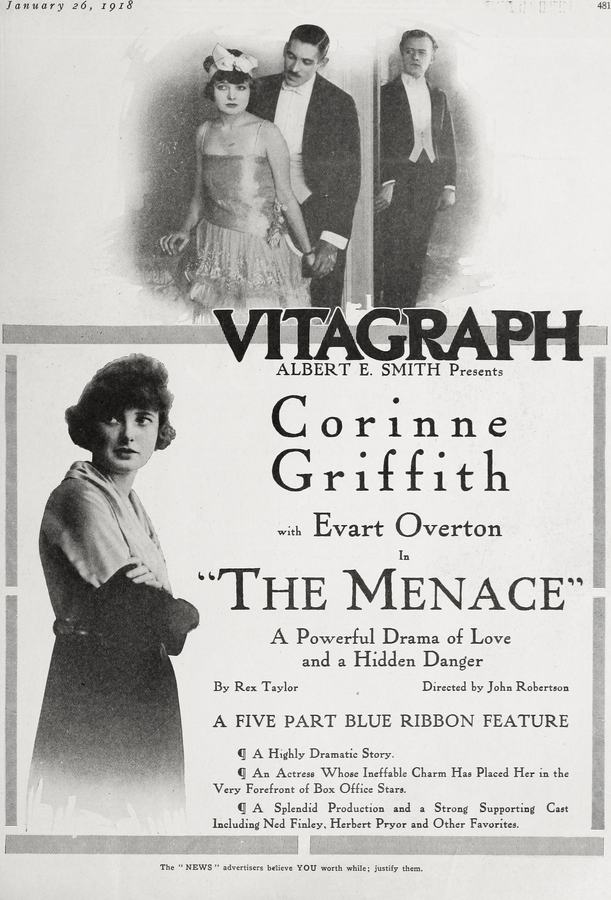
The cinematic landscape, particularly in its nascent stages, frequently served as a crucible for exploring profound philosophical quandaries. Among these, the enduring 'nature versus nurture' debate stands as a titan, a theme masterfully, if somewhat simplistically, tackled in 'The Menace.' This film, a fascinating relic from an era brimming with moralistic narratives, doesn't merely tell a story; it posits a grand, audacious experiment, inviting its audience to ponder the very essence of human character. Dr. Burnell, the architect of this social hypothesis, embodies the fervent progressive spirit of his time, convinced that environment is the ultimate sculptor of destiny. His decision to adopt Richard, the offspring of a notorious crook named Morgan, isn't born of mere philanthropy but of a deeply held conviction, a desire to prove that even the seed of a criminal can blossom into an upright citizen given the right soil. This premise alone sets a compelling stage, drawing us into a world where scientific inquiry bleeds into personal drama, where the lines between objective observation and emotional entanglement blur.
Richard's upbringing, meticulously orchestrated by Dr. Burnell, is a testament to this environmentalist credo. He is shielded, nurtured, and educated, emerging as a paragon of virtue, a young man seemingly untouched by the shadowy lineage from which he sprang. His engagement to Virginia Denton, a symbol of societal acceptance and purity, appears to be the ultimate vindication of Dr. Burnell's theory. Yet, the past, as is its cinematic wont, refuses to remain buried. The sudden reappearance of Morgan, Richard's biological father, acts as a corrosive agent, threatening to dissolve the carefully constructed edifice of Richard's life. Morgan's demand for Richard's complicity in a series of robberies isn't just a criminal act; it's a psychological assault, a direct challenge to Dr. Burnell's life's work and to Richard's very identity. This moral quandary, the forced choice between preserving a lie and succumbing to an inherited shadow, creates a palpable tension that resonates throughout the film. One might draw parallels here with The Picture of Dorian Gray, not in its supernatural elements, but in the idea of an inherent corruption lurking beneath a polished exterior, or the struggle against an internal moral decay.
The narrative’s strength lies in its ability to complicate Dr. Burnell’s initial certainty. As he observes Richard's reluctant involvement in Morgan's schemes, his unwavering faith in environmental determinism begins to waver. This internal conflict within the doctor is crucial; it elevates the film beyond a simple good-versus-evil tale into a more nuanced exploration of human fallibility and the complexities of moral judgment. Is Richard's participation a sign of an inescapable, inherited vice, or merely the desperate act of a man cornered by circumstance? The film masterfully keeps us guessing, mirroring Dr. Burnell's own crisis of conviction. The performances, particularly that of Herbert Prior as Dr. Burnell, convey this intellectual and emotional turmoil with a quiet intensity. Corinne Griffith, as Virginia Denton, brings a necessary grace and vulnerability to her role, serving not just as a romantic interest but as an embodiment of the societal stakes involved in Richard's moral struggle. Her eventual discovery of Richard's complicity is a devastating blow, not just to their engagement, but to the audience's hope for a straightforward resolution.
The climactic sequence, involving the robbery at the Denton home, is a masterstroke of dramatic irony. Richard, in a desperate bid to extricate himself and trap Morgan, conspires with Dr. Burnell. This act of apparent betrayal, designed to clear his name, instead plunges him deeper into despair when Virginia herself witnesses the act. This moment is particularly poignant, highlighting the tragic consequences of a truth half-revealed, a plan gone awry. It's a testament to the writers George H. Plympton, Rex Taylor, and Irma Taylor, who crafted a scenario that maximizes the emotional impact. The immediate breaking of the engagement by Virginia is entirely understandable, yet it leaves the audience yearning for justice, for Richard's true intentions to be known. The tension builds to an almost unbearable degree, reminiscent of the moral tightropes walked in films like The Conscience of John David, where characters grapple with impossible choices and their far-reaching repercussions. The use of dark orange and yellow hues for emphasis in the mental landscape of the viewer during these dramatic turns would perfectly underscore the urgency and peril.
Then comes the revelation, a narrative pivot so profound it reconfigures everything that came before. Morgan, cornered and with nothing left to lose, unveils the astonishing truth: Richard is not his son, but Dr. Burnell's own, kidnapped in infancy. This twist, while a classic device, is executed with such impact that it retroactively recontextualizes every interaction, every struggle, every doubt. It's a moment of profound vindication, not just for Richard, but for the very idea of inherent goodness. Dr. Burnell's experiment, in a sense, is proven correct, but not in the way he initially conceived. It wasn't nurture overcoming bad heredity; it was nurture aligning with good heredity, a fortunate confluence. This revelation clears Richard's name, restoring his honor and his love. The sea blue, a color of calm and clarity, would be an apt visual metaphor for the resolution that washes over the narrative at this point, cutting through the preceding tumult.
The film's exploration of identity is one of its most compelling aspects. Richard, for the majority of the story, is a man living under a false premise, burdened by a lie that isn't his own. His struggle is not just against Morgan, but against the specter of his supposed origins. The weight of societal prejudice, the assumption that 'like father, like son,' is a heavy yoke he carries. This theme of mistaken identity and the fight to clear one's name is a recurring motif in cinema, seen in various forms across different eras. 'The Menace' handles it with a directness that is both charmingly straightforward and surprisingly effective for its time. The film suggests that while environment is powerful, there might also be an irreducible core of self, a fundamental character that resists external corruption. This nuanced take, even if delivered through a dramatic twist, provides more food for thought than a simple 'nurture wins' conclusion.
One cannot overlook the societal context in which 'The Menace' was produced. The early 20th century was a period fascinated by eugenics and social engineering, where debates about heredity versus environment were not merely academic but had real-world implications for public policy and social reform. Films like 'The Menace' reflect these contemporary concerns, offering cinematic explorations of popular scientific and philosophical discussions. While the film ultimately leans towards a resolution that emphasizes inherent virtue, it does so after a thorough dramatic exploration of the alternative, giving credence to the idea that external pressures can indeed push an individual to their breaking point. The writers skillfully weave this larger societal debate into a personal drama, making it accessible and engaging for a broad audience. The film avoids didacticism by grounding its philosophical inquiry in compelling human stakes, making the audience emotionally invested in Richard's fate.
The performances, while typical of the era's acting styles, contribute effectively to the film's dramatic impact. Herbert Prior's portrayal of Dr. Burnell is particularly noteworthy, capturing the intellectual's idealism and subsequent disillusionment with conviction. Ned Finley as Morgan delivers a suitably menacing performance, a true antagonist who perfectly embodies the 'menace' of the title. His presence is a constant, suffocating threat, driving much of the plot's tension. Corinne Griffith, a popular star of the time, brings a luminous quality to Virginia, making her an empathetic figure whose heartbreak is genuinely felt. Evart Overton as Richard successfully conveys the internal conflict and the burden of his secret, making his eventual exoneration all the more satisfying. The supporting cast, including Frank A. Ford and Leila Blow, provide solid contributions, rounding out the film's world with believable characters.
Comparing 'The Menace' to other films of its period reveals both its unique qualities and its adherence to certain narrative conventions. While films like The Ring and the Man or The Mysterious Mr. Browning might also delve into criminal elements and moral dilemmas, 'The Menace' distinguishes itself with its explicit framing around a scientific experiment. This gives it a slightly more intellectual veneer, even as it delivers pulp fiction thrills. The theme of a character struggling against a perceived dark lineage, only to be cleared by a surprising revelation, can be seen in various forms across early cinema, but 'The Menace' executes it with a particular flair for high drama. The pacing, while perhaps slower by modern standards, allows for a deliberate build-up of tension and a thorough exploration of the characters' emotional states, a common characteristic of films from this specific cinematic epoch.
The film's conclusion, with Richard's name cleared and his marriage to Virginia assured, offers a conventional happy ending, yet it's one earned through significant emotional turmoil and a genuinely surprising twist. It's a resolution that reaffirms faith in personal virtue and the power of truth, even when buried under layers of deception and circumstance. The journey to this resolution is what truly captivates, offering a glimpse into the societal anxieties and moral frameworks of its time. 'The Menace' is more than just a simple melodrama; it's a commentary on identity, destiny, and the enduring human struggle to define oneself amidst external pressures. It invites us to consider how much of who we are is innate, and how much is shaped by the world around us, ultimately suggesting that sometimes, the truth of our origins is far more complex and redemptive than we could ever imagine. The writers’ ability to construct such a labyrinthine plot, leading to a satisfying yet unexpected denouement, speaks to their storytelling prowess. The film’s lasting impact comes from its courageous tackling of a debate that continues to resonate today, making it a valuable piece of cinematic history.
Ultimately, 'The Menace' stands as a compelling example of early cinema's capacity for intricate storytelling and thematic depth. It's a film that asks big questions and, through a series of dramatic revelations, provides an answer that is both comforting and thought-provoking. The struggle of Richard, caught between a fabricated past and a desired future, is universal, resonating with anyone who has ever felt constrained by circumstances or misjudged by others. The film’s legacy is not just in its dramatic twists, but in its earnest engagement with the very fabric of human nature, making it a worthy watch for those interested in the historical evolution of cinematic narrative and its enduring power to explore the profound mysteries of identity and destiny.
IMDb —
1925
Community
Log in to comment.