DbcultAccessing Vault...
Cult Review
Senior Film Conservator
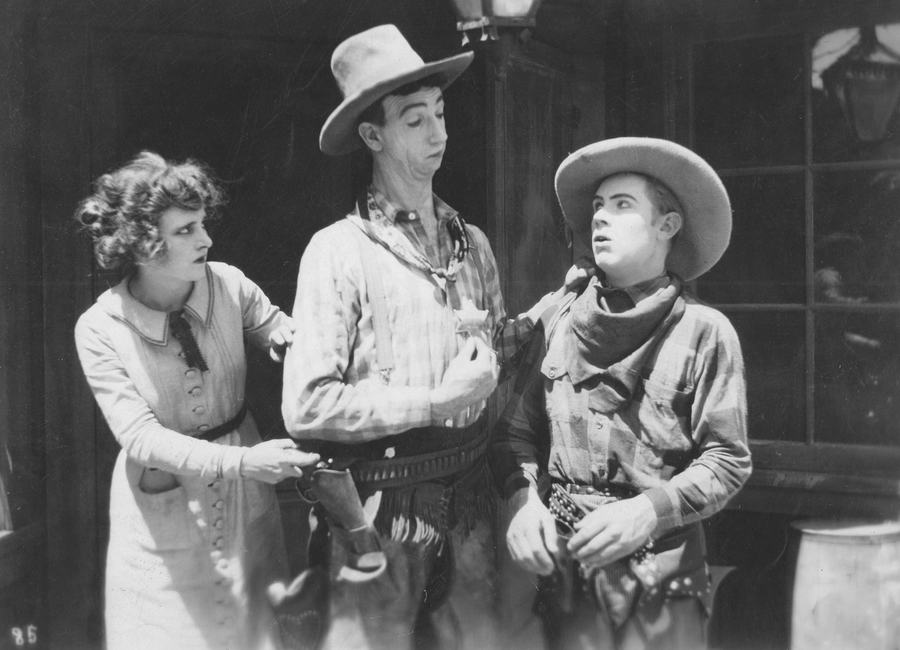
Alfred J. Goulding’s Mama’s Cowpuncher is a film that defies easy categorization, straddling the line between silent-era slapstick and existential drama with a deftness that feels both anachronistic and eerily prescient. At its core lies a deceptively simple narrative: a young man’s struggle to reconcile his innate talents with the expectations imposed upon him by family, gender norms, and the brutal demands of frontier life. Yet Goulding, with a writer’s flair for the absurd and a director’s eye for visual metaphor, turns this premise into a microcosm of American cultural anxiety. The film’s power emerges not from its plot mechanics but from its unrelenting focus on the psychological toll of identity performativity—a theme that resonates with aching clarity in today’s climate of curated personas.
The film opens with a sequence that immediately establishes its tonal duality. Young Harry (a disarmingly vulnerable Joe Murphy) is shown mimicking the grandeur of classical pianists in a parlor scene, his small hands dwarfed by the ivory keys. This image of delicate artistry is shattered in the next scene as Harry is thrust into the smoke-filled chaos of a frontier saloon, his fingers now fumbling with a piano keyboard that’s been repurposed as a bar. The contrast is jarring, but Goulding lingers on Harry’s face—specifically his eyes, which dart between the piano and the rowdy patrons with a mix of confusion and silent rage. This is not mere character development; it’s a masterclass in visual storytelling that compresses a lifetime of stifled potential into a single, haunting close-up.
What follows is a study in the grotesque transformation of identity. Harry’s mother and father, depicted in brief but telling scenes, represent the suffocating weight of familial expectation. Their obsession with his pianist career is less about nurturing talent and more about projecting social status—a theme that echoes through The Double Standard (1919) but with a uniquely Western twist. When Harry is abandoned at the dance hall, the film’s true exploration begins. Here, the piano—the symbol of his former life—becomes a tool of mockery. Patrons hurl coins at it; it’s used as a makeshift table for whiskey and cigars. The instrument’s degradation mirrors Harry’s own, a silent commentary on how quickly society discards those who fail to conform.
The film’s most audacious choice is its portrayal of Harry’s metamorphosis into a 'rougher than the Atlantic' cowpuncher. This isn’t a heroic transformation but a grotesque parody of masculinity. With the aid of the Black cook (a scene-stealing Bartine Burkett), Harry adopts a series of performative Western skills—roping, bronco-busting, and sharp-shooting—all executed with the clumsy precision of a child playing dress-up. These sequences, shot with a mock-seriousness that borders on satire, highlight the absurdity of the 'frontier hero' archetype. Yet there’s a tragic kernel beneath the humor: Harry’s willingness to become a 'terrorizing cowpuncher' to please his lover reveals a deep-seated insecurity about his own worth. The film doesn’t let us forget that his violence is performative, a role he’s forced to adopt to survive in a world that sees him as neither artist nor man.
The relationship between Harry and his lover—a fleeting but pivotal character who delivers the infamous 'rough' line—is handled with a mixture of tenderness and cruelty. Her desire for a 'tough' partner isn’t framed as empowerment but as a reflection of societal conditioning. This dynamic invites comparisons to the gender politics of Camille (1917), though Goulding’s approach is far more subversive. When Harry finally embraces his 'rough' persona to clean up the bad men, the act feels less like redemption and more like a hollow victory. The final scenes, where he stands amidst the wreckage of his former life, are haunting in their ambiguity. Is this a man finding his true self, or merely another mask?
Technically, Mama’s Cowpuncher is a marvel of silent film craftsmanship. The use of shadows in the dance hall scenes creates a chiaroscuro effect that elevates the narrative tension, while the editing—particularly in the fight sequences—anticipates later innovations in kinetic storytelling. The piano, recurring as both a literal and metaphorical device, is framed with such reverence that it becomes a character in its own right. These elements, combined with the cast’s physical expressiveness, create a film that feels both of its time and ahead of it.
For modern audiences, the film’s greatest strength lies in its unflinching examination of identity. Harry’s journey—from pianist to puncher—serves as a metaphor for anyone who has ever felt forced to adopt a persona to fit into a predefined role. The film’s ending, deliberately open, refuses to offer easy resolutions. Instead, it lingers on Harry’s face as he stares at the piano in the distance, its keys now cracked and broken. This final image is more than a visual callback; it’s a poignant reminder that identity is not a fixed destination but a series of choices made in the face of impossible expectations.
In the pantheon of Westerns, Mama’s Cowpuncher occupies a unique space. It shares the frontier setting of Riding with Death and the moral ambiguity of The Rebel, but its true kinship lies in its absurdist tone. The film’s most direct descendant might be The Bull-Dogger, another work that uses the Western genre as a canvas for exploring personal transformation. Yet where those films often lean into mythmaking, Goulding’s work undercuts the genre’s conventions at every turn. The result is a film that feels both deeply rooted in its era and startlingly contemporary.
For film scholars, Mama’s Cowpuncher offers a rich tapestry of themes to dissect. The interplay between music and violence, the deconstruction of the 'self-made man' myth, and the gendered expectations of performance all invite deeper analysis. Its treatment of race through the Black cook’s character is particularly noteworthy—Burkett’s performance is both a subversion of Western tropes and a subtle critique of the racial hierarchies of the time. While the film doesn’t explicitly confront these issues, its very existence as a work of art that centers a marginalized perspective speaks volumes.
In conclusion, Mama’s Cowpuncher is a film that demands to be seen more than once. Its layers of meaning unfold with each viewing, revealing new depths in its exploration of identity, ambition, and the performative nature of self. For those interested in the evolution of the Western genre, it serves as a fascinating counterpoint to more traditional works. And for general audiences, it offers a gripping, often bizarre, but ultimately moving story about the cost of becoming who others want you to be.
To further explore related themes, consider watching The Bull-Dogger for another take on transformation in the Western genre, or Riding with Death for a more traditional exploration of frontier morality. Both films, while distinct, share Mama’s Cowpuncher’s fascination with the fluidity of identity in the American West.
IMDb 5.9
1935
Community
Log in to comment.