DbcultAccessing Vault...
Cult Review
Senior Film Conservator
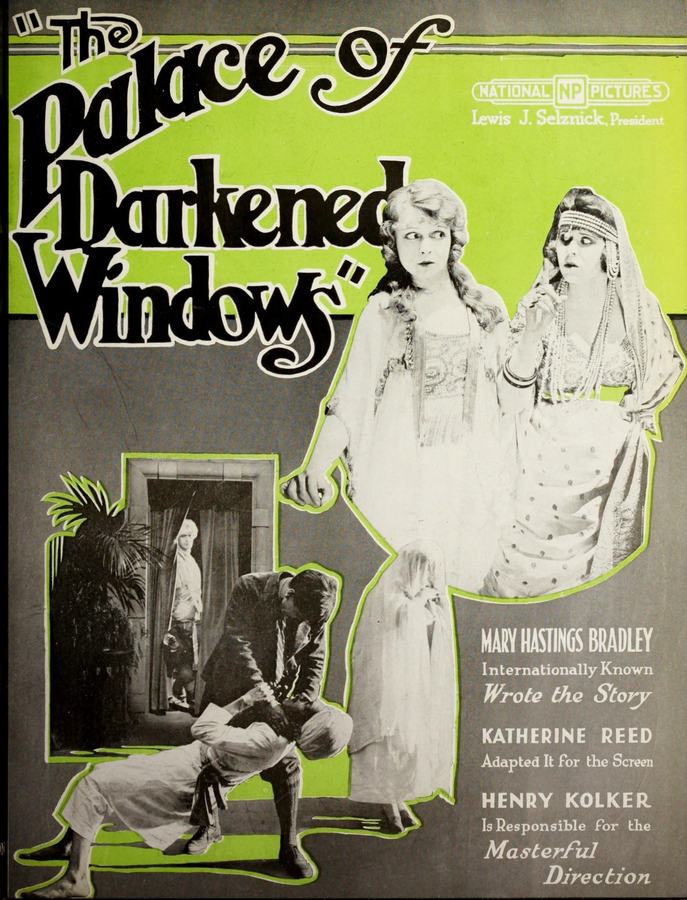
There is a moment, roughly seventeen minutes into The Palace of Darkened Windows, when the camera forgets to blink. A servant extinguishes the last gas-lamp; the frame dims to a bruised violet; only the Rajah's emerald turban retains chromatic defiance, bobbing through the corridor like a firefly possessed. In that eclipse you sense the film's true engine—not plot, but chiaroscuro, the hunger to swallow light and viewer alike. Katherine S. Reed and Mary Hastings Bradley's screenplay flirts with the stock tropes of 1920 orientalia—snake-charmers, veiled houris, bazaar chase—but under the soot of genre it smuggles a treatise on the commodification of female autonomy that feels eerily contemporary.
Travelogue morphs into captivity narrative with the speed of a slamming portcullis. Arlee's entrance into the palace is rendered as a slow dissolve: her silhouette superimposed upon a fresco of Radha besieged by gopis, the visual rhyme unmistakable. Aunt Eva's earlier comic bluster—grousing about chilblains and the impertinence of monkeys—curdles into muted horror once she grasps that etiquette itself has become her jailer. The harem sequences, shot mostly in medium close-up to evade censorious scissors, achieve claustrophobia through repetition: lattice, veil, lattice, veil, until the pattern itself seems to breathe.
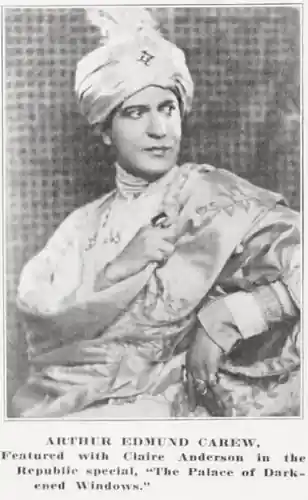
Arthur Edmund Carewe plays the sovereign like a man paging through an instruction manual for tyranny he has memorised but never internalised. His smile arrives a half-second late, as though couriered from a distant department. Compare this to the predatory suavity of Pring's Captain Falconer, whose desire is framed less by lust than by colonial ledger: Arlee is the territory he believes Britain forgot to claim. The mirroring of these male appetites—one absolute, one imperial—renders the palace a crucible where gender and geopolitics melt into the same molten coin.
Director of photography Jay Belasco eschews the postcard palette audiences expected after missionary-doc vistas. Instead he opts for tenebrous jewel tones—saffron that has bled and faded, indigo bruised toward black. When Billy finally clambers up the palace rampart, the moonlight is not silver but a sickly pumpkin orange, the same shade that would later haunt Green Eyes' asylum corridors. This chromatic dysmorphia infects the viewer, suggesting rescue itself may be merely a different costume for catastrophe.
Virginia Caldwell's Arlee is calibrated at the cusp between the Victorian wax-doll heroine and the flapper soon to arrive. Watch how she signals dawning comprehension: not the traditional hand-to-mouth but a subtle slackening of the lacrimals, the iris drifting a millimeter off-center—a silent admission that the world has just revised its contract with her. Nicholas Dunaew's Billy is less cowboy than cartographer of panic; every glance is a surveyor's measurement of how far he stands from calamity. The comic foil Gerald Pring has the more thankless task: to register thwarted ardour while wearing pith-helmet symbolism, yet he weaponises the stiff upper lip until it quivers like a tuning fork of mortification.
Commentators often liken the palace sequence to The Silent Mystery's locked-room hysterics, yet the spatial politics here are inverted: the women are visible at every moment, their seclusion a spectacle for hidden peepholes. The camera repeatedly assumes the Rajah's point-of-view, gliding through corridors as though on casters, pausing to ogle ankle-bracelets that chime like captive sparrows. Yet Reed and Bradley complicate the scopophilic bait: Arlee ultimately weaponises that very visibility, encoding her SOS into the ornamental stitching of a purdah scarf, knowing male gaze will dismiss it as mere decoration. Thus the harem becomes both prison and printing press.
Captain Falconer's final howler—hoisting Aunt Eva across his shoulder like a sack of regimental laundry—earns the film's only intertitle laugh line: "Rescued the wrong century, old boy." The gag lands harder now, a century on, when post-colonial readings savour the Briton's blunder as karmic satire. Note the framing: Claire Anderson's Eva, apoplectic beneath her crushed picture-hat, fills the foreground while distant parapets swarm with sepoys loyal to the Rajah. The empire's civilising mission collapses into farce in a single irised circle.
Original exhibitors relied on a patchwork cue-sheet: Hindu drums during palace revelry, a hackneyed waltz for the American courtship, dissonant harp when the women realise the trap. Modern restorations often substitute ambient minimalism; I urge curators to resurrect the cacophony. Those abrupt tempo shifts—from tabla throb to string scherzo—mimic the characters' cultural vertigo. Without them, the film risks aesthetic lullaby where it should feel like cardiac arrest.
If Daring Hearts flirts with abduction only to restore patriarchal equilibrium, and Sweetheart of the Doomed aestheticises victimhood, Palace occupies a liminal third space: it eroticises confinement just long enough to indict your own gaze, then slams the peephole shut. The closest analogue is perhaps Dikaya sila, where Siberian vastness substitutes for oriental claustrophobia; both films understand that landscape itself can be a coercive lover.
Only a 35mm nitrate partial—reels 3, 5, and 6—survived the 1927 Fox vault fire. The 2018 Gosfilmfond reconstruction interpolates stills and explanatory intertitles, producing a stroboscopic viewing experience not unlike watching memory attempt to reassemble itself. The missing banquet reel is especially cruel; contemporary reviews raved about a tracking shot that pirouetted around a table laden with pomegranates split to resemble fresh wounds. We must imagine the crimson, an absence that throbs louder than presence.
Today's campus activists will recognise the institutional gaslighting: the Rajah's courtiers insist the women are "honored guests" even as anklets click shut. Arlee's gradual realisation—first bewilderment, then tactical compliance, then sabotage—maps onto survivor testimonials. When she finally presses her sari against the torch to create a smoke signal, the gesture feels kin to victims weaponising social media against powerful gatekeepers. Historicity melts; the film suddenly breathes in the present tense.
I confess unease during the bathing-pool sequence, where eunuch guards circle like sharks. Belasco's camera lingers on droplets sliding down Caldwell's clavicle, perilously close to exploitation. Yet the actress complicates the moment: her eyes, reflected in the basin's ripple, lock onto the lens with accusatory chill, as though to say, "You want exotic bathos? Drink deep, voyeur." The Brechtian rupture salvages the scene, converting potential soft-core into indictment of its own consumption.
No direct remakes exist, though echoes reverberate: The Empire of Diamonds' mirrored labyrinth, A Phantom Fugitive's gender-swapped pursuit. Critics who revere The Iron Heart's proletarian melodrama dismiss Palace as imperial fever dream, yet that dismissal reenacts the very colonial myopia the film critiques. Cinephiles hungry for a feminist ur-text predating Piccadilly should queue this hallucination immediately.
Scored on technical availability, the film earns a provisional 7/10; as an experiential jolt it spikes to 9. Approach it not as antiquity but as open wound. Let its orange moon burn your retinas, let its sea-blue shadows drown your certainties, and when the palace windows finally darken, ask yourself whose gaze still incarcerates whom.

IMDb 5.5
1935
Community
Log in to comment.